

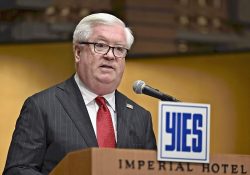
Markus Gabriel speaks at a lecture in Tokyo on Friday.
6:00 JST, September 27, 2025
Markus Gabriel, a renowned philosopher, emphasized the necessity of “ethical capitalism” to counter “authoritarian capitalism” at a lecture held in Tokyo on Friday.
At the lecture organized by the Yomiuri International Economic Society, Gabriel, a professor at the University of Bonn in Germany, said, “Authoritarian capitalism is coming, but it’s not there yet.”
Gabriel added there are two forms of authoritarian capitalism: demagogic and bureaucratic. The first kind poses an internal threat to liberal democracies if they come under the influence of a demagogic figure. Some have said China adopts bureaucratic authoritarian capitalism, though Gabriel himself disagrees, as he does not believe the country is capitalist.
Gabriel also discussed neo-illiberalism, characterizing it with three features: labor suppression, ethno-nationalism and clientelism. Under neo-illiberalism, labor rights would be suppressed or destroyed, he said. He also stressed that “we need good political science to really study” regimes that are not liberal democracies.
The world faces “nested crises,” where several crises “hang together in a spiral … [and] form a typhoon,” according to Gabriel. “If you start from AI … everything will look like an AI problem for you.”
Another topic Gabriel spoke about was the “invisible hand,” which is a metaphor introduced by 18th century economist and philosopher Adam Smith. According to the metaphor, the accumulation of people pursuing their own self-interest may unintentionally bring about beneficial social and economic outcomes.
“I think that what Adam Smith called the ‘invisible hand’ is not a mathematical law of markets. That was just a mistake,” Gabriel said. He instead described the invisible hand as an example of “sympathy” and ethical capitalism.
Gabriel has been advocating ethical capitalism, in which ethics is an essential part of economic activities. At the lecture, he highlighted the importance of the idea by presenting an example of whether to prioritize renewable energy or fossil fuel. He said that it is important to “lead not just in markets but in values.”






Most Read
Popular articles in the past 24 hours
-

‘Dry Bonsai’ Gives New Life to Withered Trees, Allows Free Artist...
-

Japanese Students Use Traditional Pickle to Create Novel Wagashi ...
-

McDonald's Japan Raises Prices; Big Mac to Cost ¥500, Double Chee...
-

Nepal Bus Crash Kills 19 People, Injures 25 Including One Japanes...
-

Japan’s Nikkei Stock Average Rises as AI-Related Stocks Shine; Co...
-

Astellas Collaborates with Vir to Develop Its Experimental Prosta...
-

Early-Blooming Kawazu Cherry Blossoms Create Sea of Pink at Park ...
-

Joruri Bunraku Narrative Performed in Honor of Donald Keene by La...
Popular articles in the past week
-

Producer Behind Pop Group XG Arrested for Cocaine Possession
-

Japan PM Takaichi’s Cabinet Resigns en Masse
-

Sanae Takaichi Elected Prime Minister of Japan; Keeps All Cabinet...
-

Japan's Govt to Submit Road Map for Growth Strategy in March, PM ...
-

Bus Carrying 40 Passengers Catches Fire on Chuo Expressway; All E...
-
U.S. Firm to Build Training Hub in Fukushima N-plant for Debris R...
-

Japan, U.S. Name 3 Inaugural Investment Projects; Reached Agreeme...
-

Riku-Ryu Pair Wins Gold Medal: Their Strong Bond Leads to Major C...
Popular articles in the past month
-
Producer Behind Pop Group XG Arrested for Cocaine Possession
-
Japan PM Takaichi’s Cabinet Resigns en Masse
-

Japan Institute to Use Domestic Commercial Optical Lattice Clock ...
-

Man Infected with Measles Reportedly Dined at Restaurant in Tokyo...
-

Israeli Ambassador to Japan Speaks about Japan’s Role in the Reco...
-

Videos Plagiarized, Reposted with False Subtitles Claiming ‘Ryuky...
-

Man Infected with Measles May Have Come in Contact with Many Peop...
-

Prudential Life Insurance Plans to Fully Compensate for Damages C...
Top Articles in Business
-
Prudential Life Insurance Plans to Fully Compensate for Damages Caused by Fraudulent Actions Without Waiting for Third-Party Committee Review
-

Narita Airport, Startup in Japan Demonstrate Machine to Compress Clothes for Tourists to Prevent People from Abandoning Suitcases
-
Japan, U.S. Name 3 Inaugural Investment Projects; Reached Agreement After Considerable Difficulty
-

Toyota Motor Group Firm to Sell Clean Energy Greenhouses for Strawberries
-

SoftBank Launches AI Service for Call Centers That Converts Harsh Customer Voices into Softer Voices
JN ACCESS RANKING
-
Producer Behind Pop Group XG Arrested for Cocaine Possession
-
Japan PM Takaichi’s Cabinet Resigns en Masse
-
Japan Institute to Use Domestic Commercial Optical Lattice Clock to Set Japan Standard Time
-
Man Infected with Measles Reportedly Dined at Restaurant in Tokyo Station
-
Israeli Ambassador to Japan Speaks about Japan’s Role in the Reconstruction of Gaza