
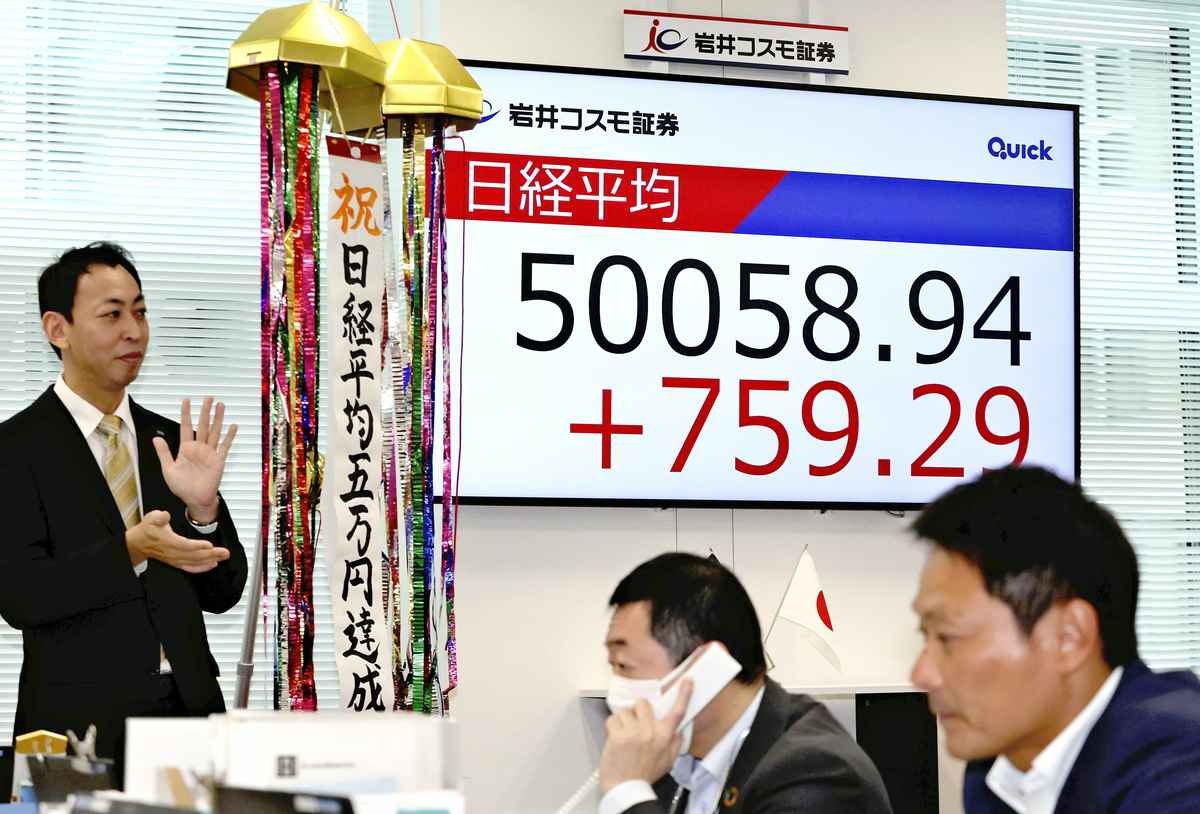
A kusudama paper ball opens in celebration of the Nikkei index hitting 50,000 points for the first time, at IwaiCosmo Securities Co. in Chuo Ward, Tokyo, on Monday.
17:28 JST, October 27, 2025
The Nikkei Stock Average exceeded 50,000 for the first time during the Tokyo Stock Exchange’s trading hours on Monday, closing at 50,512.32. That is up from 40,000 in March last year.
In February last year, the index surpassed the all-time closing high set during the bubble economy, about 34 years prior.
The TOPIX index, which represents a broad range of stocks, also surpassed its previous all-time high on Monday.
Major U.S. stocks rose at the end of last week, supporting stock prices in the Tokyo market at the start of this week, with the AI and semiconductor sectors showing gains. High-priced stocks for chip-related companies like Advantest Corp. were major players in pushing up the Nikkei index. SoftBank Group Corp., which invests in chip-related firms, also made a notable contribution with its share gains.
Additionally, investor confidence got a boost from easing trade tensions between the United States and China. The two countries held ministerial-level trade talks in Malaysia through Sunday, paving the way for Washington to shelve a 100% tariff on Chinese goods that had been scheduled for Nov. 1.
The “Takaichi trade” also remained strong. Investors continue to expect a “responsible and aggressive fiscal policy” from Prime Minister Sanae Takaichi, who took office on Oct. 21.
“Opinion polls by multiple parties show that the Takaichi Cabinet enjoys high approval ratings. There are growing hopes for her economic policies, such as for measures against rising prices,” said Yutaka Miura of Mizuho Securities Co.
At the end of 1989, the Nikkei average closed at an all-time high of 38,915.87, but then the bubble economy burst and the index slumped. It fell to a post-bubble low of 7,054.98 on March 10, 2009, amid the economic turmoil caused by the collapse of Lehman Brothers in 2008.
Stock prices began an upward trend when Prime Minister Shinzo Abe launched his second administration in December 2012, partly due to the Bank of Japan’s large-scale monetary easing. Since 2023, the pace of gains has accelerated, driven by buying from overseas investors focused on improved capital efficiency at Japanese companies.
Amid enthusiasm for a market led by AI and semiconductor stocks, where there is a high potential for growth, the Nikkei average set a record high for the first time in about 34 years on Feb. 22, 2024. On March 4, 2024, it topped 40,000 points.






Most Read
Popular articles in the past 24 hours
-
78% Interested in Reconstruction from 2011 Disaster; Concern High...
-
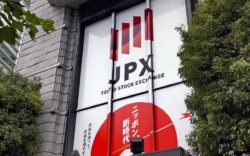
Japan’s Nikkei Stock Average Rise Lifted by AI Stocks, Easing Con...
-

2 Mt. Fuji Hikers Identified as Police Warn People Not to Climb i...
-

15 Years since Great East Japan Earthquake: How Can Affected Area...
-

Parents in Japan to Get Instagram Notifications When Teens Repeat...
-

Tokyo Conference 2026 Opens, Discusses Rebuilding Multilateralism...
-

Italy Shocks U.S. in World Baseball Classic Pool Game
-

CARTOON OF THE DAY (March 11)
Popular articles in the past week
-

Ibaraki Pref.'s 1st Foreign Bus Driver Hired in Tsukuba
-

Nippon Life Insurance's U.S. Arm Sues OpenAI Over Legal Assistanc...
-
Govt to Utilize ODA for Ensuring Economic Security; Securing Ener...
-

Amid Strait of Hormuz Blockade, Shipping Companies Scramble to Ge...
-
Japan Govt Survey Finds Just 10% of Workers Want Working Hours to...
-
Japan's 2nd Round of U.S. Investments May Be Worth Over $100 Bill...
-

Beckoning Cats Get Makeover to Fit Modern Lifestyles with Sleek D...
-

Imperial Family Watches World Baseball Classic Game Against Austr...
Popular articles in the past month
-

Producer Behind Pop Group XG Arrested for Cocaine Possession
-

Japan PM Takaichi’s Cabinet Resigns en Masse
-

Man Infected with Measles Reportedly Dined at Restaurant in Tokyo...
-

Videos Plagiarized, Reposted with False Subtitles Claiming ‘Ryuky...
-

iPS Treatments Pass Key Milestone, but Broader Applications Far f...
-

Sanae Takaichi Elected Prime Minister of Japan; Keeps All Cabinet...
-

Nepal Bus Crash Kills 19 People, Injures 25 Including One Japanes...
-

South Korea Tightens Rules on Foreigners Buying Homes in Seoul Me...
Top Articles in Business
-

Japan, U.S. Name 3 Inaugural Investment Projects; Reached Agreement After Considerable Difficulty
-

Japan’s Major Real Estate Firms Expanding Overseas Businesses to Secure Future Growth, Focusing on Europe, U.S., Asia
-
Nippon Life Insurance’s U.S. Arm Sues OpenAI Over Legal Assistance Provided by ChatGPT
-

Transport Companies See Opportunity in Narita Expansion; Airlines, Railways Prepare to Meet Expected Growth in Demand
-
Amid Strait of Hormuz Blockade, Shipping Companies Scramble to Get Japan-Linked Vessels out of Persian Gulf
JN ACCESS RANKING
-
Producer Behind Pop Group XG Arrested for Cocaine Possession
-
Japan PM Takaichi’s Cabinet Resigns en Masse
-
Man Infected with Measles Reportedly Dined at Restaurant in Tokyo Station
-
Videos Plagiarized, Reposted with False Subtitles Claiming ‘Ryukyu Belongs to China’; Anti-China False Information Also Posted in Japan
-
iPS Treatments Pass Key Milestone, but Broader Applications Far from Guaranteed