
Driving Forward with Akio Toyoda: Toyota Chairman Reassures U.S. Dealers Amid Tariff Concerns
16:06 JST, January 29, 2026
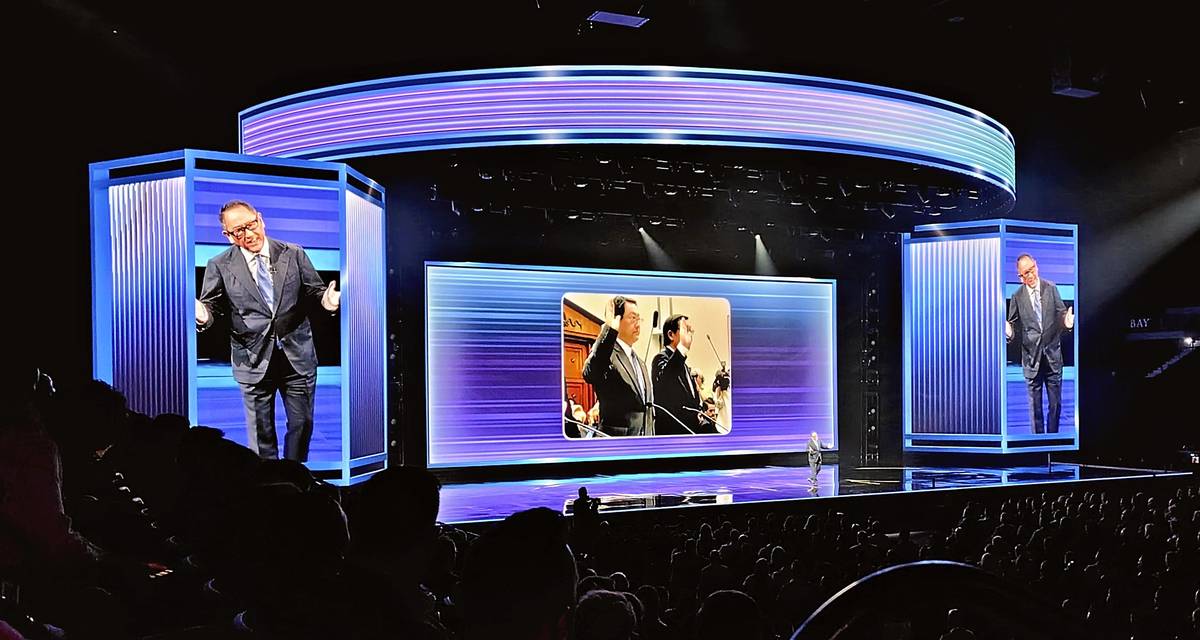
Akio Toyoda, chairman of Toyota Motor Corp., delivers a presentation at the company’s U.S. National Dealer Meeting on Sept. 10 in Las Vegas.
Given the excitement, you might have thought a rock star had appeared.
On Sept. 10, Akio Toyoda, chairman of Toyota Motor Corp., took the stage at the company’s U.S. National Dealer Meeting in Las Vegas. About 5,000 dealership representatives greeted him with a standing ovation. This went well beyond the relationship of a top automaker exec and the company’s dealerships.
Why was Toyoda welcomed so enthusiastically?
2 stints in U.S.
Toyoda has long had ties with the United States.
Before joining Toyota Motor, he spent some of his formative 20s there. After graduating from Keio University’s Faculty of Law, he went to the United States and earned an MBA at Babson College in Massachusetts. Afterward, he stayed in the United States, working as an investment banker. In an address he delivered at Babson in 2019, he recalled his time at the college, saying, “I just went from my dorm, to class, to the library, to my dorm, to class, to the library.”
In 1998, at age 41, he was sent to New United Motor Manufacturing Inc. (NUMMI) in California, a joint venture between Toyota and General Motors Co. He worked there for about two years.
The NUMMI plant where Toyoda worked was sold to Tesla Inc. in 2010, in the wake of the 2008 financial crisis. Toyoda was serving as president of Toyota Motor then.
“I, myself, spent time at NUMMI and I learned much about working in America there, so I feel a sense of attachment toward the plant. I am extremely happy that the ‘DNA of car-making’ that the NUMMI team developed over 25 years of production there will live on in (a future-oriented industry),” Toyoda said at a press conference at the time.
A little known fact: When the site once owned by NUMMI was being sold off, Toyoda insisted it go to a company in the industry.
Tears shed after testifying
Toyoda also had his share of difficulties.
In February 2010, eight months after taking up the presidency, Toyoda testified at a U.S. House of Representatives hearing following a wave of recalls triggered by a fatal accident in San Diego in the summer of 2009. When he was heading to Washington, he told himself, “Even if I have to resign as president less than a year after taking the post, I must protect everyone with ties to Toyota.”
At the hearing, Toyoda offered his prayers for those who died in the accident, who all came from one family, and said, “I will do everything in my power to ensure that such a tragedy never happens again.”
“All the Toyota vehicles bear my name,” he added. “For me, when the cars are damaged, it is as though I am as well … Reflecting on the issues today, what we lacked was the customers’ perspective … I will ensure that members of the management team actually drive the cars, and that they check for themselves where the problem lies as well as its severity.”
As the firm’s top executive — and a member of the founding family — took the full brunt of the blame, the fierce criticism of Toyota Motor gradually died down. During this time, Toyoda found emotional support from employees at Toyota Motor’s dealerships and plants in the United States. About 200 people traveled to Washington to hold a rally to support him. After the congressional hearing, Toyoda spoke to them.
When he said, “In the hearing, I was not alone,” tears streamed down his face. He realized that while he had been “trying to protect everyone, it turned out that everyone was protecting me instead.”
“We need to reassert the values that have been our hallmark: our uncompromising commitment to the spirit of Customer First, our unwavering Genchi Genbutsu focus” of going to the source, the workplace, Toyoda told those who had protected him. Many in the audience were reportedly moved to tears themselves.
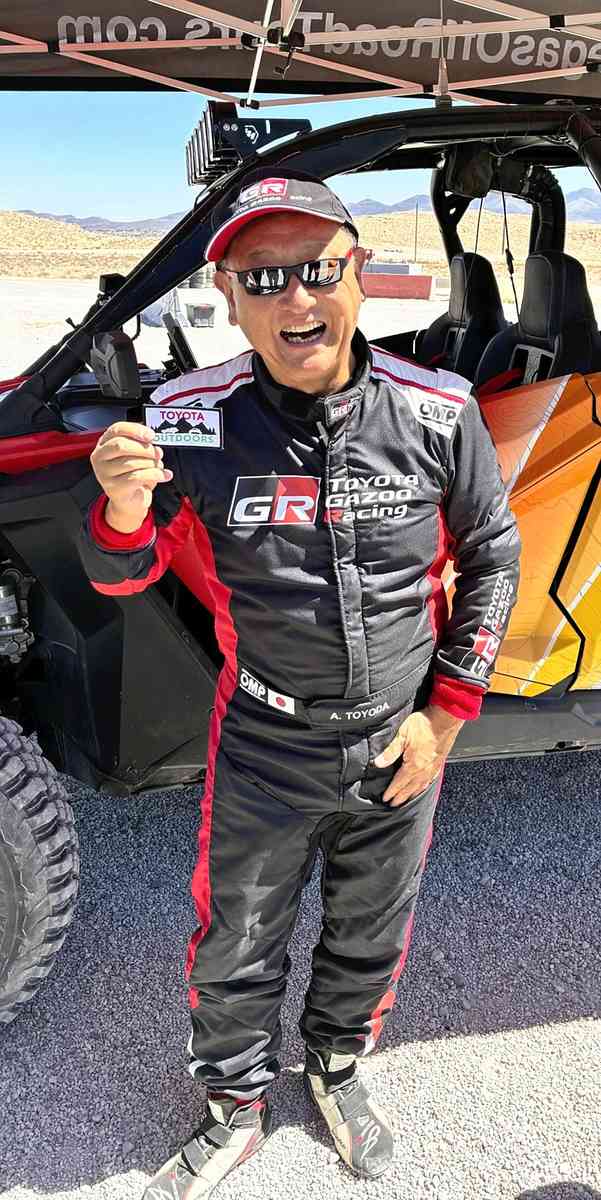
Akio Toyoda, chairman of Toyota Motor Corp., poses after driving an off-road buggy in a Las Vegas suburb on Sept. 9, the day before the company’s U.S. National Dealer Meeting.
Unwavering principles
On Sept. 9, the day before this year’s U.S. National Dealer Meeting, Toyoda sat down to speak with The Yomiuri Shimbun in a Las Vegas suburb. Regarding U.S. dealerships, he said: “That’s super important. Carmakers might be seen as higher in the hierarchy, but for Toyota, it’s the customer and the market (that are most important).” Fifteen years after pledging to keep the customer first in the wake of the recall, he has not swerved from his values. Dealership staff are on the front lines, interacting with customers, who are Toyota’s prime focus. So, naturally the dealerships are important, too.
And the dealerships can sense Toyoda’s feelings.
There is an anecdote that runs like this: In the aftermath of the 2008 financial crisis and the massive recalls, Toyota was not able to introduce new models to the North American market for several years. The owner of a North American dealership handed Toyoda an axe and asked which he thought was better: a lumberjack who never stops cutting wood, or one who occasionally takes a break and sharpens his axe before getting back to work. As Toyoda was pondering the question, the owner encouraged him, telling him that now was the time for Toyota to sharpen its axe. He told Toyoda that the automaker should leave things to the dealers while no new models were being released, and expressed hope that the company would make great cars again.
In recent years, Toyota has consistently introduced popular models to the North American market, centered around the SUV RAV4. “It’s not like we have exceptional designers or super engineers,” Toyoda said. “From top management to the front line, we have all been dedicating ourselves to making products, spending hours and hours.”
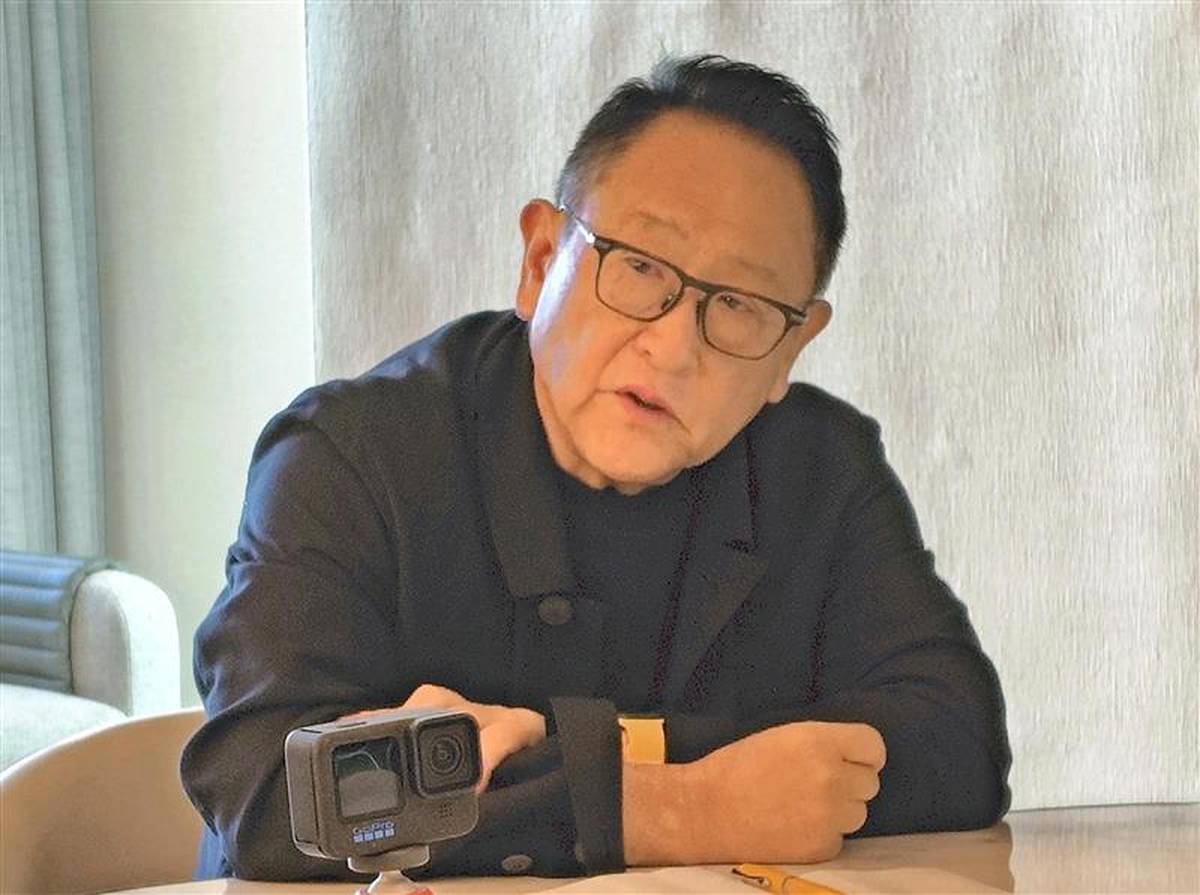
Akio Toyoda, chairman of Toyota Motor Corp., speaks to The Yomiuri Shimbun after giving a speech at the company’s U.S. National Dealer Meeting on Sept. 10 in Las Vegas.
‘Don’t worry’
During the dealer meeting, Toyoda did not offer his take on U.S. tariffs, nor did he comment on the company’s stance on pricing or other matters in the U.S. market. His message was simple and clear: Toyota will do what it can for the governments of Japan and the United States, for the automotive industry and for the firm’s customers. “Don’t’ worry,” he said.
What specifically does Toyota plan to do? For one, it will further advance localization.
In his speech, Toyoda noted that in 2024, Toyota sold about 2.4 million vehicles in North America, with about 1.8 million produced locally and the remaining roughly 570,000 imported from Japan.
“Our philosophy has always been (to) build where you sell, buy where you build. And that’s not going to change. We need to build more vehicles not just in the U.S. but everywhere (in the world),” he said, indicating the company would push for more local production in the United States.
Secondly, the automaker will lobby the Japanese government.
In Japan-U.S. tariff negotiations, “non-tariff barriers” in Japan’s auto market became a theme of discussion. Toyoda explained that differing safety and vehicle regulations between the United States and Japan make it difficult for U.S. automakers to sell cars in Japan. He said that the company has been actively trying to remove what the United States calls “non-tariff barriers.”
This would make it easier to export U.S.-made vehicles to Japan, potentially contributing to a reduction in the U.S. trade deficit. For Toyota, this would also facilitate the re-importation of models like the Camry sedan, which Toyota has stopped producing and selling in Japan. That might ultimately expand consumer choice.
Toward the end of his speech, a large screen at the venue displayed a photo from the U.S. congressional hearing. “I’m sure I don’t need to remind you of the many challenges we’ve faced in the past,” he said. “There’s nothing … we can’t overcome together.” The audience erupted in applause.
For Toyota and Toyoda, the recall in the United States and the subsequent congressional hearing were a major ordeal and a bitter experience. However, it was also an experience that strengthened the bond with U.S. dealerships, leading to the firm’s current strength. At the dealer meeting, you could feel the affection in the air.
This article was originally distributed by DOW JONES YOMIURI SHIMBUN Pro on Oct. 7, 2025.


Related Tags
Most Read
Popular articles in the past 24 hours
-

China’s National People’s Congress Opens: Military Expansion Cont...
-
Japanese Nationals in 4 Gulf Countries to Be Evacuated with Chart...
-
Japan, Canada to Launch Strategic Roadmap on Defense, Economic Se...
-
Excited Baseball Fans Gather at Tokyo Dome Ahead of Japan's Openi...
-
AI Can't Be Listed as Inventor on Patent Applications, Japan's To...
-
Hanamaruki to Sell Liquid 'Shio-Koji' Seasoning to U.S. Consumers
-
Tokyo Police Arrest NHK Director over Sexual Assault
-
CARTOON OF THE DAY (March 6)
Popular articles in the past week
-

South Korea Tightens Rules on Foreigners Buying Homes in Seoul Me...
-
2 Unpublished Early Novellas by Japan's Kenzaburo Oe Discovered, ...
-

Ibaraki Pref.'s 1st Foreign Bus Driver Hired in Tsukuba
-
Strait of Hormuz Closure Shakes Markets; Prolonged Closure Could ...
-

Iran Situation: Japan Must Exert Diplomatic Efforts without Merel...
-
Amid Strait of Hormuz Blockade, Shipping Companies Scramble to Ge...
-
Measles Patient Visited Hospital in Bunkyo Ward, Tokyo, Metropoli...
-
Tokyo’s ‘Strawberry War’ Intensifies as Producers Vie to Become ‘...
Popular articles in the past month
-

Producer Behind Pop Group XG Arrested for Cocaine Possession
-

Japan PM Takaichi’s Cabinet Resigns en Masse
-

Man Infected with Measles Reportedly Dined at Restaurant in Tokyo...
-

Videos Plagiarized, Reposted with False Subtitles Claiming ‘Ryuky...
-

Prudential Life Insurance Plans to Fully Compensate for Damages C...
-

Woman with Measles Visited Hospital in Tokyo Multiple Times Befor...
-

iPS Treatments Pass Key Milestone, but Broader Applications Far f...
-

Sanae Takaichi Elected Prime Minister of Japan; Keeps All Cabinet...
Top Articles in Business
-
Prudential Life Insurance Plans to Fully Compensate for Damages Caused by Fraudulent Actions Without Waiting for Third-Party Committee Review
-

Japan, U.S. Name 3 Inaugural Investment Projects; Reached Agreement After Considerable Difficulty
-
Japan’s Major Real Estate Firms Expanding Overseas Businesses to Secure Future Growth, Focusing on Europe, U.S., Asia
-
SoftBank Launches AI Service for Call Centers That Converts Harsh Customer Voices into Softer Voices
-
Transport Companies See Opportunity in Narita Expansion; Airlines, Railways Prepare to Meet Expected Growth in Demand
JN ACCESS RANKING
-
Producer Behind Pop Group XG Arrested for Cocaine Possession
-
Japan PM Takaichi’s Cabinet Resigns en Masse
-
Man Infected with Measles Reportedly Dined at Restaurant in Tokyo Station
-
Videos Plagiarized, Reposted with False Subtitles Claiming ‘Ryukyu Belongs to China’; Anti-China False Information Also Posted in Japan
-
Prudential Life Insurance Plans to Fully Compensate for Damages Caused by Fraudulent Actions Without Waiting for Third-Party Committee Review