
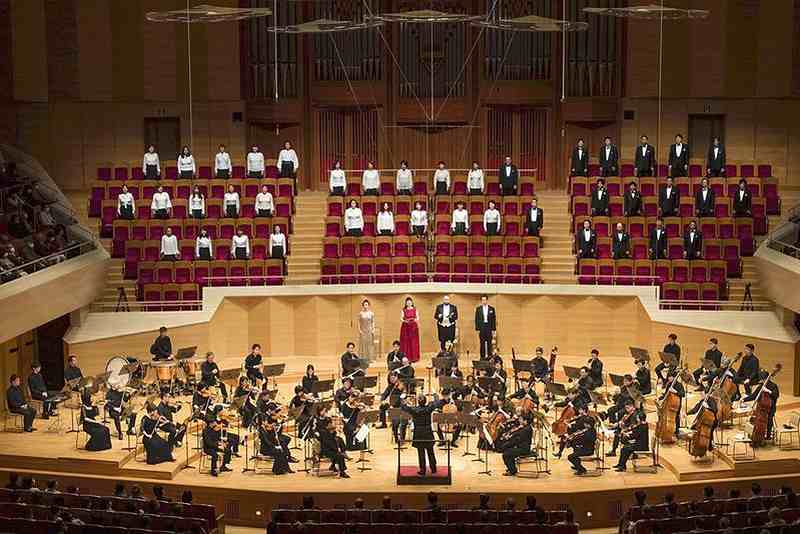
The Yomiuri Nippon Symphony Orchestra performs Beethoven’s Symphony No. 9 “Choral” last year.
December 10, 2021
The omicron variant of the coronavirus has landed with a thud on a popular year-end cultural event in Japan: concerts of Beethoven’s Symphony No. 9 “Choral.”
Because border restrictions have been tightened due to concerns over the variant, conductors and singers scheduled to perform the symphony with Japanese orchestras later this month are now barred from entering the country, forcing the orchestras to scramble to find replacements.
Productions of Beethoven’s ninth symphony in December are important for orchestras in Japan as the concerts are a big draw.
Due to the entry restrictions, Italian conductor Fabio Luisi and three soloists who had been scheduled to perform with the NHK Symphony Orchestra can no longer enter Japan. To fill the gap, the orchestra has appointed conductor Tadaaki Otaka and three Japanese singers to perform. The Yomiuri Nippon Symphony Orchestra has replaced Francesco Angelico, who was to conduct six performances of the Ninth in Tokyo and Osaka, with John Axelrod, who is already in Japan.
Kazushi Ono, the music director of the Tokyo Metropolitan Symphony Orchestra, was planning to return to his home in Brussels after finishing an opera production at the New National Theatre, Tokyo, but hastily changed his schedule to replace a conductor who was supposed to conduct three concerts featuring the symphony from Dec. 24-26.
“To be honest, I wanted to take a break,” Ono said, “but, as music director, I have responsibilities, so I’ll do my best.”
The New Japan Philharmonic and the Tokyo Philharmonic Orchestra have also been forced to replace conductors.
Even if the performances are held, orchestras are heavyhearted as concertgoers were hoping to hear the work of the originally scheduled conductors and singers.
“We plan concerts several years in advance, but there’s nothing we can do if we’re suddenly told, ‘No entry to Japan from tomorrow,’” said an orchestra’s public relations official. “We feel bad for failing to meet the audiences’ expectations.”
Koichi Iriyama, 58, president of the Japan Association of Classical Music Presenters, hopes to get advanced notice as early as possible in the future.
“It couldn’t be helped this time because a quick response [to the situation] was required, but I feel uneasy about the future,” Iriyama said.







Most Read
Popular articles in the past 24 hours
-

Japanese High School Student Aims to Share Kaiten History Through...
-

Business Hotels Expanding into Regional Areas in Japan, Aiming to...
-

Milano Cortina 2026: Japan Sees Leap in Olympic Performance Throu...
-

Milano Cortina 2026: Japan's Satoshi Furuno Places 4th in Men's S...
-

Milano Cortina 2026: Speed Skater Takagi Finishes 6th in the 1,50...
-
Osaka: 40 Ninjas Display Shuriken Throwing Skills at Japan Champi...
-

Fiji Defense Minister Hopes Japan Will Support Stabilization of P...
-

Milano Cortina 2026: Malinin Highlights Dangers of Social Media i...
Popular articles in the past week
-

Japan PM Takaichi’s Cabinet Resigns en Masse
-

Man Infected with Measles Reportedly Dined at Restaurant in Tokyo...
-

Sanae Takaichi Elected Prime Minister of Japan; Keeps All Cabinet...
-

Japan's Govt to Submit Road Map for Growth Strategy in March, PM ...
-

Bus Carrying 40 Passengers Catches Fire on Chuo Expressway; All E...
-

Milano Cortina 2026: Figure Skaters Riku Miura, Ryuichi Kihara Pa...
-

Japan, U.S. Name 3 Inaugural Investment Projects; Reached Agreeme...
-

U.S. Firm to Build Training Hub in Fukushima N-plant for Debris R...
Popular articles in the past month
-
Japan PM Takaichi’s Cabinet Resigns en Masse
-

Japan Institute to Use Domestic Commercial Optical Lattice Clock ...
-

Israeli Ambassador to Japan Speaks about Japan’s Role in the Reco...
-
Man Infected with Measles Reportedly Dined at Restaurant in Tokyo...
-

Videos Plagiarized, Reposted with False Subtitles Claiming ‘Ryuky...
-

Man Infected with Measles May Have Come in Contact with Many Peop...
-

Prudential Life Insurance Plans to Fully Compensate for Damages C...
-

Woman with Measles Visited Hospital in Tokyo Multiple Times Befor...
Top Articles in Culture
-

BTS to Hold Comeback Concert in Seoul on March 21; Popular Boy Band Releases New Album to Signal Return
-

Director Naomi Kawase’s New Film Explores Heart Transplants in Japan, Production Involved Real Patients, Families
-

‘Jujutsu Kaisen’ Voice Actor Junya Enoki Discusses Rapid Action Scenes in Season 3, Airing Now
-

Tokyo Exhibition Offers Inside Look at Impressionism; 70 of 100 Works on ‘Interiors’ by Monet, Others on Loan from Paris
-
Traditional Japanese Silk Hakama Tradition Preserved by Sole Weaver in Sendai
JN ACCESS RANKING
-
Japan PM Takaichi’s Cabinet Resigns en Masse
-
Japan Institute to Use Domestic Commercial Optical Lattice Clock to Set Japan Standard Time
-
Israeli Ambassador to Japan Speaks about Japan’s Role in the Reconstruction of Gaza
-
Man Infected with Measles Reportedly Dined at Restaurant in Tokyo Station
-
Videos Plagiarized, Reposted with False Subtitles Claiming ‘Ryukyu Belongs to China’; Anti-China False Information Also Posted in Japan