
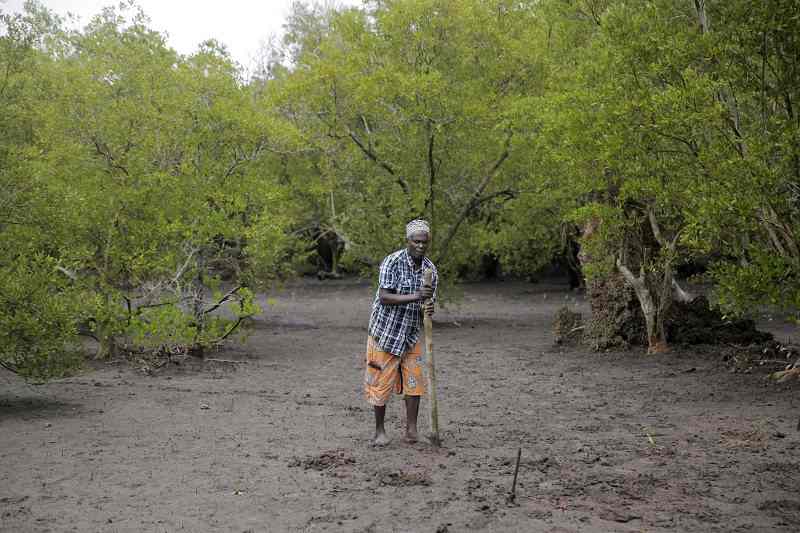
A member of Mikoko Pamoja, Swahili for ‘mangroves together’, plants a mangrove tree at Gazi Bay, in Kwale county, Kenya, June 12, 2022.
10:50 JST, November 15, 2022
SHARM EL-SHEIKH (AP) — African nations want to increase how much money they receive from schemes that offset greenhouse gas emissions and are looking for ways to address the issue at U.N. climate talks currently underway in Egypt.
Carbon offsets, where polluters can effectively cancel out their emissions by paying into initiatives such as tree-planting, are currently cheaper to purchase in Africa than in many other parts of the world where schemes are more strictly regulated. African nations are looking to the climate talks to get a better price on the ‘carbon market’ to help achieve their own emissions reductions targets and move toward clean energy. The schemes have come under scrutiny by environmental groups who are concerned they are a free pass to keep polluting.
“We should look at carbon trading as an income tool for our developmental agenda,” Zambian environment minister Collins Nzovu told The Associated Press. “If we hurry into this market, we may lose our national heritage and give away at a low price that we will regret in future.”
In carbon trading, one credit issued equals one ton of carbon dioxide or another greenhouse gas equivalent removed from the atmosphere. The voluntary carbon market, which remains dominant in Africa, has been plagued by integrity and transparency concerns. Africa’s market currently sees the continent earning less than $10 per ton of carbon. Other regions can secure over $100 for the same amount in some instances.
Still, carbon credit schemes have recorded relative successes in Kenya, Tanzania and Congo.
The Ntakata Mountains Project in Tanzania, for example, has seen local communities now have more money to put in schools, community clinics and infrastructure. Similar success has been reported in Kenya’s Mikoko Pamoja project, as well as others dotted around the continent.
But efforts remain to make the industry more regulated, particularly in Africa.
“High-integrity carbon registries, which sustain a supply of high-quality and trustworthy credits that are tradable in the global exchange markets, are critical and will allow African countries to succeed in those processes,” said Antonio Pedro, the executive secretary of the U.N. Economic Commission for Africa.
Pedro added that significant support from developed countries, where the demand for such high-quality carbon credits will be required, is essential to regulating markets. But for the market to not push emissions up even further, there would need to be limitations on how companies can use carbon credits.
On Wednesday, U.S. climate envoy John Kerry announced a controversial plan to encourage big businesses to tap into carbon markets, sparking concerns from environmental groups that it would give companies a license to keep emitting at higher rates. Kerry insisted that the credits would be “highly regulated” and there were multiple “guardrails against abuse,” including the types of firms able to buy them and how they can be used.
A study released at the U.N. summit on Saturday by the Africa Climate Policy Centre found that the continent stands a chance of limiting global warming to temperatures set in the Paris agreement if the price of a carbon credit is pegged at $120 per ton of carbon. That would rake in about $82 billion a year, the report found.
Experts say that for carbon markets to be effective at limiting warming, they have to have credibility.
“Carbon markets need to be cushioned in integrity as they bring benefits to both the investor and the communities. There have been bad experiences in the past. Integrity in carbon markets is key,” Pedro said.








Most Read
Popular articles in the past 24 hours
-
Milano Cortina 2026: Japanese Gold Medalist Figure Skater Miura S...
-

Yokohama to Test Out Renewable-Powered Offshore Floating Data Cen...
-
Japan’s Takaichi Speaks on New U.S. Tariff in Upper House, Says P...
-

Ishinomaki Man Plush Toy Offers Hope to Children in Times of Disa...
-
Japan Authorities Begin On-site Inspection of Japanese Microsoft ...
-
Japan's Takaichi Lets LDP Lawmakers Choose Gifts for Election Suc...
-

Nikkei Tops 59,000 for First Time
-

Dodgers' Roki Sasaki Erratic in First Spring Training Outing, Giv...
Popular articles in the past week
-

Producer Behind Pop Group XG Arrested for Cocaine Possession
-

iPS Treatments Pass Key Milestone, but Broader Applications Far f...
-

Japan, U.S. Name 3 Inaugural Investment Projects; Reached Agreeme...
-

Tokyo Skytree's Elevator Stops, Trapping 20 People; All Rescued (...
-

Japan’s Major Real Estate Firms Expanding Overseas Businesses to ...
-
Milano Cortina 2026: Japanese Gold Medalist Figure Skater Miura S...
-

Baby Monkey Punch Captures Hearts at Chiba Pref. Zoo, on Social M...
-

Milano Cortina 2026: Japanese Figure Skater Kaori Sakamoto’...
Popular articles in the past month
-
Producer Behind Pop Group XG Arrested for Cocaine Possession
-

Japan PM Takaichi’s Cabinet Resigns en Masse
-

Japan Institute to Use Domestic Commercial Optical Lattice Clock ...
-

Man Infected with Measles Reportedly Dined at Restaurant in Tokyo...
-

Israeli Ambassador to Japan Speaks about Japan’s Role in the Reco...
-

Videos Plagiarized, Reposted with False Subtitles Claiming ‘Ryuky...
-

Man Infected with Measles May Have Come in Contact with Many Peop...
-

Prudential Life Insurance Plans to Fully Compensate for Damages C...
Top Articles in News Services
-
Survey Shows False Election Info Perceived as True
-
Hong Kong Ex-Publisher Jimmy Lai’s Sentence Raises International Outcry as China Defends It
-
Japan’s Nikkei Stock Average Touches 58,000 as Yen, Jgbs Rally on Election Fallout (UPDATE 1)
-
Japan’s Nikkei Stock Average Falls as US-Iran Tensions Unsettle Investors (UPDATE 1)
-

Trump Names Former Federal Reserve Governor Warsh as the Next Fed Chair, Replacing Powell
JN ACCESS RANKING
-
Producer Behind Pop Group XG Arrested for Cocaine Possession
-
Japan PM Takaichi’s Cabinet Resigns en Masse
-
Man Infected with Measles Reportedly Dined at Restaurant in Tokyo Station
-
Israeli Ambassador to Japan Speaks about Japan’s Role in the Reconstruction of Gaza
-
Videos Plagiarized, Reposted with False Subtitles Claiming ‘Ryukyu Belongs to China’; Anti-China False Information Also Posted in Japan