
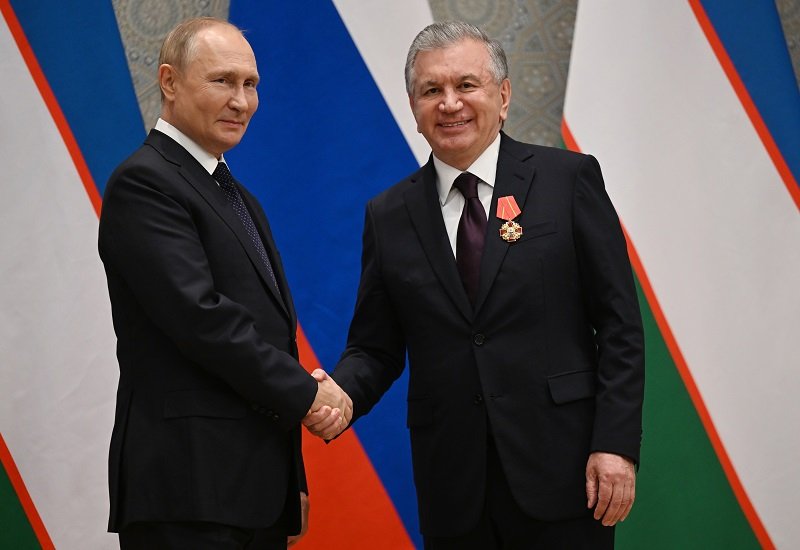
Russian President Vladimir Putin, left, awards Uzbekistan President Shavkat Mirziyoyev with the Order of Alexander Nevsky during a meeting on the sidelines of the Shanghai Cooperation Organization summit in Samarkand, Uzbekistan, on Thursday.
20:00 JST, September 17, 2022
Russian President Vladimir Putin is having a difficult time trying to secure influence within the former Soviet states, where Moscow has long viewed as areas it still held sway, as the Shanghai Cooperation Organization summit meeting came to an end on Friday.
Moscow’s struggle is the result of Kazakhstan and other former Soviet countries distancing themselves from Russia since its invasion of Ukraine. To make matters worse, armed clashes involving former Soviet members have recently erupted one after another, shaking the security led by the Russian military.
The RIA news agency posted a video of Putin waiting for Kyrgyz President Sadyr Japarov to arrive at the venue for Thursday’s bilateral talks. Putin greeted his counterpart, who was late, with a big smile.
Putin is notorious for being late for meetings with world dignitaries, including with Queen Elizabeth II, who passed away on Sept. 8. However, in Samarkand, Uzbekistan, where the summit was being held, he behaved humbly toward the leaders of the former Soviet nations.
On Thursday, Putin held talks with Uzbekistan President Shavkat Mirziyoyev and awarded him with a medal for his efforts to strengthen relations with Russia.
Putin is known for his tough demeanor, but his recent behavior is a sign that some leaders of the former Soviet states are trying to distance themselves from Russia following its invasion of Ukraine.
Among them is Kazakhstan’s President Kassym-Jomart Tokayev, who attended the St. Petersburg International Economic Forum in June. Joining Putin at a plenary session, Tokayev declared that he did not recognize the area in eastern Ukraine effectively controlled by pro-Russia forces as an official state, criticizing Moscow’s unilateral recognition of the region as a state. Tokayev has also been actively seeking to strengthen ties with China and Europe.
The situation among the former Soviet states is also becoming unstable. According to TASS and other news agencies, there have been a series of clashes involving border patrol guards in the region between Tajikistan and Kyrgyzstan since Wednesday.
The Institute for the Study of War, a U.S. policy research institute, said in its assessment released Thursday that the uptick in violence between Tajikistan and Kyrgyzstan occurred as a result of Russia’s decision to deploy soldiers from its military bases in the two countries to the frontlines in Ukraine.
Large-scale military clashes have also recently erupted on the border between Azerbaijan and Russia’s ally Armenia. It is widely understood that Azerbaijan, with Turkey’s support, took advantage of Russia being heavily focused on invading Ukraine and attacked Armenia.
U.S. House Speaker Nancy Pelosi is reportedly scheduled to visit Armenia soon, likely further intensifying the struggle for influence over the former Soviet bloc.




Most Read
Popular articles in the past 24 hours
-

Voters Using AI to Choose Candidates in Japan's Upcoming General ...
-

Japan's Snow-Clad Beauty: Camellia Flowers Seen in Winter Bloom a...
-
Monkey Strikes Junior High School Girl from Behind in Japan's Yam...
-
Genichiro Inokuma's Mural in Ueno Station That Gave Hope in Postw...
-
Senior Japanese Citizens Return to University to Gain Knowledge, ...
-
Heavy Snow Linked to 30 Deaths across Japan since Late Jan.; JMA ...
-

Tokyo Police Arrest Head of Resignation Assistance Firm
-

Foreign and Security Policy: Political Parties Must Discuss How T...
Popular articles in the past week
-

Japan Institute to Use Domestic Commercial Optical Lattice Clock ...
-
Australian Woman Dies After Mishap on Ski Lift in Nagano Prefectu...
-
Foreign Snowboarder in Serious Condition After Hanging in Midair ...
-
Chinese Embassy in Japan Reiterates Call for Chinese People to Re...
-

Narita Airport, Startup in Japan Demonstrate Machine to Compress ...
-

Toyota Motor Group Firm to Sell Clean Energy Greenhouses for Stra...
-
Sakie Yokota, Last Surviving Parent of a North Korea Abductee, Ur...
-
Beer Yeast Helps Save Labor, Water Use in Growing Rice; Govt Hope...
Popular articles in the past month
-
Univ. in Japan, Tokyo-Based Startup to Develop Satellite for Disa...
-
JAL, ANA Cancel Flights During 3-day Holiday Weekend due to Blizz...
-
China Confirmed to Be Operating Drilling Vessel Near Japan-China ...
-

China Eyes Rare Earth Foothold in Malaysia to Maintain Dominance,...
-
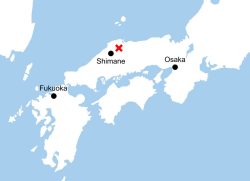
M6.2 Earthquake Hits Japan's Tottori, Shimane Prefectures; No Tsu...
-
Japan Institute to Use Domestic Commercial Optical Lattice Clock ...
-
Japan, Qatar Ministers Agree on Need for Stable Energy Supplies; ...
-

Japan, Italy to Boost LNG Cooperation; Aimed at Diversifying Japa...
Top Articles in World
-
China Confirmed to Be Operating Drilling Vessel Near Japan-China Median Line
-
China Eyes Rare Earth Foothold in Malaysia to Maintain Dominance, Counter Japan, U.S.
-
Japan, Qatar Ministers Agree on Need for Stable Energy Supplies; Motegi, Qatari Prime Minister Al-Thani Affirm Commitment to Cooperation
-
North Korea Possibly Launches Ballistic Missile
-
10 Universities in Japan, South Korea, Mongolia to Establish Academic Community to Promote ICC Activities, Rule of Law
JN ACCESS RANKING
-
Univ. in Japan, Tokyo-Based Startup to Develop Satellite for Disaster Prevention Measures, Bears
-
JAL, ANA Cancel Flights During 3-day Holiday Weekend due to Blizzard
-
China Confirmed to Be Operating Drilling Vessel Near Japan-China Median Line
-
China Eyes Rare Earth Foothold in Malaysia to Maintain Dominance, Counter Japan, U.S.
-
Japan Institute to Use Domestic Commercial Optical Lattice Clock to Set Japan Standard Time