
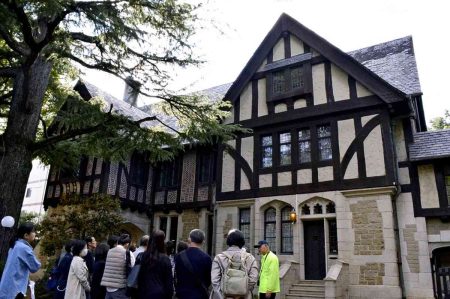
Participants on a guided tour of the “Daimaru Villa” building in Kamigyo Ward, Kyoto, listen to explanations about its features and history in early November.
17:16 JST, March 1, 2026
KYOTO — Architectural tourism, known as architourism, is a type of cultural tourism involving touring famous architectural structures and enjoying walks around them, allowing visitors to rediscover their value and appeal.
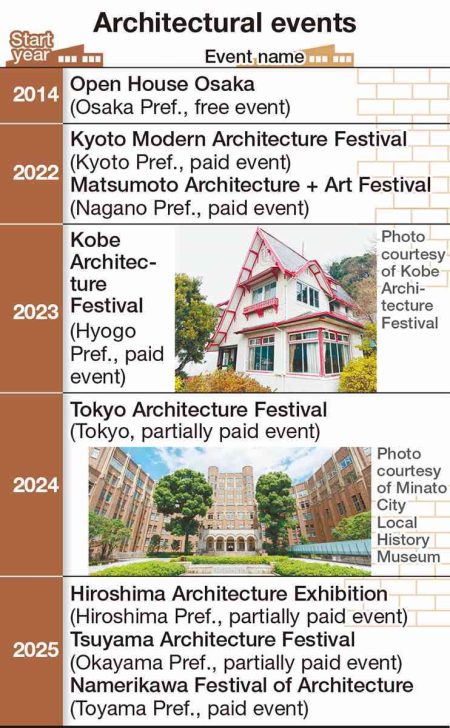
Architecture festivals, during which multiple modern and contemporary structures are specially opened to the public for a limited period, are becoming more popular. Some of these events are held concurrently with art exhibitions or food festivals.
In Japan, more than 20 events offer limited access to structures that are usually closed to the public. There is a growing movement to make these events paid to ensure their sustainable continuation.
In addition, to support the preservation and use of these structures, the Cultural Affairs Agency will implement large-scale promotional initiatives.
The former Shimomura family residence located in front of the Kyoto Imperial Palace in Kamigyo Ward, Kyoto, is commonly known as the “Daimaru Villa.”
The Western-style building was designed by American architect William M. Vories for Shotaro Shimomura, head of the family that founded the Daimaru department store chain. It was built in the early Showa era (1926-89) and was designated an Important Cultural Property last year.
The building is usually closed to the public and only opens during the annual Kyoto Modern Architecture Festival in November.
During last year’s festival on Nov. 1-9, 10 guided tours were held, each accommodating up to 20 people. The participation fee was ¥6,000 per person.
A 26-year-old male part-time worker from Tennoji Ward, Osaka, said, “The ceiling design and the deer-shaped piece were impressive. I was happy to see the details of the interior as it’s usually closed to the public.”
Maintaining Western-style buildings requires significant time, effort and money.
The building manager said: “By providing guided tours, we hope to share the building’s historical value with many people and encourage everyone to consider the importance of preserving it.”
Surge in applicants
The festival, which was launched in 2022 by an executive committee that included the Kyoto municipal government, highlights buildings in Kyoto that were constructed during and after the Meiji era (1868-1912).
Participants purchase a passport, which grants them unlimited entry during the event period. A portion of the profits is paid to the owners of the participating buildings. Last year’s event covered 129 buildings and attracted 71,000 visitors, both record numbers. One guided tour was so popular that it received more than 10 times the number of applicants it could accept.
While such events were usually free to enter in the past, the success of the Kyoto event has led to an increase in paid events in Kobe, Tokyo and Hiroshima Prefecture since 2023.
Naotake Maeda, a specially appointed professor of architectural culture at Kyoto Arts and Crafts University and a member of the Kyoto Modern Architecture Festival executive committee, said: “Many people visit modern and contemporary buildings for inspiration on how to renovate similar buildings elsewhere. These events also have the potential to promote community development and serve as tourist attractions.”
Stopping demolitions
In response to the growing interest in architectural events, the Cultural Affairs Agency this fiscal year launched a new project called LinkArchiScape, which effectively and comprehensively features architecture festivals nationwide.
During the Kyoto architecture festival, the project held exhibitions in Kyoto, showcasing similar events and structures across Japan.
Starting next fiscal year, the project plans to hold similar exhibitions in various other locations. The project will also provide more information on events nationwide on its official website and support new events.
The agency’s move stems from a sense of crisis regarding buildings designed by renowned architects being demolished one after another due to aging and insufficient earthquake resistance.
Since 2022, at least two landmark buildings have been demolished: Kisho Kurokawa’s Nakagin Capsule Tower in Tokyo and Junzo Sakakura’s former Hashima Municipal Office main building in Gifu Prefecture. In addition, the former Kagawa Prefectural Gymnasium designed by Kenzo Tange is planned to be demolished.
A senior specialist at the agency’s Cultural Resources Utilization Division said: “By effectively and comprehensively connecting events nationwide, we aim to contribute to the use and preservation of modern and contemporary architecture.”


Related Tags

Most Read
Popular articles in the past 24 hours
-

Improvement of Japanese Language Schools Lags Rise in Foreigners
-
Japan's Test-Takers in Sapporo Offered Special Accommodation Arra...
-
Rental Lab Space in Tokyo Area More Than Doubles Since 2010, Offe...
-

Japanese Shipping Giants Halt Strait of Hormuz Transit as Iran Co...
-

U.S. Launches Attacks on Iran: Avoid Escalation of Conflict by An...
-
Parents of Japanese Teen Shot in U.S. Strive for Gun Control
-

Disinformation Spreads About Team Mirai, Ballot Readers; Online P...
-
Sawtooth Roof Factory Stands as Monument to Ashikaga Textile Hist...
Popular articles in the past week
-

Nepal Bus Crash Kills 19 People, Injures 25 Including One Japanes...
-
Milano Cortina 2026: Japanese Gold Medalist Figure Skater Miura S...
-
Tokyo Spends Big on Children, Wins Over Parents
-

McDonald's Japan Raises Prices; Big Mac to Cost ¥500, Double Chee...
-

‘Dry Bonsai’ Gives New Life to Withered Trees, Allows Free Artist...
-

Japan’s Miura, Kihara Announce Withdrawal from Figure Skating Wor...
-

Exhibition Featuring Yoshiharu Tsuge’s Manga World Underway in Ch...
-

Yokohama to Test Out Renewable-Powered Offshore Floating Data Cen...
Popular articles in the past month
-

Producer Behind Pop Group XG Arrested for Cocaine Possession
-

Japan PM Takaichi’s Cabinet Resigns en Masse
-

Man Infected with Measles Reportedly Dined at Restaurant in Tokyo...
-

Israeli Ambassador to Japan Speaks about Japan’s Role in the Reco...
-

Videos Plagiarized, Reposted with False Subtitles Claiming ‘Ryuky...
-

Man Infected with Measles May Have Come in Contact with Many Peop...
-

Prudential Life Insurance Plans to Fully Compensate for Damages C...
-

Woman with Measles Visited Hospital in Tokyo Multiple Times Befor...
Top Articles in Society
-
Producer Behind Pop Group XG Arrested for Cocaine Possession
-
Man Infected with Measles Reportedly Dined at Restaurant in Tokyo Station
-
Man Infected with Measles May Have Come in Contact with Many People in Tokyo, Went to Store, Restaurant Around When Symptoms Emerged
-
Woman with Measles Visited Hospital in Tokyo Multiple Times Before Being Diagnosed with Disease
-

Bus Carrying 40 Passengers Catches Fire on Chuo Expressway; All Evacuate Safely
JN ACCESS RANKING
-
Producer Behind Pop Group XG Arrested for Cocaine Possession
-
Japan PM Takaichi’s Cabinet Resigns en Masse
-
Man Infected with Measles Reportedly Dined at Restaurant in Tokyo Station
-
Israeli Ambassador to Japan Speaks about Japan’s Role in the Reconstruction of Gaza
-
Videos Plagiarized, Reposted with False Subtitles Claiming ‘Ryukyu Belongs to China’; Anti-China False Information Also Posted in Japan