
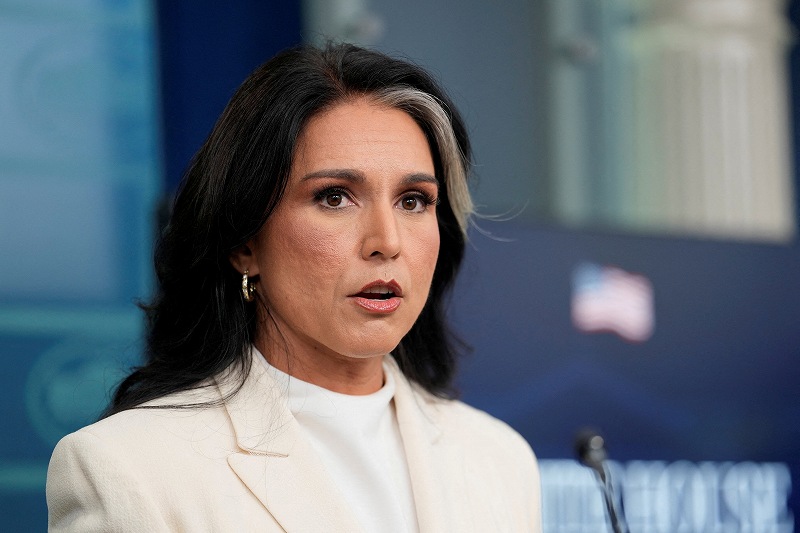
U.S. Director of National Intelligence Tulsi Gabbard speaks during a press briefing, at the White House in July, 2025.
12:36 JST, February 8, 2026
WASHINGTON (Reuters) — U.S. Director of National Intelligence Tulsi Gabbard on Saturday disputed claims by lawmakers that she sought to block Congress from accessing a whistleblower complaint, saying she took “immediate action” once notified of the need to provide security guidance for its release.
A top-secret complaint filed with the intelligence community’s inspector general last May by an anonymous government official alleged that the U.S. spy chief’s office sought to prevent the routine dissemination of certain classified intelligence for political reasons.
Gabbard was appointed to her post by Republican President Donald Trump last year.
A November letter from Andrew Bakaj, the whistleblower’s lawyer, to Gabbard’s office, which was also shared with the House of Representatives and Senate intelligence committees, alleged that Gabbard had hindered the dissemination of the May complaint to lawmakers by failing to provide necessary security guidance on how to handle it.
Democrats such as Senator Mark Warner, the vice chair of the Senate Intelligence Committee, have said that Gabbard’s agency, the Office of the Director of National Intelligence, was required under law to relay the May complaint to Congress within 21 days rather than waiting until February.
In a social media post on Saturday, Gabbard accused Democrats of spreading a “blatant lie.”
Successive inspectors general spanning the presidencies of Trump and his Democratic predecessor Joe Biden did not find the complaint to be credible, Gabbard wrote on X. The 21-day requirement “only applies when a complaint is determined by the Inspector General to be both urgent AND apparently credible,” Gabbard wrote.
Reuters could not verify the contents of the original complaint. The Guardian newspaper and the New York Times have reported that it was related to the handling of an intelligence intercept related to someone close to Trump.
Gabbard also wrote that she previously had not been informed by the inspector generals that the whistleblower had “chosen to send the complaint to Congress, which would require me to issue security instructions.” Gabbard wrote that once made aware of the need to provide security guidance to share the complaint with lawmakers on December 4, she took “immediate action” to do so.










Most Read
Popular articles in the past 24 hours
-

Schools Should Stress Role of Newspapers in Democracy, Says Japan...
-
Symptomatic Measles Victim Visited Defense Ministry in Tokyo; May...
-
Magnitude 4.1 Earthquake Jolts Areas near Mt. Fuji; No Tsunami Ex...
-

High Chocolate Prices Shake Up Valentine's Lineup at Japan's Depa...
-

SoftBank Launches AI Service for Call Centers That Converts Harsh...
-

Tokyo, Many Regions across Japan Hit with Heavy Snow
-

Milano Cortina 2026: Japan’s Maruyama Wins Bronze Medal in Women’...
-

Milano Cortina 2026: Japan's Kimura, Kimata Dazzle in Big Air To ...
Popular articles in the past week
-

Man Infected with Measles May Have Come in Contact with Many Peop...
-

BTS to Hold Comeback Concert in Seoul on March 21; Popular Boy Ba...
-

Israeli Ambassador to Japan Speaks about Japan’s Role in the Reco...
-

Rising Prices in Japan Squeeze Household Finances; Major Parties ...
-

Tokyo Had 65,000 More People Move In Than Out In 2025; Osaka Area...
-

Milano Cortina 2026: Japan’s Athletes Arrive in Italy for Milano ...
-

Green Tea Exports Hit Record High in 2025 Amid Growing Demand, Li...
-

Sapporo Snow Festival Opens with 210 Snow and Ice Sculptures at 3...
Popular articles in the past month
-

Univ. in Japan, Tokyo-Based Startup to Develop Satellite for Disa...
-

Japan Institute to Use Domestic Commercial Optical Lattice Clock ...
-
JAL, ANA Cancel Flights During 3-day Holiday Weekend due to Blizz...
-

China Eyes Rare Earth Foothold in Malaysia to Maintain Dominance,...
-
Man Infected with Measles May Have Come in Contact with Many Peop...
-

Japan, Qatar Ministers Agree on Need for Stable Energy Supplies; ...
-
Australian Woman Dies After Mishap on Ski Lift in Nagano Prefectu...
-

Japan, Italy to Boost LNG Cooperation; Aimed at Diversifying Japa...
Top Articles in News Services
-

Prudential Life Expected to Face Inspection over Fraud
-

South Korea Prosecutor Seeks Death Penalty for Ex-President Yoon over Martial Law (Update)
-

Trump Names Former Federal Reserve Governor Warsh as the Next Fed Chair, Replacing Powell
-

Suzuki Overtakes Nissan as Japan’s Third‑Largest Automaker in 2025
-

Japan’s Nikkei Stock Average Alls from Record as Tech Shares Retreat; Topix Rises (UPDATE 1)
JN ACCESS RANKING
-
Japan Institute to Use Domestic Commercial Optical Lattice Clock to Set Japan Standard Time
-
JAL, ANA Cancel Flights During 3-day Holiday Weekend due to Blizzard
-
China Eyes Rare Earth Foothold in Malaysia to Maintain Dominance, Counter Japan, U.S.
-
Man Infected with Measles May Have Come in Contact with Many People in Tokyo, Went to Store, Restaurant Around When Symptoms Emerged
-
Japan, Qatar Ministers Agree on Need for Stable Energy Supplies; Motegi, Qatari Prime Minister Al-Thani Affirm Commitment to Cooperation