
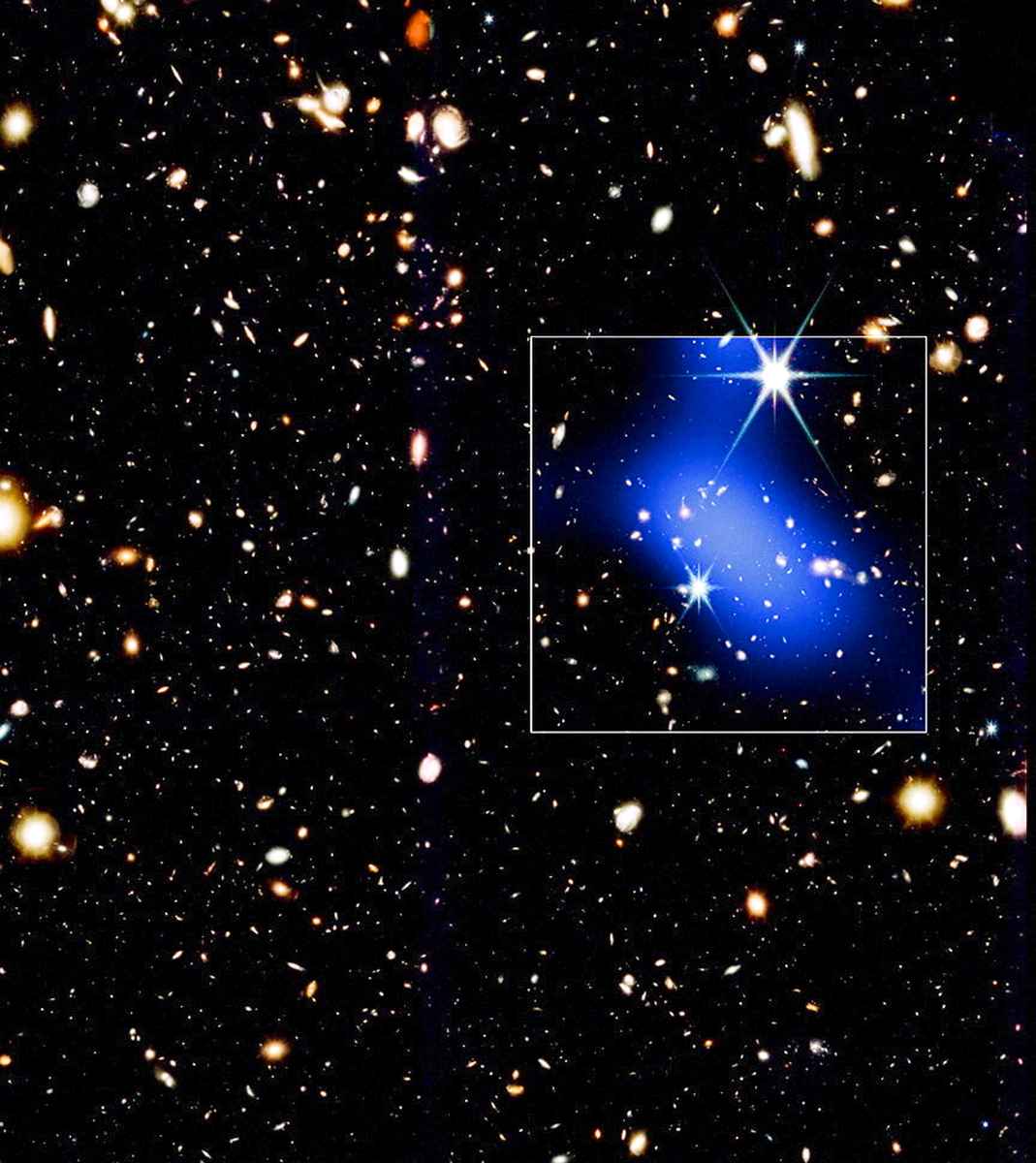
A developing galaxy cluster dating to about 1 billion years after the Big Bang is shown in this handout image released on Jan. 28. The white box marks the field of view of the Chandra X-ray Observatory data (blue) that is overlaid on an infrared image from the James Webb Space Telescope showing the location of galaxies.
18:03 JST, February 6, 2026
WASHINGTON (Reuters) — Observations by NASA’s James Webb Space Telescope and Chandra X-ray Observatory are providing fresh evidence that the universe grew up a lot more quickly than previously known, with observations of a galaxy cluster forming sooner after the Big Bang than once thought possible.
Researchers said these observations show an emerging galaxy cluster containing at least 66 potential member galaxies, with a total cluster mass of about 20 trillion stars the size of our sun, dating to about 1 billion years after the Big Bang event that initiated the universe roughly 13.8 billion years ago.
Galaxy clusters are among the largest structures in the cosmos and were thought to have needed much more time to come together in the early universe. Our Milky Way is part of a galaxy cluster.
“A galaxy cluster is, as the name suggests, an assembly of galaxies, typically hundreds to several thousands. These galaxies are embedded in a halo of hot gas heated to millions of degrees, and the whole system is bound together by dark matter,” said astrophysicist Akos Bogdan of the Harvard and Smithsonian Center for Astrophysics, lead author of the study published in the journal Nature.
Dark matter, which does not emit or reflect light, represents about 85% of the universe’s matter. Ordinary matter — like stars, planets and everything else that is visible — accounts for the rest. Scientists infer the existence of dark matter based on the gravitational effects it exerts on a large scale such as how galaxy clusters are held together.
Spotting a nascent galaxy cluster that was beginning to reach maturity when the universe was roughly 7% its current age was a surprise to scientists. They said the structure, which they called a protocluster, exhibited all the signatures of a mature galaxy cluster such as the halo of superheated gas and a centrally peaked brightness distribution in X-ray emissions.
You may also like to read
Astronomers Unveil Map of Dark Matter’s DistributionUnder most models, the universe should not have been at a mature enough state with a sufficient density of galaxies for an emerging galaxy cluster of this size to form at this early juncture in its history. Until now, the earliest similar structure observed dated to about 3 billion years post-Big Bang.
“Our findings provide further evidence for a more rapid growth of cosmic structure than is predicted by current cosmological models,” said astrophysicist and study coauthor Gerrit Schellenberger of the Center for Astrophysics.
“Together with the recent James Webb Space Telescope discoveries of unexpectedly luminous galaxies in the early universe, as well as supermassive black holes already in place just 500 million years after the Big Bang, our results strengthen the case that key elements of our understanding of the universe may be incomplete,” Schellenberger said.
Since Webb was launched in 2021 and became operational in 2022, its observations have revolutionized the understanding of the early universe, showing how things got off to a much quicker start than previously believed.
The galaxies of the protocluster were found using Webb. The X-ray emission from the protocluster was confirmed using the Chandra observatory.
“The combination of Chandra and Webb observations provides a uniquely powerful window into the early universe, enabling transformative discoveries,” Schellenberger said.









Most Read
Popular articles in the past 24 hours
-

Israeli Ambassador to Japan Speaks about Japan’s Role in the Reco...
-
Japan’s Govt Sets Goal for World’s No. 3 in Number of Highly Cite...
-

‘Bonbon Drop’ 3D Stickers Fly Off Shelves in Japan
-
Visitors Enjoy Early Blooming Flowers Set Against Mt. Fuji
-
Japan IT Groups Urge Apple, Google to Waive New Commissions
-

Japan’s Nikkei Stock AverageRallies on Earnings in Unsteady Trade...
-
Shirakawa Ice Pillars Hit Seasonal Peak in Nagano Pref.
-

Milano Cortina 2026: Japan’s Ayumu Hirano Points toward Com...
Popular articles in the past week
-

Man Infected with Measles May Have Come in Contact with Many Peop...
-
Australian Woman Dies After Mishap on Ski Lift in Nagano Prefectu...
-
Foreign Snowboarder in Serious Condition After Hanging in Midair ...
-

Chinese Embassy in Japan Reiterates Call for Chinese People to Re...
-
Narita Airport, Startup in Japan Demonstrate Machine to Compress ...
-

Toyota Motor Group Firm to Sell Clean Energy Greenhouses for Stra...
-

BTS to Hold Comeback Concert in Seoul on March 21; Popular Boy Ba...
-

Beer Yeast Helps Save Labor, Water Use in Growing Rice; Govt Hope...
Popular articles in the past month
-
Univ. in Japan, Tokyo-Based Startup to Develop Satellite for Disa...
-
JAL, ANA Cancel Flights During 3-day Holiday Weekend due to Blizz...
-

Japan Institute to Use Domestic Commercial Optical Lattice Clock ...
-

China Eyes Rare Earth Foothold in Malaysia to Maintain Dominance,...
-
China Confirmed to Be Operating Drilling Vessel Near Japan-China ...
-
Man Infected with Measles May Have Come in Contact with Many Peop...
-

Japan, Qatar Ministers Agree on Need for Stable Energy Supplies; ...
-
Australian Woman Dies After Mishap on Ski Lift in Nagano Prefectu...
Top Articles in News Services
-

Prudential Life Expected to Face Inspection over Fraud
-

South Korea Prosecutor Seeks Death Penalty for Ex-President Yoon over Martial Law (Update)
-

Trump Names Former Federal Reserve Governor Warsh as the Next Fed Chair, Replacing Powell
-

Suzuki Overtakes Nissan as Japan’s Third‑Largest Automaker in 2025
-
Japan’s Nikkei Stock Average Alls from Record as Tech Shares Retreat; Topix Rises (UPDATE 1)
JN ACCESS RANKING
-
Univ. in Japan, Tokyo-Based Startup to Develop Satellite for Disaster Prevention Measures, Bears
-
JAL, ANA Cancel Flights During 3-day Holiday Weekend due to Blizzard
-
Japan Institute to Use Domestic Commercial Optical Lattice Clock to Set Japan Standard Time
-
China Eyes Rare Earth Foothold in Malaysia to Maintain Dominance, Counter Japan, U.S.
-
Man Infected with Measles May Have Come in Contact with Many People in Tokyo, Went to Store, Restaurant Around When Symptoms Emerged