
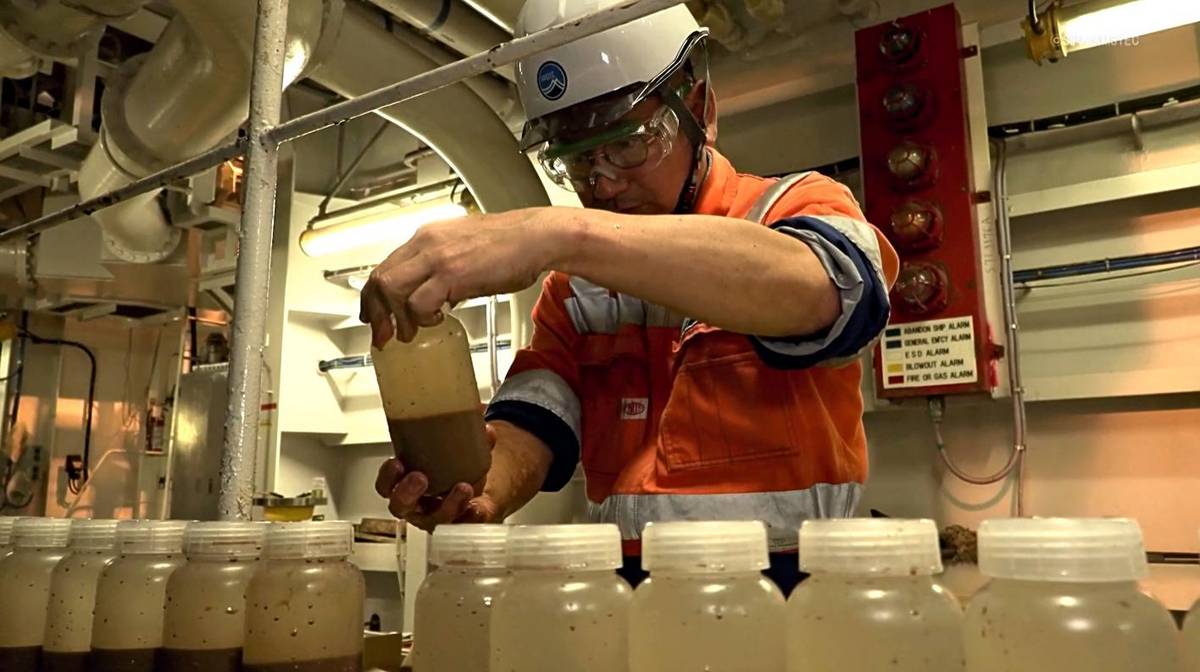
A worker checks for rare earths aboard Chikyu, a deep-sea drilling ship.
17:12 JST, February 3, 2026
The successful test excavation of rare earth-bearing mud from the deep ocean floor by the Japan Agency for Marine-Earth Science and Technology (JAMSTEC) was a major step forward for Japan’s economic security.
JAMSTEC announced Monday the excavation was conducted at a depth of about 5,700 meters off Minami-Torishima, a remote island about 1,900 kilometers from central Tokyo.
Rare earth elements are indispensable to high-tech industries. China, which dominates the rare earth market, uses them as a diplomatic card, which has prompted the Japanese government and companies to diversify their procurement sources.
According to one estimate, rare earth deposits around Minami-Torishima amount to at least 16 million tons, enough to meet global demand for hundreds of years.
Rare earth ores from land-based mines, common in China and elsewhere, contain high levels of radioactive substances and produce large amounts of environmental pollutants during the refining process. In contrast, the mud off Minami-Torishima is a clean resource containing hardly any radioactive substances, according to Prof. Yasuhiro Kato of the University of Tokyo, who discovered the rare earth-bearing mud.
“And there is an abundant supply. If commercial development progresses, it could significantly transform the supply chain for rare earths,” said the specialist in earth resource science.
High costs
However, major barriers remain to commercializing these rare earth elements. There is still uncertainty over whether the technology can be produced to continuously excavate large quantities of rare earths over a long period. Profitability is yet another major challenge.
Excavating mud from the ocean floor off Minami-Torishima is estimated to cost at least two to 20 times more than mining rare earths elsewhere, according to Yoshikiyo Shimamine, senior fellow at the Dai-ichi Life Research Institute Inc. Costs for transportation and processing would also have to be taken into account.
The operation could still be justifiable economically if 3,500 tons of rare earth-laden mud is collected per day, according to a 2016 report by the Natural Resources and Energy Agency and others.
Under the Cabinet Office research initiative known as the Cross-ministerial Strategic Innovation Promotion Program, a facility to dehydrate the mud for easier transport will be built on Minami-Torishima, and full-scale test excavation will begin by February 2027, with the aim of collecting up to 350 tons of mud a day. But this is only one-tenth the amount mentioned in the report. Another report, on excavation costs and profitability in the program, is expected to be compiled by March 2028.
“Securing rare earth elements using Japan’s own technology would be significant for national security,” Shimamine said. But he added that full-scale commercial excavation off Minami-Torishima would start in 2030 at the earliest.
“We need to pave the way for full-scale excavation as soon as possible through cooperation with the United States and other countries,” he said.
Diversifying procurement
Japan has managed to lower its dependence on China for rare earths, from sourcing 85% from the country in 2009 to 58% in 2020.
Japan has focused on diversifying procurement sources, expanding stockpiles and promoting reuse. The Japan Organization for Metals and Energy Security (JOGMEC) is promoting new mine development and support for companies so they can secure rights to rare earths and bolster stockpiles.
JOGMEC also manages national stockpiles to prepare for potential disruptions in the rare earths supply. While the specific stockpile levels are classified, JOGMEC is working to build up stockpiles based on the projected annual demand for 2030.
However, according to a senior official at the Economy, Trade and Industry Ministry, it will take several years to several decades to develop mines and expand stockpiles. Since global demand for electric vehicles and components is growing, the official said it is not easy to secure a supply.
According to sources, the Chinese government has tightened export controls on certain types of rare earths to Japan. China is also moving to secure rare earth assets worldwide.
Japanese companies are also advancing measures to prepare for rising risks to rare earth procurement. In some of Nissan Motor Co.’s EVs, the firm has already adopted motors that use no dysprosium, a rare earth. In October, major auto equipment maker Astemo, Ltd. also said that it had developed a rare earth-free motor for EVs. It aims to introduce the motor around 2030.




Most Read
Popular articles in the past 24 hours
-

Voters Using AI to Choose Candidates in Japan's Upcoming General ...
-

Japan's Snow-Clad Beauty: Camellia Flowers Seen in Winter Bloom a...
-
Monkey Strikes Junior High School Girl from Behind in Japan's Yam...
-
Genichiro Inokuma's Mural in Ueno Station That Gave Hope in Postw...
-
Senior Japanese Citizens Return to University to Gain Knowledge, ...
-

Foreign and Security Policy: Political Parties Must Discuss How T...
-
Heavy Snow Linked to 30 Deaths across Japan since Late Jan.; JMA ...
-

Tokyo Police Arrest Head of Resignation Assistance Firm
Popular articles in the past week
-

Japan Institute to Use Domestic Commercial Optical Lattice Clock ...
-
Australian Woman Dies After Mishap on Ski Lift in Nagano Prefectu...
-
Foreign Snowboarder in Serious Condition After Hanging in Midair ...
-
Chinese Embassy in Japan Reiterates Call for Chinese People to Re...
-
Narita Airport, Startup in Japan Demonstrate Machine to Compress ...
-

Toyota Motor Group Firm to Sell Clean Energy Greenhouses for Stra...
-

Sakie Yokota, Last Surviving Parent of a North Korea Abductee, Ur...
-

Beer Yeast Helps Save Labor, Water Use in Growing Rice; Govt Hope...
Popular articles in the past month
-
Univ. in Japan, Tokyo-Based Startup to Develop Satellite for Disa...
-

JAL, ANA Cancel Flights During 3-day Holiday Weekend due to Blizz...
-
China Confirmed to Be Operating Drilling Vessel Near Japan-China ...
-
China Eyes Rare Earth Foothold in Malaysia to Maintain Dominance,...
-
M6.2 Earthquake Hits Japan's Tottori, Shimane Prefectures; No Tsu...
-
Japan Institute to Use Domestic Commercial Optical Lattice Clock ...
-

Japan, Qatar Ministers Agree on Need for Stable Energy Supplies; ...
-

Japan, Italy to Boost LNG Cooperation; Aimed at Diversifying Japa...
Top Articles in Business
-
Japan, Italy to Boost LNG Cooperation; Aimed at Diversifying Japan’s LNG Sources
-

Honda to Launch New Electric Motorbike in Vietnam
-

Asics Opens Factory for Onitsuka Tiger Brand in Western Japan
-

Japan’s ANA to Introduce Nationwide Logistics Service Using Drones, Will Be Used to Deliver Supplies in Remote Areas
-
JR Tokai, Shizuoka Pref. Agree on Water Resources for Maglev Train Construction
JN ACCESS RANKING
-
Univ. in Japan, Tokyo-Based Startup to Develop Satellite for Disaster Prevention Measures, Bears
-
JAL, ANA Cancel Flights During 3-day Holiday Weekend due to Blizzard
-
China Confirmed to Be Operating Drilling Vessel Near Japan-China Median Line
-
China Eyes Rare Earth Foothold in Malaysia to Maintain Dominance, Counter Japan, U.S.
-
Japan Institute to Use Domestic Commercial Optical Lattice Clock to Set Japan Standard Time