
Japanese Byobu Folding Screens Tailored to Meet Modern Lifestyles; Foreign Orders Also Piling up
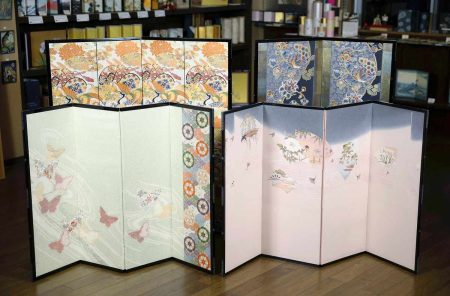
Byobu folding screens made with kimono and obi sash belts
16:00 JST, February 1, 2026
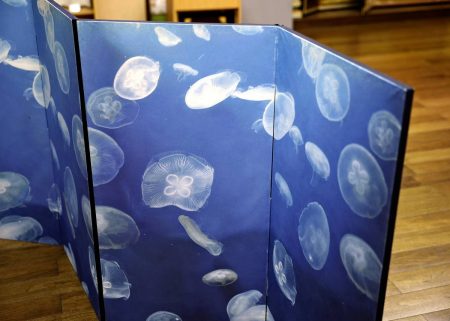
A byobu with a photo of jellyfish
Byobu folding screens are a sure way to add elegance and glamour to any room. Although they are gradually disappearing from modern Japanese households, new types of folding screens are emerging, tailored to meet the diverse lifestyles and necessities of the present age.
Vibrant kimono embroidered with images of birds and butterflies, a photograph of jellyfish drifting through water, T-shirts and jeans — these are just some of the items used to make byobu at Kataoka Byobu Store Co. in Sumida Ward, Tokyo.
The specialist store, which was founded in 1946, is filled with byobu made with diverse materials and featuring imaginative designs.
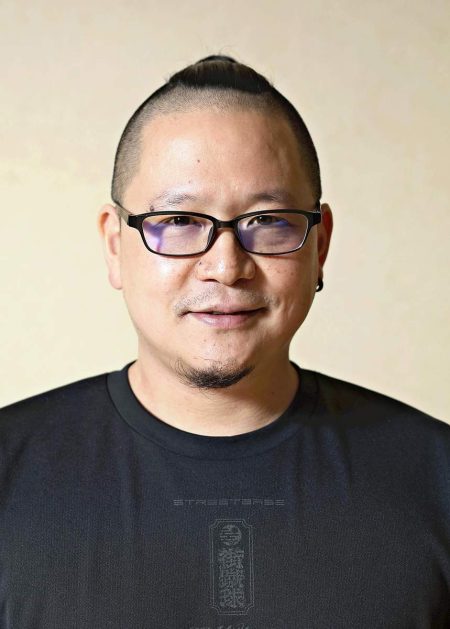
Koto Kataoka
“We create byobu while exploring how they’ll be used in contemporary times,” said third-generation owner Koto Kataoka, 37.
Born in Tokyo in 1988, Kataoka turned his focus to his family’s business after he felt the sting of being unable to give good answers to questions about Japanese culture while in the United States on a short-term study abroad program as a high school student.
After graduating from university, he studied abroad again before joining Kataoka Byobu Store. He became the company’s representative in 2024.
Byobu are said to primarily serve three functions: stopping drafts, partitioning spaces and serving as canvases.
The first function is considered to be the origin of the word byobu, with the kanji character “byo” meaning “to block” and “bu” referring to wind. Until around the Meiji era (1868-1912), people were said to have placed byobu at the heads of their futons when sleeping.
As for the second function, byobu have been used to create rooms in homes that have few walls and to conceal futons, private belongings and other items.
Regarding the third function, many artists have left masterpieces on byobu panels, including “Wind God and Thunder God Screens” by Tawaraya Sotatsu and “Irises” by Ogata Korin.
“Since byobu can be folded with the painting facing inward, many works have been preserved in excellent condition,” Kataoka said.
Kataoka Byobu Store has created various folding screens, including for hina dolls used in the Hina Matsuri festival in March and for warrior dolls on Children’s Day in May. Large golden byobu are also used at hotels and wedding venues.
Amid declining demand for byobu, the store is focusing on tailor-making them.
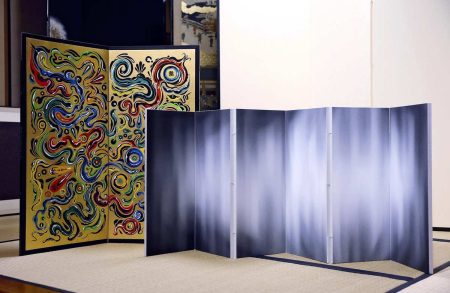
Collaborative works with artists
Recently, requests to make byobu out of kimono have been increasing, and these orders are filled using urauchi — a technique in which washi paper is glued to the rear of a kimono as a backing material.
“It doesn’t take up much space because it can be folded,” Kataoka said. “It’s great that people are choosing to keep alive the memories associated with certain kimono by turning them into byobu.”
Kataoka said he also receives many requests from foreigners asking for byobu as decor. There are also requests for byobu as wall hangings, usually from restaurants and hotels.
Kataoka is also enthusiastic about creating new types of byobu using photographs and images from manga or by collaborating with artists.
“Byobu have a long history that connects the past and the present,” Kataoka said. “It would be great if our initiative became a tradition 100 years from now.”
Trick panels
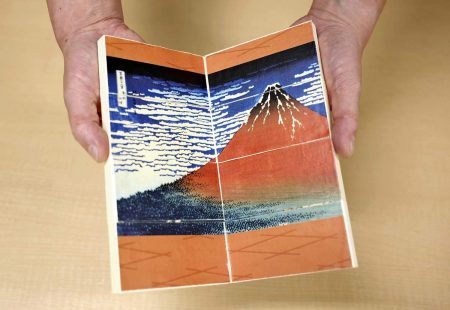
Trick panels
A workshop at Kataoka Byobu Store allows visitors to create their own unique karakuri byobu, or trick panel, a type of folding screen with images on two rectangular panels that form different pictures depending on how the panels are flipped.
Washi Japanese paper is usually used for the panels.
Four different images can be formed, with a print of famous ukiyo-e artist Katsushika Hokusai’s work on one of them. For the remaining three, the visitors can add whatever photos or images they like.
Those who want to take part in a workshop need to send an email to info@byoubu.co.jp or a fax to 03-3622-0294 in advance with their desired date and the number of participants. The workshop costs ¥4,400 per person.




Most Read
Popular articles in the past 24 hours
-

Voters Using AI to Choose Candidates in Japan's Upcoming General ...
-

Japan's Snow-Clad Beauty: Camellia Flowers Seen in Winter Bloom a...
-

Monkey Strikes Junior High School Girl from Behind in Japan's Yam...
-

Genichiro Inokuma's Mural in Ueno Station That Gave Hope in Postw...
-
Senior Japanese Citizens Return to University to Gain Knowledge, ...
-

Heavy Snow Linked to 30 Deaths across Japan since Late Jan.; JMA ...
-

Tokyo Police Arrest Head of Resignation Assistance Firm
-

Foreign and Security Policy: Political Parties Must Discuss How T...
Popular articles in the past week
-

Japan Institute to Use Domestic Commercial Optical Lattice Clock ...
-

Australian Woman Dies After Mishap on Ski Lift in Nagano Prefectu...
-

Foreign Snowboarder in Serious Condition After Hanging in Midair ...
-

Chinese Embassy in Japan Reiterates Call for Chinese People to Re...
-
Narita Airport, Startup in Japan Demonstrate Machine to Compress ...
-

Toyota Motor Group Firm to Sell Clean Energy Greenhouses for Stra...
-

Sakie Yokota, Last Surviving Parent of a North Korea Abductee, Ur...
-

Beer Yeast Helps Save Labor, Water Use in Growing Rice; Govt Hope...
Popular articles in the past month
-
Univ. in Japan, Tokyo-Based Startup to Develop Satellite for Disa...
-

JAL, ANA Cancel Flights During 3-day Holiday Weekend due to Blizz...
-

China Confirmed to Be Operating Drilling Vessel Near Japan-China ...
-

China Eyes Rare Earth Foothold in Malaysia to Maintain Dominance,...
-
M6.2 Earthquake Hits Japan's Tottori, Shimane Prefectures; No Tsu...
-
Japan Institute to Use Domestic Commercial Optical Lattice Clock ...
-

Japan, Qatar Ministers Agree on Need for Stable Energy Supplies; ...
-

Japan, Italy to Boost LNG Cooperation; Aimed at Diversifying Japa...
Top Articles in Culture
-

Junichi Okada Wears Three Hats in ‘Last Samurai Standing,’ Serving as Star, Producer, Action Choreographer in Thrilling Netflix Period Drama
-
Lifestyle at Kyoto Traditional Machiya Townhouse to Be Showcased in Documentary
-

Maison&Objet Kicks off Near Paris with Japanese Lighting Designers’ Installations on Display, Creating Rich Environment
-

‘Jujutsu Kaisen’ Voice Actor Junya Enoki Discusses Rapid Action Scenes in Season 3, Airing Now
-

Prestigious Japanese Literature Prize Names Toriyama, Hatakeyama as Winners
JN ACCESS RANKING
-
Univ. in Japan, Tokyo-Based Startup to Develop Satellite for Disaster Prevention Measures, Bears
-
JAL, ANA Cancel Flights During 3-day Holiday Weekend due to Blizzard
-
China Confirmed to Be Operating Drilling Vessel Near Japan-China Median Line
-
China Eyes Rare Earth Foothold in Malaysia to Maintain Dominance, Counter Japan, U.S.
-
Japan Institute to Use Domestic Commercial Optical Lattice Clock to Set Japan Standard Time