
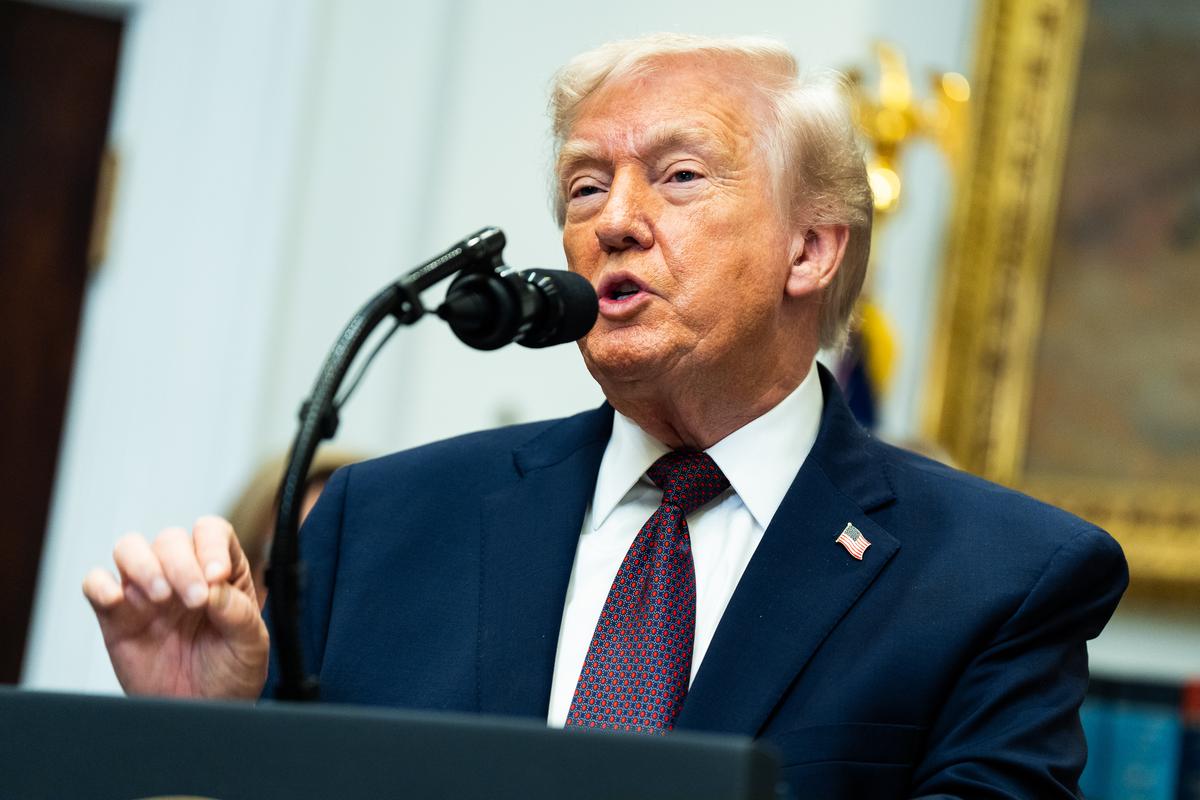
President Donald Trump said earlier this month that Republicans should embrace health care as a core priority.
13:47 JST, January 16, 2026
President Donald Trump on Thursday revealed a health care proposal he dubbed the “Great Healthcare Plan,” outlining a set of cost-cutting ideas but stopping short of offering a detailed replacement for the Affordable Care Act.
“I’m calling on Congress to pass this framework into law without delay, have to do it right now, so that we can get immediate relief to the American people,” Trump said in a video posted by the White House.
The administration released no legislative text nor timeline for related congressional action and did not indicate whether Republican leaders support the proposal, even as health care costs loom as a central issue in this year’s closely contested midterm elections. Asked how the proposal would advance in Congress, administration officials said it was a “broad architecture” intended to guide lawmakers on next steps.
“There’ll be ongoing conversations, and we hope to be able to support with specific language for the legislation,” Mehmet Oz, one of Trump’s top health care deputies, told reporters Thursday on a conference call. The White House also launched a new website, GreatHealthcare.gov, ahead of Trump’s announcement.
Polls have found that many voters are unhappy with rising health care premiums and lawmakers’ inability to reach a deal on ACA subsidies that expired last month, a lapse that has contributed to a spike in health-insurance costs for millions of marketplace enrollees.
Democrats mocked the administration’s language Thursday, questioning whether Trump could call his proposal a “plan” given the lack of details.
“Donald Trump’s new plan is a Band-Aid for the full-blown health care crisis he and Republicans in Congress created,” Sen. Elizabeth Warren (D-Massachusetts) told The Washington Post in a statement.
Trump’s proposal includes a mix of initiatives that are already underway, such as Trump’s push to cut U.S. drug prices by linking them with the lower cost of drugs sold abroad, and some of his stalled ambitions, such as his desire to redirect billions of dollars in federal funding away from health insurers and toward average Americans. Trump also called to restore funding for the ACA’s cost-sharing reduction program, an insurance subsidy program that he ended in his first term, and to institute “maximum price transparency” by requiring hospitals and insurers to make more information available to consumers.
The proposal does not include new ideas to expand health coverage or simplify America’s often-byzantine health-care system. It also falls far short of Trump’s promises to deliver a replacement for the ACA, the sweeping 2010 health law that has been credited with helping more than 20 million Americans get health coverage and has long been targeted for repeal by Trump and his GOP allies. Republican leaders have refused to extend an ACA subsidy program that expired in December, with Democrats pushing to restore that program as a way to lower health care costs and reduce instability in insurance markets.
In his announcement, Trump criticized the ACA as “hated” and “unaffordable” but said that his own proposal to restore funding for the cost-sharing reduction program would lead to meaningful savings for the most popular plans sold on the ACA marketplaces.
Trump’s proposal comes as Republicans are attempting to position the party ahead of this year’s midterm elections, which are expected to be closely contested and center on pocketbook issues such as health care costs.
GOP leaders said they supported Trump’s general ideas, while declining to detail legislative next steps.
“I haven’t gotten into the weeds on it, but obviously, they’re trying to get at the issue of costs,” Senate Majority Leader John Thune (R-South Dakota) told reporters, calling the president’s price-transparency ideas “no-brainers.”
Some conservative policy experts and consumer advocates also cheered the proposal, saying that lowering drug costs and improving health-care price transparency have bipartisan appeal.
“President Trump is taking on insurers, hospitals, and all middlemen to hold them accountable and deliver radical transparency,” Cynthia Fisher, a longtime champion of price transparency and the founder of PatientRightsAdvocate.org, said in a statement.
But Democrats panned Trump’s ideas as inadequate and stale – saying that years of government price-transparency efforts had failed to yield significant savings for consumers, for instance – and called on Republicans to work with their party on restoring ACA subsidies.
Sen. Ron Wyden (Oregon), the top Democrat on the Senate Finance Committee that oversees aspects of the U.S. health system, dismissed Trump’s announcement as one of his “empty promises” on health care.
“Every American should be asking themselves a simple question: are you paying more for your health care than you were a year ago?” Wyden said in a statement, alluding to reports that premiums have risen across the country. “The answer ought to tell you everything you need to know about the Trump-Republican health care agenda.”
Liberal advocacy groups and Democratic campaign staff also said they planned to cite Trump’s announcement as an example of Republicans’ limited health care proposals, compared with Democrats’ more expansive plans.
“Trump’s health care plan is … a subsidy,” Grace Silva, a spokeswoman for 314 Action, a liberal advocacy group working to elect scientists and physicians to government, wrote in a statement.
Trump said earlier this month that Republicans should embrace health care as a core priority, arguing that GOP lawmakers were missing an opportunity to win over Americans on an issue that consistently rates among voters’ top election-year priorities.
“It’s never been our issue. It should be our issue,” Trump told House Republicans at a policy session last week.
Americans are more likely to trust Democrats than Republicans on health care issues, polls show. Trump’s failed efforts to repeal the ACA in 2017 helped contribute to Democrats retaking the House the following year – a scenario that has left many Republicans wary of attempting major health care reform again, particularly ahead of this year’s midterms.
Administration officials disputed that Thursday’s proposal fell short of the president’s pledge to unveil a replacement for the ACA. Oz, the administrator of the Centers for Medicare and Medicaid Services, repeatedly described the proposal as a “holistic” approach to health care by focusing on issues such as drug costs and price transparency, rather than the health insurance plans at the center of the ACA.
“The Great Healthcare Plan is designed to be able to answer the questions that all Americans are asking, not just a few,” Oz told reporters.










Most Read
Popular articles in the past 24 hours
-
JR Tokai Breaks Ground on Yamanashi Maglev Station; Will Be Part ...
-
‘King Kazu’ Discusses His Connection to Fukushima
-

Japan’s Gunma Official Suspended For Unauthorized Absence From Wo...
-

Milano Cortina 2026: Japan’s Alpine Skier Muraoka Extends P...
-

Rising Kabuki Star Works to Ensure Deaf Audience's Enjoyment of P...
-

Lady Bess: Iroha Okuda, Mayuko Kominami Discuss Performing Elizab...
-

Japan Considering Taking Part in U.S. ‘Golden Dome’ Defense Syste...
-

Trump Discourages Iranian Soccer Team from Attending the World Cu...
Popular articles in the past week
-

Japan Figure Skating Legend Yuzuru Hanyu Is Proud Disaster Surviv...
-

Nippon Life Insurance's U.S. Arm Sues OpenAI Over Legal Assistanc...
-

Govt to Utilize ODA for Ensuring Economic Security; Securing Ener...
-

Massive Sewer Pipe Found Jutting Out of Highway in Osaka
-

15 Measles Patients Confirmed in Tokyo in Past 6 Days; 1 May Have...
-

Beckoning Cats Get Makeover to Fit Modern Lifestyles with Sleek D...
-

Japan Govt to Tighten Requirements to Receive Permanent Residency...
-

Japan Govt Survey Finds Just 10% of Workers Want Working Hours to...
Popular articles in the past month
-

Producer Behind Pop Group XG Arrested for Cocaine Possession
-

Japan PM Takaichi’s Cabinet Resigns en Masse
-

Man Infected with Measles Reportedly Dined at Restaurant in Tokyo...
-

Videos Plagiarized, Reposted with False Subtitles Claiming ‘Ryuky...
-
Japan Figure Skating Legend Yuzuru Hanyu Is Proud Disaster Surviv...
-

iPS Treatments Pass Key Milestone, but Broader Applications Far f...
-

Sanae Takaichi Elected Prime Minister of Japan; Keeps All Cabinet...
-

Nepal Bus Crash Kills 19 People, Injures 25 Including One Japanes...
Top Articles in News Services
-
Survey Shows False Election Info Perceived as True
-

Japan’s Nikkei Stock Average Falls as US-Iran Tensions Unsettle Investors (UPDATE 1)
-
Japan’s Nikkei Stock Average Rises on Tech Rally and Takaichi’s Spending Hopes (UPDATE 1)
-

Japan to Ban Use of Power Banks on Airplanes
-

North Korea Unveils Image of Kim Jong Un’s Teenage Daughter Firing Rifle
JN ACCESS RANKING
-
Producer Behind Pop Group XG Arrested for Cocaine Possession
-
Japan PM Takaichi’s Cabinet Resigns en Masse
-
Man Infected with Measles Reportedly Dined at Restaurant in Tokyo Station
-
Videos Plagiarized, Reposted with False Subtitles Claiming ‘Ryukyu Belongs to China’; Anti-China False Information Also Posted in Japan
-
Japan Figure Skating Legend Yuzuru Hanyu Is Proud Disaster Survivor and Gold Medalist, Vows to Continue Support Efforts