
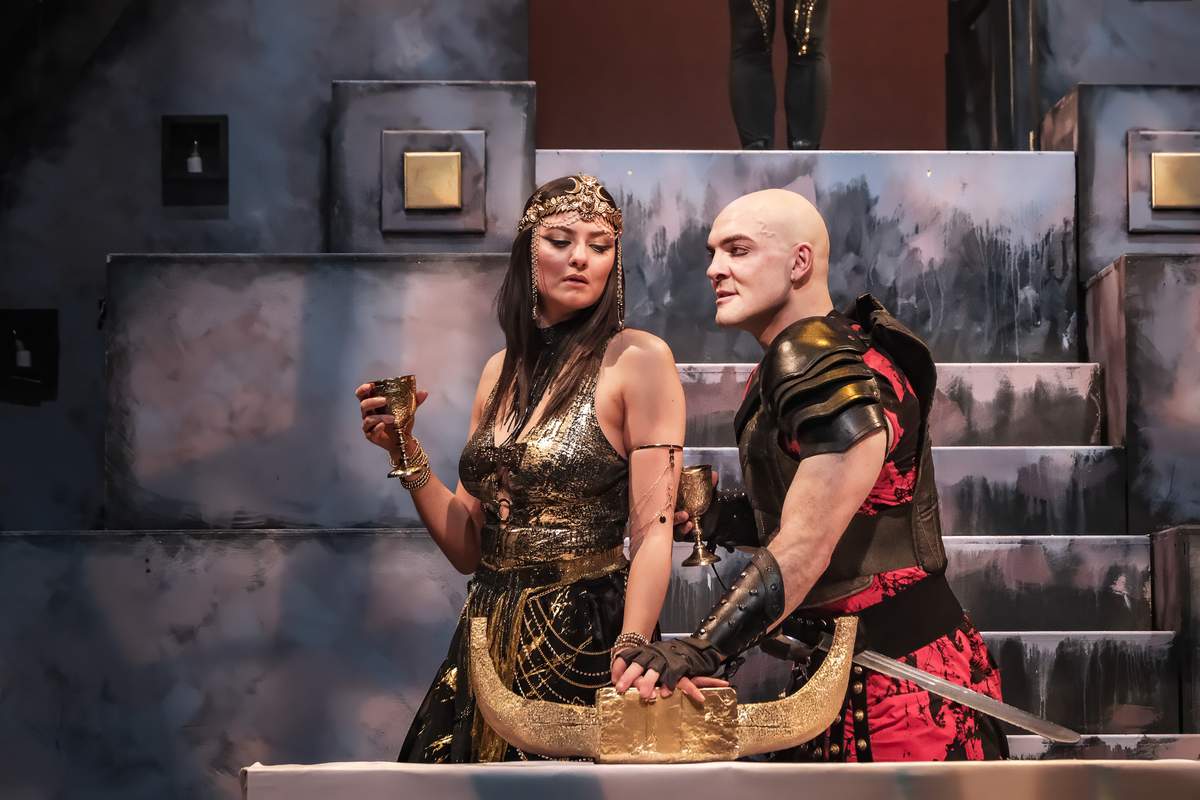
Irina Kavsadze, left, and Vato Tsikurishvili in Synetic Theater’s “Antony & Cleopatra.”
15:14 JST, January 13, 2026
A warship speeds toward battle as waves slap against the hull. Troops on deck glare at the enemy.
The man in charge, the famed warrior Antony (Vato Tsikurishvili), is not merely commanding the ship: He is fused with it. Supported by knotted ropes, his body juts forward, almost horizontal, so that his head and torso constitute the ship’s prow and his angry face signals the craft’s belligerent momentum.
That naval skirmish, conjured with bodies, ropes and sound, is a high point of Synetic Theater’s diffuse but visually arresting “Antony & Cleopatra,” which is running at a Shakespeare Theatre Company venue before moving to Virginia next month. Virtuosic physicality and ingenious stage pictures are the fortes of this distinctive company, of course, but the nautical sequence is more than a clever bit of business. It captures one of the production’s most resonant themes: how geopolitical conflicts can become personalized, merging with the whims and foibles of individual leaders.
Premiered in 2010 as one of Synetic’s trademark wordless Shakespeare adaptations and not remounted since, director Paata Tsikurishvili’s “Antony & Cleopatra” delivers other striking moments: the donning of bright-red gloves by conspirators bent on assassinating the potential monarch Caesar (Tony Amante). The slabs of map held by court minions, who shuffle their positions until they are depicting the Mediterranean coastline – as if Busby Berkeley had turned his mind to ancient cartography.
And, ranging on and around the pyramid that looms at center stage, are visceral battle scenes: the fighters who leap, kick, spin and flip; the blades that emit sparks when they collide; the shields that become battering rams. Even Cleopatra (a regal Irina Kavsadze) spars with her lover Antony after he has betrayed her, at one point pinning his body to the floor with her foot. (Vato Tsikurishvili, who packs gruff vitality into Antony, has remounted Ben Cunis’s original fight choreography. Phil Charlwood remounted the scenic design, originally by Anastasia Ryurikov Simes.)
What is often missing amid the theatrical coups is narrative focus. The incorporation of backstory, including the tale of Cleopatra’s rivalry with her brother Ptolemy (Natan-Maël Gray), detracts from the titular romance. And while Shakespeare’s original admittedly also bops between places, personalities and armies, its dialogue often returns to the eponymous lovers when they aren’t onstage themselves. That conversational gravity can’t be a factor in this dialogue-free version, adapted by Nathan Weinberger and Paata Tsikurishvili.
The over-exoticization of Egypt here also has the side effect of diffusing focus. Cleopatra’s eerie servant Mardian (Stella Bunch), wearing an outfit and mask that evoke the Egyptian god Osiris, haunts the stage like the Nile delta’s mystical soul. At one point, Mardian executes a slow magic trick, making a vessel move telekinetically; at another, the character writhes like the asp that will be the queen’s suicide weapon.
Other figures adopt walk-like-an-Egyptian poses, or dance seductively with veils, adding to an Orientalist vibe that the broody, growly, shivery soundscape reinforces. (Sound designer and resident composer Koki Lortkipanidze created the original sound design with Irakli Kavsadze. Irina Tsikurishvili choreographed, and Erik Teague designed the costumes.) When a court ritual seems to fascinate Antony, it becomes unclear whether he is attracted primarily to Cleopatra or to her mysterious homeland.
Valuably lightening the atmosphere are a few flashes of comedy, such as when Roman strongman Octavian (Philip Fletcher), ridiculing Antony, clowns around with a mock Cleopatra (Maryam Najafzada, who plays Octavian’s sister Octavia). Their bodies bounce madly in a spoof sex scene.
The sequence goes on too long, but the humor adds variety. Stitching together jokes to politics, bedroom to battlefield, Egyptian palace to Roman Senate, “Antony & Cleopatra” unfurls a broad canvas that – given its topical themes of imperialism, military aggression, and no-kings sentiment – seems to stretch to the present day.







Most Read
Popular articles in the past 24 hours
-

Trump Fires Homeland Security Secretary Noem after Mounting Criti...
-
Japanese Nationals in 4 Gulf Countries to Be Evacuated with Chart...
-

China’s National People’s Congress Opens: Military Expansion Cont...
-

Hanamaruki to Sell Liquid 'Shio-Koji' Seasoning to U.S. Consumers
-

Strawberry Prince’s Rinu Discusses His Dream of Voice Acting, Suc...
-

CARTOON OF THE DAY (March 6)
-
Japan Foreign Minister Confirms Two Japanese Detained in Iran
-

Donald Keene’s Drinking Buddy and Translator Yukio Kakuchi Pays T...
Popular articles in the past week
-

South Korea Tightens Rules on Foreigners Buying Homes in Seoul Me...
-
2 Unpublished Early Novellas by Japan's Kenzaburo Oe Discovered, ...
-

Strait of Hormuz Closure Shakes Markets; Prolonged Closure Could ...
-

Iran Situation: Japan Must Exert Diplomatic Efforts without Merel...
-

Amid Strait of Hormuz Blockade, Shipping Companies Scramble to Ge...
-
Measles Patient Visited Hospital in Bunkyo Ward, Tokyo, Metropoli...
-

Ibaraki Pref.'s 1st Foreign Bus Driver Hired in Tsukuba
-

Tokyo’s ‘Strawberry War’ Intensifies as Producers Vie to Become ‘...
Popular articles in the past month
-

Producer Behind Pop Group XG Arrested for Cocaine Possession
-

Japan PM Takaichi’s Cabinet Resigns en Masse
-

Man Infected with Measles Reportedly Dined at Restaurant in Tokyo...
-

Videos Plagiarized, Reposted with False Subtitles Claiming ‘Ryuky...
-

Prudential Life Insurance Plans to Fully Compensate for Damages C...
-

Woman with Measles Visited Hospital in Tokyo Multiple Times Befor...
-

iPS Treatments Pass Key Milestone, but Broader Applications Far f...
-

Sanae Takaichi Elected Prime Minister of Japan; Keeps All Cabinet...
Top Articles in News Services
-
Survey Shows False Election Info Perceived as True
-
Hong Kong Ex-Publisher Jimmy Lai’s Sentence Raises International Outcry as China Defends It
-

Japan’s Nikkei Stock Average Falls as US-Iran Tensions Unsettle Investors (UPDATE 1)
-
Japan’s Nikkei Stock Average Touches 58,000 as Yen, Jgbs Rally on Election Fallout (UPDATE 1)
-
Japan’s Nikkei Stock Average Rises on Tech Rally and Takaichi’s Spending Hopes (UPDATE 1)
JN ACCESS RANKING
-
Producer Behind Pop Group XG Arrested for Cocaine Possession
-
Japan PM Takaichi’s Cabinet Resigns en Masse
-
Man Infected with Measles Reportedly Dined at Restaurant in Tokyo Station
-
Videos Plagiarized, Reposted with False Subtitles Claiming ‘Ryukyu Belongs to China’; Anti-China False Information Also Posted in Japan
-
Prudential Life Insurance Plans to Fully Compensate for Damages Caused by Fraudulent Actions Without Waiting for Third-Party Committee Review