
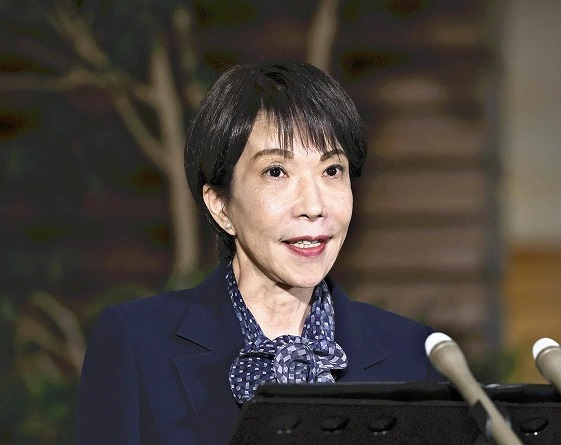
Prime Minister Sanae Takaichi speaks at the Prime Minister’s Office on Dec. 26.
13:50 JST, December 31, 2025
Tokyo, Dec. 31 (Jiji Press)—Few members of Japan’s conservative ruling Liberal Democratic Party, even those who are considered relatively liberal, dare to openly criticize their ultraconservative leader, Sanae Takaichi, also prime minister, amid unabated high public support for her.
Now that the LDP’s intraparty factions except the one led by Taro Aso, vice president of the party, have been disbanded due to their long-term engagement in creating slush funds, party members critical of Takaichi find it difficult to funnel their voices into force, observers pointed out.
On Thursday, the party’s General Council unanimously gave the nod to the Takaichi government-proposed initial budget for fiscal 2026 with the largest-ever general-account expenditures, despite concerns over her aggressive spending policy eroding the country’s fiscal discipline further.
“If you speak badly of a prime minister who enjoys broad public backing, you will do nothing but come under fire,” said a member who once was a cabinet minister.
Shigeru Ishiba, Takaichi’s immediate predecessor, is an exception.
After Takaichi’s “Taiwan contingency remarks” in a parliamentary session provoked China’s harsh backlash, Ishiba said the prime minister should not have made any parliamentary comment that could develop into an international issue.
He also criticized a ruling coalition bill calling for automatically reducing within a year 45 seats in the House of Representatives, the all-important lower chamber of the Diet, the country’s parliament. “I have never seen such a move in democracies in the world,” he said. The bill has been put on hold due to the opposition camp’s strong protest.
Furthermore, the former prime minister cast doubt on the effectiveness of “rice coupons” proposed by the Takaichi administration as an inflation relief measure.
“To get (Takaichi) to do a good job for the country, members of the ruling coalition have to say what they have to say,” Ishiba reiterated on a YouTube channel on Dec. 22.
But there have been no visible arguments within the LDP against actions taken by Takaichi.
Fumio Kishida, Takaichi’s another predecessor regarded as a liberalist and former faction leader, accepted her offer to head the Headquarters for Japan’s Growth Strategy, set up directly under the LDP chief, in a show of support for the Takaichi government.
“In private conversations, Kishida has complained about the fallout from the Takaichi remarks, such as Beijing’s de facto reinstatement of an import ban on Japanese marine products,” people close to him said. “But he has never expressed discontent publicly.”
Former LDP Secretary-General Hiroshi Moriyama, who has been heading the suprapartisan Japan-China Friendship Parliamentarians’ Union and has not necessarily been getting along with Takaichi, also keeps his mouth shut.
LDP factions had sometimes helped unite intraparty dissidents to attack a prime minister. After the dissolution of the factions involved in the funding scandal, however, it became difficult for party members to make collective actions under public scrutiny.
“Horizontal ties between lawmakers have weakened,” an LDP source said.
“If I’m labeled as anti-Takaichi, I will be unable to receive support from the party leadership,” a Lower House rookie in the LDP said of fears spreading particularly among lawmakers without solid local supporters.
Still, it may be too politically naive to think that the silence will last long.
After the 2026 regular Diet session begins on Jan. 23, the prime minister and other cabinet ministers will be grilled everyday by opposition lawmakers.
Recalling that a serious blow was dealt to the government of the time during budget committee deliberations in many cases in the past, an aide to Takaichi said, “Once the high approval ratings for the Takaichi administration head south, the atmosphere in the LDP will drastically change.”





Most Read
Popular articles in the past 24 hours
-

3,000 Accounts Posting, Spreading Content Critical of Japan on X;...
-

Milano Cortina 2026: Sakamoto Serves as Flag Bearer; Japan Earns ...
-

Milano Cortina 2026: There Were Cheers across the Country, after ...
-

A Packed Bus Plunges off a Nepal Highway, Killing 19 and Injuring...
-

Luna Sea Drummer Shinya Dies at 56; Powerful Drummer Behind ‘Desi...
-

Milano Cortina 2026: ‘Magical’ Italian Games Close wi...
-

Milano Cortina 2026: Riku-Ryu Duo Stick Together During Closing C...
-
Emperor Receives Well-Wishes from Public on His 66th Birthday
Popular articles in the past week
-

Japan PM Takaichi’s Cabinet Resigns en Masse
-

Man Infected with Measles Reportedly Dined at Restaurant in Tokyo...
-

Sanae Takaichi Elected Prime Minister of Japan; Keeps All Cabinet...
-

Japan's Govt to Submit Road Map for Growth Strategy in March, PM ...
-

Bus Carrying 40 Passengers Catches Fire on Chuo Expressway; All E...
-

U.S. Firm to Build Training Hub in Fukushima N-plant for Debris R...
-

Japan, U.S. Name 3 Inaugural Investment Projects; Reached Agreeme...
-

Riku-Ryu Pair Wins Gold Medal: Their Strong Bond Leads to Major C...
Popular articles in the past month
-
Japan PM Takaichi’s Cabinet Resigns en Masse
-

Japan Institute to Use Domestic Commercial Optical Lattice Clock ...
-

Israeli Ambassador to Japan Speaks about Japan’s Role in the Reco...
-
Man Infected with Measles Reportedly Dined at Restaurant in Tokyo...
-

Videos Plagiarized, Reposted with False Subtitles Claiming ‘Ryuky...
-

Man Infected with Measles May Have Come in Contact with Many Peop...
-

Prudential Life Insurance Plans to Fully Compensate for Damages C...
-

Woman with Measles Visited Hospital in Tokyo Multiple Times Befor...
Top Articles in News Services
-
Survey Shows False Election Info Perceived as True
-

Prudential Life Expected to Face Inspection over Fraud
-
Hong Kong Ex-Publisher Jimmy Lai’s Sentence Raises International Outcry as China Defends It
-

Japan’s Nikkei Stock Average Touches 58,000 as Yen, Jgbs Rally on Election Fallout (UPDATE 1)
-
Japan’s Nikkei Stock Average Falls as US-Iran Tensions Unsettle Investors (UPDATE 1)
JN ACCESS RANKING
-
Japan PM Takaichi’s Cabinet Resigns en Masse
-
Japan Institute to Use Domestic Commercial Optical Lattice Clock to Set Japan Standard Time
-
Israeli Ambassador to Japan Speaks about Japan’s Role in the Reconstruction of Gaza
-
Man Infected with Measles Reportedly Dined at Restaurant in Tokyo Station
-
Videos Plagiarized, Reposted with False Subtitles Claiming ‘Ryukyu Belongs to China’; Anti-China False Information Also Posted in Japan