
Japan’s Female Lawmakers Call for More Restrooms in Lower House; Legislators Complain Daily Inconveniences

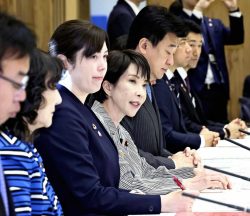
Yasukazu Hamada, chairman of the House of Representatives Rules and Administration Committee, center, meets a group of female lawmakers in the Diet Building in December.
12:44 JST, December 31, 2025
A bipartisan group of female members of the House of Representatives has requested the installation of additional restrooms for women within the lower house of the Diet Building.
Although a record 73 women were elected to the legislature in the 2024 general election, the number of women’s restrooms remains low compared to those for men, raising concerns that long wait times could interfere with their legislative duties.
When the Diet Building was completed in 1936, women did not yet have the right to vote. With the increasing number of women entering politics, more women’s restrooms have been added. The lower house wing currently has 12 for men, but only nine for women.
However, across those facilities, there are only 22 stalls for women compared to 67 stalls and urinals for men. Near the chamber of the lower house, there is only one women’s restroom, which has just two stalls.
In December, a group of 12 female lawmakers submitted a request to Yasukazu Hamada, chairman of the lower house Rules and Administration Committee, regarding the shortage of restrooms.
They noted that “congestion and waiting times have become a daily occurrence,” adding that this situation threatens to interfere with their legislative duties and the progress of house proceedings.
They called for additional restrooms to be installed near the chamber as early as possible in the next fiscal year.
Fifty-eight female lawmakers, including Prime Minister Sanae Takaichi, have voiced their support — a figure representing roughly 80% of all women in the lower house.
Yasuko Komiyama, a member of the Constitutional Democratic Party of Japan, one of the organizers, told reporters, “We sometimes have to give up on using the restroom and just hold it.”
Hamada reportedly responded that the committee would “discuss the matter positively.”






Most Read
Popular articles in the past 24 hours
-

Party Representatives’ Questions in Diet: Takaichi Says Consumpti...
-

Milano Cortina 2026: News in Pictures / Feats of Japanese Athlete...
-

Pokémon Celebrates 30 Years with Japanese Pro Baseball Collab
-

Microsoft Japan Raided by Antitrust Watchdog for Allegedly Blocki...
-
Japan Eyes Introducing Prescreening System for Foreign Travelers,...
-

Bernini, Barberini Celebrated as Vatican Marks 400 Years of St. P...
-

Nikkei Tops 59,000 for First Time
-

CARTOON OF THE DAY (February 26)
Popular articles in the past week
-

Producer Behind Pop Group XG Arrested for Cocaine Possession
-

iPS Treatments Pass Key Milestone, but Broader Applications Far f...
-

Tokyo Skytree's Elevator Stops, Trapping 20 People; All Rescued (...
-
Milano Cortina 2026: Japanese Gold Medalist Figure Skater Miura S...
-

Nepal Bus Crash Kills 19 People, Injures 25 Including One Japanes...
-

Japan’s Major Real Estate Firms Expanding Overseas Businesses to ...
-

Baby Monkey Punch Captures Hearts at Chiba Pref. Zoo, on Social M...
-

Milano Cortina 2026: Japanese Figure Skater Kaori Sakamoto’...
Popular articles in the past month
-
Producer Behind Pop Group XG Arrested for Cocaine Possession
-

Japan PM Takaichi’s Cabinet Resigns en Masse
-

Japan Institute to Use Domestic Commercial Optical Lattice Clock ...
-

Man Infected with Measles Reportedly Dined at Restaurant in Tokyo...
-

Israeli Ambassador to Japan Speaks about Japan’s Role in the Reco...
-

Videos Plagiarized, Reposted with False Subtitles Claiming ‘Ryuky...
-

Man Infected with Measles May Have Come in Contact with Many Peop...
-

Prudential Life Insurance Plans to Fully Compensate for Damages C...
Top Articles in Politics
-
Japan PM Takaichi’s Cabinet Resigns en Masse
-

Sanae Takaichi Elected Prime Minister of Japan; Keeps All Cabinet Appointees from Previous Term
-

Japan’s Govt to Submit Road Map for Growth Strategy in March, PM Takaichi to Announce in Upcoming Policy Speech
-

LDP Wins Historic Landslide Victory
-

LDP Wins Landslide Victory, Secures Single-party Majority; Ruling Coalition with JIP Poised to Secure Over 300 seats (UPDATE 1)
JN ACCESS RANKING
-
Producer Behind Pop Group XG Arrested for Cocaine Possession
-
Japan PM Takaichi’s Cabinet Resigns en Masse
-
Man Infected with Measles Reportedly Dined at Restaurant in Tokyo Station
-
Israeli Ambassador to Japan Speaks about Japan’s Role in the Reconstruction of Gaza
-
Videos Plagiarized, Reposted with False Subtitles Claiming ‘Ryukyu Belongs to China’; Anti-China False Information Also Posted in Japan