
Japanese Student Gamifies Tsunami Evacuation Drill with Nighttime Quake Scenario
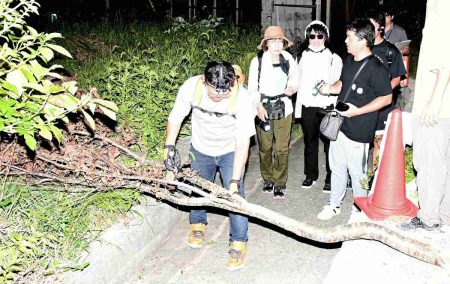
A participant in a game-style evacuation drill removes an obstacle while aiming for higher ground in Kainan, Wakayama Prefecture.
18:29 JST, December 29, 2025
Disasters strike without warning. Kindai University senior Tsuyoshi Kitahara, 21, has come up with a gamified evacuation drill using the scenario of an earthquake that occurs at night.
The first trial drill was held in the Shimizu district of Kainan, Wakayama Prefecture, where a Nankai Trough earthquake could trigger a tsunami reaching up to 8 meters. It is forecast that a 1-meter-high tsunami would hit the district in 48 minutes.
“You might feel 48 minutes is long enough to escape, but is that really the case?” Kitahara asked the 25 people who had gathered at a community center to participate in the drill. “I hope this game makes you always aware of evacuation.”
The participants included residents, high school students and prefectural staff.
This was the first trial run of Kitahara’s “cooperative night escape game.” Participants work in groups to see who can reach the evacuation site on higher ground first and who can find the most hazardous spots. It simulates escaping from a tsunami with a physically disabled individual, which means one member of each five-person group wore sunglasses and earplugs.
Participants removed obstacles simulating fallen roof tiles and trees that were placed along the course beforehand as they headed for higher ground.
They climbed steep slopes without streetlights. They shone flashlights on the ground, calling out, “Watch your step, there’s a gap here,” or “This path isn’t any good for evacuation.”
After reaching the goal, they shared feedback such as, “We want to interact more on a routine basis to be ready to give each other help in emergencies” and “We should install more streetlights.”
“I didn’t have gloves and had trouble removing obstacles,” said a 17-year-old Kainan Senior High School student who participated in the drill. “It was good to learn what’s necessary during an evacuation.”
Hailing from Higashinada Ward, Kobe, Kitahara grew up learning about disaster management in the city, which uses lessons from the Great Hanshin Earthquake in January 1995 for its disaster prevention education. The quake claimed 6,434 lives, including disaster-related deaths.
Kitahara studied architecture and urban development. In June, he began a live-in survey in Shimizu, which has many vacant houses, as part of his studies. He came up with the gamified drill at the request of a resident who wished to do an evacuation drill at night.
“I was impressed with the residents in Shimizu who interacted with each other, helping each other to do the drill,” Kitahara said. “I want to use the insights gained to revise the practical disaster mitigation manual.”


Related Tags

Most Read
Popular articles in the past 24 hours
-

Japan PM Takaichi’s Cabinet Resigns en Masse
-

Japan's Govt to Submit Road Map for Growth Strategy in March, PM ...
-

Bus Carrying 40 Passengers Catches Fire on Chuo Expressway; All E...
-

Riku-Ryu Pair Wins Gold Medal: Their Strong Bond Leads to Major C...
-

Survey Shows False Election Info Perceived as True
-

Japan’s Plan for Investment in U.S.: Aim for Mutual Development b...
-

Sanae Takaichi Elected Japan's 105th Prime Minister (UPDATE 1)
-

Milano Cortina 2026: Japan Sets Winter Olympics Medal Record at 1...
Popular articles in the past week
-
Japan PM Takaichi’s Cabinet Resigns en Masse
-

Man Infected with Measles Reportedly Dined at Restaurant in Tokyo...
-

Videos Plagiarized, Reposted with False Subtitles Claiming ‘Ryuky...
-
Japan's Govt to Submit Road Map for Growth Strategy in March, PM ...
-

Milano Cortina 2026: Figure Skaters Riku Miura, Ryuichi Kihara Pa...
-

Tokyo’s New Record-Breaking Fountain Named ‘Tokyo Aqua Symphony’
-

CRA Leadership Election Will Center on Party Rebuilding; Lower Ho...
-
Bus Carrying 40 Passengers Catches Fire on Chuo Expressway; All E...
Popular articles in the past month
-
Japan PM Takaichi’s Cabinet Resigns en Masse
-

Japan Institute to Use Domestic Commercial Optical Lattice Clock ...
-

Israeli Ambassador to Japan Speaks about Japan’s Role in the Reco...
-

Man Infected with Measles May Have Come in Contact with Many Peop...
-

China Eyes Rare Earth Foothold in Malaysia to Maintain Dominance,...
-

Prudential Life Insurance Plans to Fully Compensate for Damages C...
-
Man Infected with Measles Reportedly Dined at Restaurant in Tokyo...
-

Woman with Measles Visited Hospital in Tokyo Multiple Times Befor...
Top Articles in JN Specialities
-

Tokyo University of the Arts Now Offering Free Guided Tour of New Storage Building, Completed in 2024
-

Exhibition Shows Keene’s Interactions with Showa-Era Writers in Tokyo, Features Newspaper Columns, Related Materials
-

The Japan News / Weekly Edition (1/30-2/5)
-

Step Back in Time at Historical Estate Renovated into a Commercial Complex in Tokyo
-
Prevent Accidents When Removing Snow from Roofs; Always Use Proper Gear and Follow Safety Precautions
JN ACCESS RANKING
-
Japan PM Takaichi’s Cabinet Resigns en Masse
-
Japan Institute to Use Domestic Commercial Optical Lattice Clock to Set Japan Standard Time
-
Israeli Ambassador to Japan Speaks about Japan’s Role in the Reconstruction of Gaza
-
Man Infected with Measles May Have Come in Contact with Many People in Tokyo, Went to Store, Restaurant Around When Symptoms Emerged
-
Prudential Life Insurance Plans to Fully Compensate for Damages Caused by Fraudulent Actions Without Waiting for Third-Party Committee Review