
The 2025 Osaka-Kansai Expo’s visitor count of 25.57 million came in first among this year’s top 10 Japanese news stories. Japan’s surge in bear attacks and Sanae Takaichi becoming the nation’s first female prime minister also featured on the list, which was chosen by Yomiuri Shimbun readers in a poll conducted from Nov. 26 to Dec. 11. Out of 22,421 valid votes received, 32 responses perfectly predicted the results.
***
1. Osaka Expo attracts over 25 mil. visitors
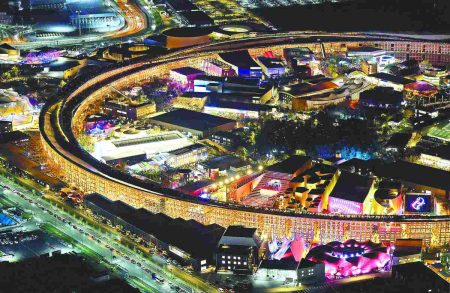
The venue of the 2025 Osaka-Kansai Expo is seen in Osaka on Oct. 13.
The 2025 Osaka-Kansai Expo opened on April 13 and saw 25.57 million visitors during its 184-day run through Oct. 13.
Japan and 158 countries and regions participated in the Expo on Yumeshima, an artificial island in Osaka, with the theme of “Designing Future Society for Our Lives.”
The Expo’s official mascot Myaku-Myaku and its iconic Grand Ring wooden structure gained immense popularity. Total profits from the Expo are expected to reach ¥28 billion.
The Expo was also a place where visitors could reflect on war and peace. Ukraine showed videos depicting life during wartime, and Ukrainian refugees who fled Russia’s aggression served as guides.
However, there were also operational challenges.
While operators aimed to have a line-free Expo by allowing visitors to make reservations, lines became the norm at popular pavilions.
In August, Osaka Metro suspended operations due to a power failure, stranding about 38,000 people, many of whom were forced to spend the night at the Expo site.
As the future of the Expo site is still undecided, the focus now shifts to how the area will be developed and how the Expo’s legacy will be continued.
2. Bear attacks surge to record high
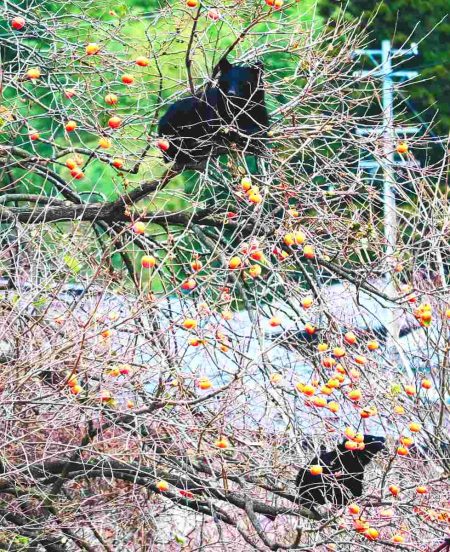
Two bears eat persimmons in a residential area in Iwaizumi, Iwate Prefecture.
There were 230 victims of bear attacks in Tokyo and 20 other prefectures from April to November, according to the Environment Ministry’s initial figure announced on Dec. 5.
The number exceeded the figure of 219 for all of fiscal 2023 in just eight months, setting a record high. Akita Prefecture had the highest number at 66.
Fatalities from bear attacks also increased from six in fiscal 2023 to 13.
The revised Wildlife Protection, Control, and Hunting Management Law came into effect in September, allowing “emergency hunting with guns,” in which hunters can use guns against bears in residential areas. On Oct. 15, the Sendai city government conducted its first emergency hunt for a bear that appeared near a residential area.
The Self-Defense Forces and police have also established countermeasures to deal with bears. The Ground Self-Defense Force and the Akita prefectural government agreed on Nov. 5 to work together to capture bears.
National Public Safety Commission regulations, which allow police officers to use rifles to cull bears, came into effect on Nov. 13.
On Nov. 28, the Environment Ministry earmarked a record ¥3.4 billion in the supplementary budget proposal for the current fiscal year to support countermeasures against bears.
3. Takaichi becomes Japan’s 1st female prime minister
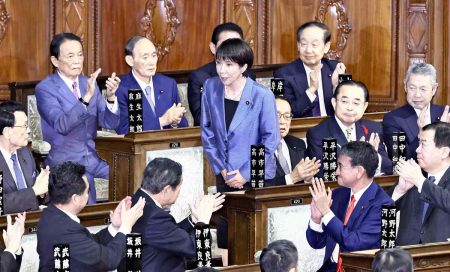
Liberal Democratic Party President Sanae Takaichi bows after being named prime minister in a plenary session of the House of Representatives on Oct. 21.
Sanae Takaichi became the first female prime minister of Japan.
After winning the Liberal Democratic Party presidential election on Oct. 4, she was named prime minister at an extraordinary Diet session on Oct. 21.
Takaichi, Yoshimasa Hayashi, Takayuki Kobayashi, Toshimitsu Motegi and Shinjiro Koizumi ran in the presidential election to succeed then Prime Minister Shigeru Ishiba, who announced in September that he would step down.
No candidate secured the majority in the first round, leading to a runoff vote between Takaichi and Koizumi.
Takaichi defeated Koizumi and became the 29th president of the LDP. On Oct. 21, she was named the 104th prime minister of Japan and the first female prime minister in the country’s constitutional history.
Prior to the extraordinary Diet session, Komeito announced its withdrawal from the coalition on Oct. 10, citing a disagreement with the LDP on strengthening regulations on political donations from corporations and organizations. The LDP-Komeito coalition, which had lasted 26 years, came to an end.
On Oct. 20, the Japan Innovation Party agreed to form a coalition with the LDP.
Since becoming prime minister, Takaichi has been actively engaging in meetings with leaders of other nations and compiling comprehensive economic measures.
4. Rising rice prices trigger release of govt-stockpiled rice
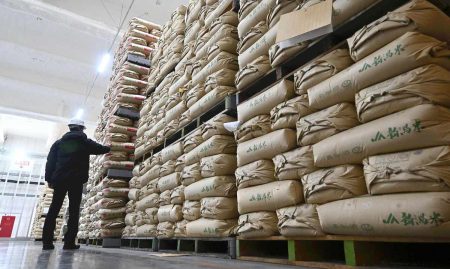
Government-stockpiled rice stacked high in a storage facility
The Agriculture, Forestry and Fisheries Ministry announced on Feb. 14 that it would release 210,000 tons of government-stockpiled rice to major rice distributors in response to rice prices continuously increasing since summer 2024.
However, the average price for a 5-kilogram bag of rice remained more than double compared to the previous year.
Then Agriculture, Forestry and Fisheries Minister Taku Eto said in May: “I have never bought rice myself. My supporters give me quite a lot of rice. I have so much rice that I could sell it.” Eto later resigned to take responsibility for the remark.
Shinjiro Koizumi, Eto’s successor, announced the goal of having government-stockpiled rice be sold at stores for about ¥2,000 per 5 kilograms. In July, the average price at supermarkets nationwide fell to about ¥3,500 per 5 kilograms for the first time in six months.
In August, then Prime Minister Shigeru Ishiba announced a policy shift, reviewing production adjustments that effectively cut rice production and introducing measures to increase production.
However, under Prime Minister Sanae Takaichi’s Cabinet, which was launched in October, newly appointed agriculture minister Norikazu Suzuki effectively reversed the policy of increasing rice production, touting “production based on demand.”
Rice prices stayed high, and in November, the average price at supermarkets nationwide increased to a record high of ¥4,335 per 5 kilograms.
5. Ohtani returns to mound; Yamamoto named World Series MVP

The Los Angeles Dodgers’ Shohei Ohtani hits a leadoff home run in Game 4 of the NL Championship Series.
The Los Angeles Dodgers defeated the Toronto Blue Jays in the World Series on Nov. 1, securing their second consecutive championship and their ninth overall.
The team includes three Japanese players: Shohei Ohtani, Yoshinobu Yamamoto and Roki Sasaki.
Yamamoto became the first Japanese pitcher to be named the World Series MVP.
Ohtani, after recovering from surgery on his right elbow, took the mound as a Dodger for the first time this year, reviving his role as a two-way player for the first time in two seasons. Ohtani was the starting pitcher for the first time in the postseason and helped the team win as a batter as well, including hitting three home runs in one game.
He was unanimously named the winner of the National League MVP award on Nov. 13.
Sasaki, who joined the majors this year, served as a relief pitcher in the postseason and helped the Dodgers win the World Series.
6. Baseball legend Shigeo Nagashima dies

Yomiuri Giants player Shigeo Nagashima hits a walk-off home run in a game attended by the then Emperor and Empress on June 25, 1959, at Korakuen Stadium in Tokyo.
Baseball legend Shigeo Nagashima died on the morning of June 3 due to pneumonia. He was 89.
Nagashima achieved numerous accomplishments as a player and manager for the Yomiuri Giants and was known as “Mr. Giants.”
The lifetime honorary manager of the Yomiuri Giants joined the team after graduating from Rikkyo University in 1958 and won the Rookie of the Year award. He went on to win numerous titles, including batting champion and RBI leader.
“My Giants are forever immortal,” Nagashima said at his retirement ceremony at Korakuen Stadium in Tokyo in 1974.
His No. 3 uniform number is now retired by the Giants.
After becoming manager of the Giants, he led them to five Central League championships and guided the team to Japan Series victories in 1994 and 2000. He retired as a manager in 2001.
A farewell ceremony for Nagashima was held at Tokyo Dome in Bunkyo Ward, Tokyo, on Nov. 21. Many people, including Sadaharu Oh, former teammate and chairman of the Fukuoka SoftBank Hawks, gathered to pay their respects to the legend.
7. Driver dies after truck falls into sinkhole in Yashio

A sinkhole that a truck fell into in Yashio, Saitama Prefecture
A truck fell into a sinkhole on a prefectural road in Yashio, Saitama Prefecture, on Jan. 28.
The 74-year-old man from Yachimata, Chiba Prefecture, who was driving the truck died.
The road collapse is believed to have been caused by damage to a sewer pipe that was put in place in 1983, which allowed soil to enter the pipe and create a void beneath the road. The sinkhole expanded to about 40 meters wide and 15 meters deep.
Following the accident, the Land, Infrastructure, Transport and Tourism Ministry announced interim results in September of its survey of large sewer pipes installed over 30 years ago. A total of 297 kilometers of pipes, about half of those surveyed, were determined to need repairs within five years.
8. Sakaguchi, Kitagawa win Nobel Prizes
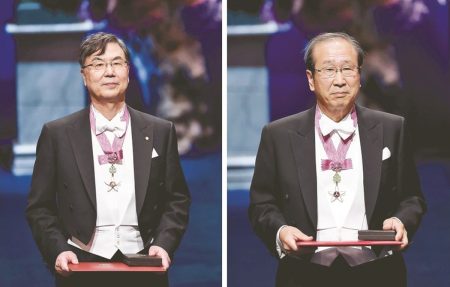
Shimon Sakaguchi, left, and Susumu Kitagawa
Shimon Sakaguchi, a specially appointed professor at the University of Osaka, was named as one of the winners of the Nobel Prize in Physiology or Medicine on Oct. 6. Sakaguchi discovered regulatory T cells, which suppress excessive immune responses.
Susumu Kitagawa, a distinguished professor at Kyoto University, was announced as one of the winners of the Nobel Prize in Chemistry on Oct. 8. Kitagawa developed metal-organic frameworks, a type of porous material that is capable of storing and separating gases.
The award ceremony was held in Stockholm on Dec. 10.
9. LDP-Komeito coalition loses majority in upper house
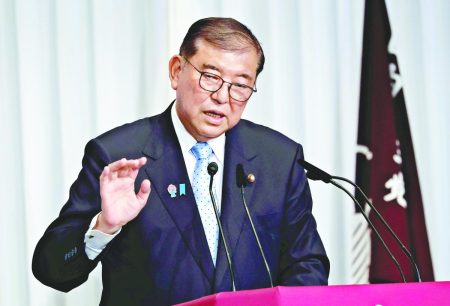
Then Prime Minister Shigeru Ishiba speaks at a press conference at Liberal Democratic Party headquarters.
The then ruling coalition between the Liberal Democratic Party and Komeito suffered a major defeat in the House of Councillors election on July 20, as the parties only secured 47 seats.
The LDP secured 39 seats while Komeito secured 8. They failed to reach the 50-seat target set by then Prime Minister Shigeru Ishiba and did not retain an upper house majority of at least 125 seats.
The defeat followed the huge loss in the 2024 House of Representatives election, marking the first time since its founding that the ruling LDP became a minority party in both houses of the Diet.
The opposition parties saw mixed results.
The Democratic Party for the People and Sanseito each gained 13 seats, securing 17 and 14 seats respectively. The Constitutional Democratic Party of Japan retained its 22 seats, while the Japan Innovation Party struggled to gain ground, increasing its seats from 5 to 7.
10. Japan experiences hottest summer on record
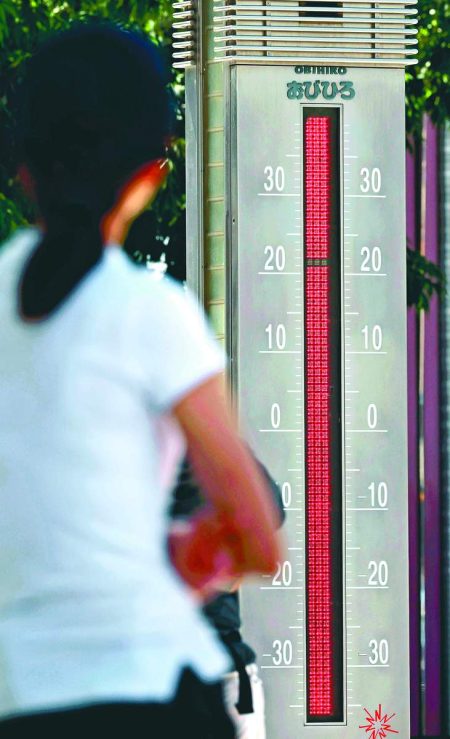
A thermometer in front of JR Obihiro Station reaches its maximum reading on July 24 in Obihiro, Hokkaido.
Japan’s average temperature from June to August was the highest since records began in 1898, the Japan Meteorological Agency said Sept. 1.
According to the agency, factors contributing to this summer’s intense heat included the strong expansion of the Pacific high-pressure system.
The city of Isesaki, Gunma Prefecture, logged a temperature of 41.8 C in August, setting a nationwide record.
More than 100,000 people nationwide were transported by ambulance for heatstroke between May and September. According to the Fire and Disaster Management Agency, it was the highest number since 2015, when it began compiling such statistics for this period.






Most Read
Popular articles in the past 24 hours
-
Japan's Defense Ministry: North Korea Appears to Have Fired Balli...
-

Milano Cortina 2026: Japan’s Oguri Wins Para Snowboard Silver at ...
-

National Intelligence Council: Proposed Body Must Be Utilized To ...
-
Aichi Fisheries Cooperatives Use Smart Tech to Farm Triploid Oyst...
-
Teachers Support Students’ Inquiry Learning behind the Scenes
-

CARTOON OF THE DAY (March 14)
-
Japan's Lower House Passes Budget Proposal; Could Be Delayed in U...
-
Fukuoka: American Beavers at Japan's Zoo Create Sculptures; Visit...
Popular articles in the past week
-

Japan Figure Skating Legend Yuzuru Hanyu Is Proud Disaster Surviv...
-
Govt to Utilize ODA for Ensuring Economic Security; Securing Ener...
-
15 Measles Patients Confirmed in Tokyo in Past 6 Days; 1 May Have...
-
Massive Sewer Pipe Found Jutting Out of Highway in Osaka
-

Japan Govt to Tighten Requirements to Receive Permanent Residency...
-
JR Tokai Breaks Ground on Yamanashi Maglev Station; Will Be Part ...
-
Power Outage Forces About 980 Passengers in Yokohama to Walk to T...
-

Beckoning Cats Get Makeover to Fit Modern Lifestyles with Sleek D...
Popular articles in the past month
-

Producer Behind Pop Group XG Arrested for Cocaine Possession
-

Japan PM Takaichi’s Cabinet Resigns en Masse
-

Man Infected with Measles Reportedly Dined at Restaurant in Tokyo...
-
Japan Figure Skating Legend Yuzuru Hanyu Is Proud Disaster Surviv...
-

iPS Treatments Pass Key Milestone, but Broader Applications Far f...
-

Sanae Takaichi Elected Prime Minister of Japan; Keeps All Cabinet...
-

Nepal Bus Crash Kills 19 People, Injures 25 Including One Japanes...
-

South Korea Tightens Rules on Foreigners Buying Homes in Seoul Me...
Top Articles in Society
-
Producer Behind Pop Group XG Arrested for Cocaine Possession
-
Man Infected with Measles Reportedly Dined at Restaurant in Tokyo Station
-
15 Measles Patients Confirmed in Tokyo in Past 6 Days; 1 May Have Come into Contact with Many in Shibuya
-

Bus Carrying 40 Passengers Catches Fire on Chuo Expressway; All Evacuate Safely
-

Ibaraki Pref.’s 1st Foreign Bus Driver Hired in Tsukuba
JN ACCESS RANKING
-
Producer Behind Pop Group XG Arrested for Cocaine Possession
-
Japan PM Takaichi’s Cabinet Resigns en Masse
-
Man Infected with Measles Reportedly Dined at Restaurant in Tokyo Station
-
Japan Figure Skating Legend Yuzuru Hanyu Is Proud Disaster Survivor and Gold Medalist, Vows to Continue Support Efforts
-
iPS Treatments Pass Key Milestone, but Broader Applications Far from Guaranteed