
Tokyo Economic Security Forum to Hold Inaugural Meeting Amid Tense Global Environment
9:00 JST, December 14, 2025
Energy resources, rare earths, food, semiconductors, advanced technology — how can Japan secure strategic materials essential to the development of the economy and protect supply chains?
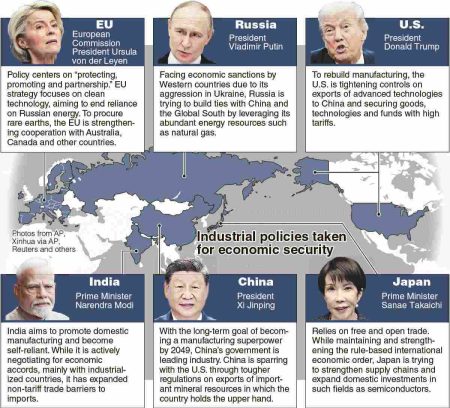
At the Tokyo Economic Security Forum, to be held at the Nikkei Hall in Chiyoda Ward, Tokyo, on Monday, and a series of related events, experts from around the world will share their knowledge and explore ways to cooperate. This comes against the backdrop of a faltering international order and a rapidly expanding risk to the very foundations of national economies.
The free trade system centered on the World Trade Organization, which was established in 1995, reduced or abolished tariffs and streamlined exchanges of goods and services. This system was a driving force for global economic growth.
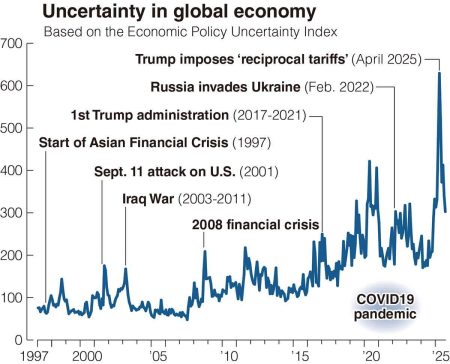
Despite this, the second Trump administration that came to power in the United States in January has adopted a clearly protectionist approach that prioritizes what it sees as in its own interests.
In April, the United States imposed “reciprocal tariffs” on a wide range of products from practically every nation and territory.
Russia’s aggression against Ukraine beginning in 2022 was a unilateral attempt to change the status quo through use of military force. This conflict disrupted supply chains for energy and other materials, and also become a factor behind higher inflation around the globe.
Some observers have suggested we are at “the end of the globalization era” because this exposed the fragility of logistics networks for materials such as semiconductors and energy supplies that are essential for industries to operate, and highlighted the risk of relying on certain nations for important minerals.
Public-private collaboration
Public-private collaboration is one tool for dealing with these issues. Depending only on private companies that pursue economic rationality to nurture strategically important industries is fraught with danger. Semiconductors are a classic case in point. According to the industry ministry, Japanese companies held more than 50% of the global chip market in 1988. By 2019, this market share had dived to 10%.
Semiconductors are so essential that they have been called “the rice of industry.” Relying on companies in other nations to develop and manufacture chips, which are needed for all sorts of high-tech products, flies in the face of “securing national interests.”
The government has decided to provide about ¥1.8 trillion in financial support to Rapidus Corp., which aims to mass-produce next-generation semiconductors in Japan, and is prepared to inject more than another ¥1 trillion by fiscal 2027. Major Japanese companies, such as Toyota Motor Corp., Sony Group Corp. and SoftBank Corp., have also invested in Rapidus.
The energy sector is the foundation for daily life and industry. Fossil fuels have been a staple since the beginning of the Industrial Revolution, but a shift away from them is underway in order to achieve decarbonization.
In February, the industry ministry formulated the “GX 2040 Vision,” a strategy for achieving a “green transformation” of industry. This vision supports corporate investment and aims to foster economic growth and the stable supply of energy sources, as well as decarbonization efforts, for which it also presents a middle- and long-term outlook.
The European Union also has announced the “Clean Industrial Deal,” which includes the creation of an EU critical raw material center to jointly purchase raw materials and the Critical Raw Materials Act, which is designed to reduce dependency on any single third nation for imports of such materials.
Diversifying suppliers
According to the U.S. Geological Survey, China produces about 70% of the world’s rare earths and holds almost 50% of known reserves. “Rare earths” is the umbrella term given to 17 elements, such as dysprosium, neodymium and other metals, that exist in small quantities and are difficult to extract. Rare earths are used in electric vehicles, wind turbine motors, nuclear reactors and more.
China imposed export restrictions on rare earths in response to Trump’s imposition of higher tariffs, forcing U.S. automaker Ford Motor Co. to temporarily halt production.
In 2010, China also restricted exports of rare earths to Japan after a collision between a Chinese fishing boat and a Japan Coast Guard vessel near the Senkaku Islands in Okinawa Prefecture.
Japan has been conducting research on alternative materials to rare earths and making efforts to diversify its suppliers of them.
There are mounting expectations that domestic production of rare earths could become a reality. An estimated 16 million tons of rare earths — one of the world’s largest reserves — has been discovered in deep-sea mud near Minami-Torishima Island in the remote Ogasawara island chain that is administratively part of Tokyo. Japan plans to start trial mining of these rare earths as early as January.
Ensuring economic security
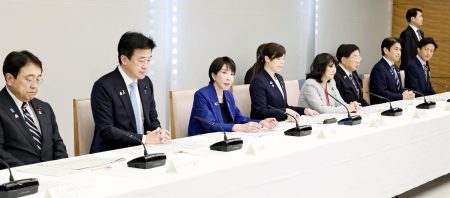
Prime Minister Sanae Takaichi, third from left, speaks during a meeting of the Council for the Promotion of Economic Security at the Prime Minister’s Office in Chiyoda Ward, Tokyo, on Nov. 7.
Bolstering “economic intelligence,” the collection and analysis of information on other nations’ technologies and developments, is essential for ensuring economic security.
The government plans to establish a new think tank for comprehensive research on economic security, which will analyze vulnerabilities in supply chains and craft risk scenarios. The think tank also will present them to the government.
The government is also considering revising the Economic Security Promotion Law, which was enacted in 2022.
“Japan is finding itself in the midst of the most severe and complex security environment since the end of World War II,” Prime Minister Sanae Takaichi said at a meeting of the Council for the Promotion of Economic Security held at the Prime Minister’s Office on Nov. 7. “Japan must promptly and vigorously respond to such changes and emerging challenges.”


Related Tags


Most Read
Most read in the last 24 hours
-

India's Arms Indigenization Quest for Self-Reliance / Desert Dril...
-

26-year-old U.S. National Falls While Climbing Mt. Fuji; Accompan...
-
Japan Passport Fees Going Down to ¥9,000 in July
-

Japanese Side Machida Zelvia Faces Ah-Ahli in Asian Champions Lea...
-

Transfer of Defense Equipment: Increase the Number of Like-minded...
-
Japan Eyes Trialing Dual-Use Tech Developed by Startups to Promot...
-

Charm of Meiji-Era Poet Takuboku Examined from Viewpoint of Donal...
-

Cherry Blossoms in Full Bloom in Hokkaido's Hakodate; Tourists Fl...
Most read in the last 7 days
-
Earthquake Hits Japan's Tohoku Region; 3-meter Tsunami Warning Is...
-

Trump Extends the Ceasefire with Iran but Keeps the Blockade
-
China, South Korea Object to Japanese PM Takaichi's Ritual Offeri...
-

India's Arms Indigenization Quest for Self-Reliance / New Delhi S...
-
Japan to Ban Use of Portable Chargers on Airplanes from April 24,...
-
¥1,000 Coins to Be Issued to Mark Anniversary of Beginning of Jap...
-

Most Serious Cyberattacks against the UK Now from Russia, Iran an...
-
New Challenges Await as Miura-Kihara Retires; Blade Maker, Ex-Coa...
Most read in the last 30 days
-
Earthquake Hits Japan's Tohoku Region; 3-meter Tsunami Warning Is...
-
Police Find Child's Shoe During Search for Missing Boy in Nantan,...
-
Body Found in Nantan, Kyoto Prefecture, During Search for 11-Year...
-
Cherry Blossoms, Rapeseed Flowers Perform Colorful ‘Duet’ in Niig...
-
Trump Extends the Ceasefire with Iran but Keeps the Blockade
-

Olympic Gold Medal-Winning Figure Skaters Riku-Ryu Announce Retir...
-
Nori Prices Surge in Japan Due to Poor Seaweed Production Amid Ri...
-
China, South Korea Object to Japanese PM Takaichi's Ritual Offeri...
Top Articles in Business
-
Foreign Tourists Set New Record in March; 30% Drop in Visitors from Middle East
-

Japan’s ANA to Introduce Fuel Surcharges to Domestic Flights from Fy27, Driven by Rising Fuel Costs, Declining Profits
-
Middle Powers Should Create Alternative to WTO, Says Research Group
-
Toyota Motor to Begin Full-Scale Hydrogen Production in May; Mass Production and Sales of Equipment Planned to Start in 2029
-
Airborne Cellular Stations to Be Tested in Ishikawa, Miyagi; Aim to Ensure Communication During Disasters
JN ACCESS RANKING
-
Earthquake Hits Japan’s Tohoku Region; 3-meter Tsunami Warning Issued (Update 1)
-
Police Find Child’s Shoe During Search for Missing Boy in Nantan, Kyoto Prefecture
-
Body Found in Nantan, Kyoto Prefecture, During Search for 11-Year-Old Boy in Area (Update 1)
-
Cherry Blossoms, Rapeseed Flowers Perform Colorful ‘Duet’ in Niigata
-
Trump Extends the Ceasefire with Iran but Keeps the Blockade
Most read in the last 24 hours
-
India's Arms Indigenization Quest for Self-Reliance / Desert Dril...
-
26-year-old U.S. National Falls While Climbing Mt. Fuji; Accompan...
-
Japan Passport Fees Going Down to ¥9,000 in July
-
Japanese Side Machida Zelvia Faces Ah-Ahli in Asian Champions Lea...
-
Transfer of Defense Equipment: Increase the Number of Like-minded...
Most read in the last 7 days
-
Earthquake Hits Japan's Tohoku Region; 3-meter Tsunami Warning Is...
-
Trump Extends the Ceasefire with Iran but Keeps the Blockade
-
China, South Korea Object to Japanese PM Takaichi's Ritual Offeri...
-
India's Arms Indigenization Quest for Self-Reliance / New Delhi S...
-
Japan to Ban Use of Portable Chargers on Airplanes from April 24,...
Most read in the last 30 days
-
Earthquake Hits Japan's Tohoku Region; 3-meter Tsunami Warning Is...
-
Police Find Child's Shoe During Search for Missing Boy in Nantan,...
-
Body Found in Nantan, Kyoto Prefecture, During Search for 11-Year...
-
Cherry Blossoms, Rapeseed Flowers Perform Colorful ‘Duet’ in Niig...
-
Trump Extends the Ceasefire with Iran but Keeps the Blockade