
Miyagi Prefecture Aims for Fishermen to Switch to Pearl Cultivation as Catch Volumes of Other Shellfish Drop
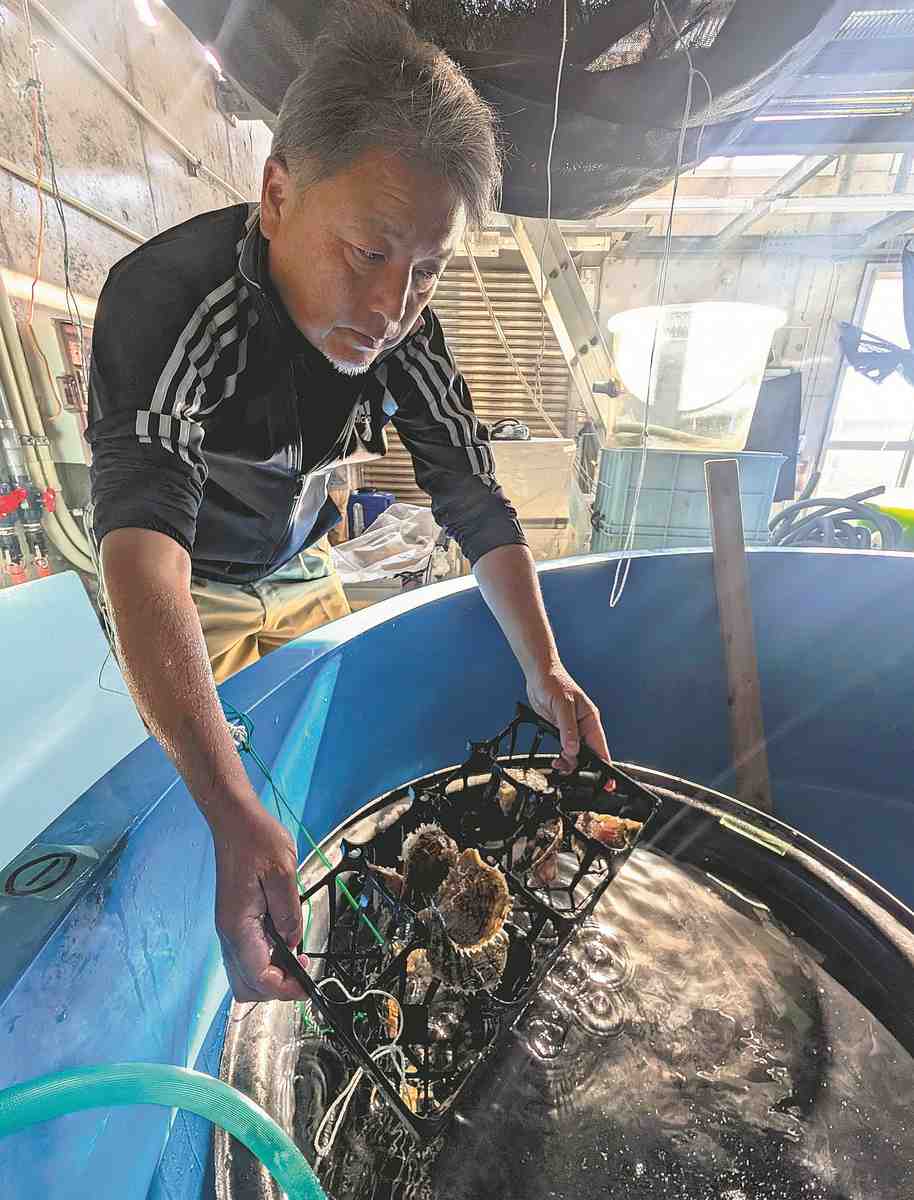
Atsushi Takekawa farms Akoya pearl oysters found in the sea off Miyagi Prefecture in Ishinomaki, Miyagi Prefecture, on Oct. 30.
13:44 JST, December 5, 2025
SENDAI — Akoya pearl oysters have been found off the coasts of Miyagi and Iwate prefectures since last year. While the northern limit of their habitat on the Pacific side was previously considered to be off the Boso Peninsula in Chiba Prefecture, rising sea temperatures may be influencing the shift.
Miyagi Prefecture started surveying the population of pearl oysters in November and is actively pursuing pearl cultivation research with the aim of creating a new income source for fishermen.
Akoya oysters were found in the sea off Miyagi Prefecture for the first time in October last year. Local fishermen found them attached to farmed oysters off the coast of Ishinomaki. After the prefectural government requested information, about 200 specimens were brought to the prefecture’s Fisheries Technology Institute from Kesennuma and Minami-Sanriku, among other locations.
According to the prefectural government, Akoya oysters mainly feed on phytoplankton and take about two years to mature, after which they can form pads. Officials of the prefectural government said that when the sea water temperature reaches around 10 C, the environment becomes unsuitable for the growth of the pearl oysters.
According to Shusaku Sugimoto, an associate professor at Tohoku University who studies climate change, due to the effects of the Kuroshio Extension, a branched flow from the Kuroshio warm current, annual average sea temperatures since 2023 have been 6 C above previous averages off Fukushima, Miyagi and Iwate prefectures. He believes Akoya oyster larvae drifted to the sea off Miyagi Prefecture, survived the winter and grew.
Young pearl oysters were also found off Ofunato, Iwate Prefecture, in December last year.
Miyagi Prefecture is focusing on researching the pearl oysters because there have been poor catches of oysters, scallops and other marine products in recent years. The prefecture’s sea squirt catch, the highest in the nation, has continued to decline, and in fiscal 2024 fell more than 60% from the previous year, while scallops also decreased by more than 40%.
Rising sea temperatures are seen as a contributing factor, and this trend is likely to continue.
Takuya Nitta, who cultivates oysters in Ishinomaki, said his catch volume of the shellfish in fiscal 2024 fell to about one-third of an average year. He said, “It’s nature we’re dealing with, but I’m really frustrated.” Because such poor catches have continued, he said, “I can have a dream in pearl farming.”
Giving fisherman more options
According to the Agriculture, Forestry and Fisheries Ministry’s statistics, Nagasaki, Ehime and Mie prefectures account for about 90% of production volume of cultured pearls in Japan. Production has fallen from about 125 tons at the peak in 1967 to 12.8 tons in a preliminary 2024 report due to a shortage of workers and other factors. Prices of cultured pearls, however, have been on the rise due to increasing demand from China and other countries.
However, establishing technologies for farming pearl oysters is not an easy task.
In February this year, the Miyagi Prefecture Fisheries Technology Institute conducted an experiment where it returned 49 pearl oysters to the sea to grow, but all died within about two months. It is assumed that they died because water temperatures in early spring temporarily dropped close to the seasonal average of 6 C to 7 C.
To harvest high-quality pearls, it is necessary to move aquaculture rafts for the farming in accordance with the changes in the season and sea water temperature. Mastering the technique of inserting the nucleus, around which the pearl is formed, into the shell is also essential. Atsushi Takekawa, chief researcher of the institute, said, “Though it is a long-term and difficult challenge, we want to provide fishermen with new options.”
Takeshi Takeuchi, senior researcher at the Mikimoto branch of the Japan Pearl Promotion Society in Shima, Mie Prefecture, offered encouragement. “This research is valuable not only for increasing interest in the pearl industry but also for understanding changes in the ocean.”


Related Tags


Most Read
Most read in the last 24 hours
-

India's Arms Indigenization Quest for Self-Reliance / Desert Dril...
-
26-year-old U.S. National Falls While Climbing Mt. Fuji; Accompan...
-
Japan Passport Fees Going Down to ¥9,000 in July
-

Japanese Side Machida Zelvia Faces Ah-Ahli in Asian Champions Lea...
-

Transfer of Defense Equipment: Increase the Number of Like-minded...
-

Japan Eyes Trialing Dual-Use Tech Developed by Startups to Promot...
-

Charm of Meiji-Era Poet Takuboku Examined from Viewpoint of Donal...
-

Cherry Blossoms in Full Bloom in Hokkaido's Hakodate; Tourists Fl...
Most read in the last 7 days
-
Earthquake Hits Japan's Tohoku Region; 3-meter Tsunami Warning Is...
-

Trump Extends the Ceasefire with Iran but Keeps the Blockade
-

China, South Korea Object to Japanese PM Takaichi's Ritual Offeri...
-

India's Arms Indigenization Quest for Self-Reliance / New Delhi S...
-

Japan to Ban Use of Portable Chargers on Airplanes from April 24,...
-

¥1,000 Coins to Be Issued to Mark Anniversary of Beginning of Jap...
-

Most Serious Cyberattacks against the UK Now from Russia, Iran an...
-

New Challenges Await as Miura-Kihara Retires; Blade Maker, Ex-Coa...
Most read in the last 30 days
-
Earthquake Hits Japan's Tohoku Region; 3-meter Tsunami Warning Is...
-
Police Find Child's Shoe During Search for Missing Boy in Nantan,...
-

Body Found in Nantan, Kyoto Prefecture, During Search for 11-Year...
-
Cherry Blossoms, Rapeseed Flowers Perform Colorful ‘Duet’ in Niig...
-
Trump Extends the Ceasefire with Iran but Keeps the Blockade
-

Olympic Gold Medal-Winning Figure Skaters Riku-Ryu Announce Retir...
-
Nori Prices Surge in Japan Due to Poor Seaweed Production Amid Ri...
-
China, South Korea Object to Japanese PM Takaichi's Ritual Offeri...
Top Articles in Society
-
Earthquake Hits Japan’s Tohoku Region; 3-meter Tsunami Warning Issued (Update 1)
-
Police Find Child’s Shoe During Search for Missing Boy in Nantan, Kyoto Prefecture
-
Body Found in Nantan, Kyoto Prefecture, During Search for 11-Year-Old Boy in Area (Update 1)
-
Cherry Blossoms, Rapeseed Flowers Perform Colorful ‘Duet’ in Niigata
-

Two Women in Osaka Found Lying on Floor Bleeding, Later Pronounced Dead
JN ACCESS RANKING
-
Earthquake Hits Japan’s Tohoku Region; 3-meter Tsunami Warning Issued (Update 1)
-
Police Find Child’s Shoe During Search for Missing Boy in Nantan, Kyoto Prefecture
-
Body Found in Nantan, Kyoto Prefecture, During Search for 11-Year-Old Boy in Area (Update 1)
-
Cherry Blossoms, Rapeseed Flowers Perform Colorful ‘Duet’ in Niigata
-
Trump Extends the Ceasefire with Iran but Keeps the Blockade
Most read in the last 24 hours
-
India's Arms Indigenization Quest for Self-Reliance / Desert Dril...
-
26-year-old U.S. National Falls While Climbing Mt. Fuji; Accompan...
-
Japan Passport Fees Going Down to ¥9,000 in July
-
Japanese Side Machida Zelvia Faces Ah-Ahli in Asian Champions Lea...
-
Transfer of Defense Equipment: Increase the Number of Like-minded...
Most read in the last 7 days
-
Earthquake Hits Japan's Tohoku Region; 3-meter Tsunami Warning Is...
-
Trump Extends the Ceasefire with Iran but Keeps the Blockade
-
China, South Korea Object to Japanese PM Takaichi's Ritual Offeri...
-
India's Arms Indigenization Quest for Self-Reliance / New Delhi S...
-
Japan to Ban Use of Portable Chargers on Airplanes from April 24,...
Most read in the last 30 days
-
Earthquake Hits Japan's Tohoku Region; 3-meter Tsunami Warning Is...
-
Police Find Child's Shoe During Search for Missing Boy in Nantan,...
-
Body Found in Nantan, Kyoto Prefecture, During Search for 11-Year...
-
Cherry Blossoms, Rapeseed Flowers Perform Colorful ‘Duet’ in Niig...
-
Trump Extends the Ceasefire with Iran but Keeps the Blockade