
Japan Prime Minister Seeks Party Unity in New Cabinet; LDP Campaign Rivals Named to Key Posts
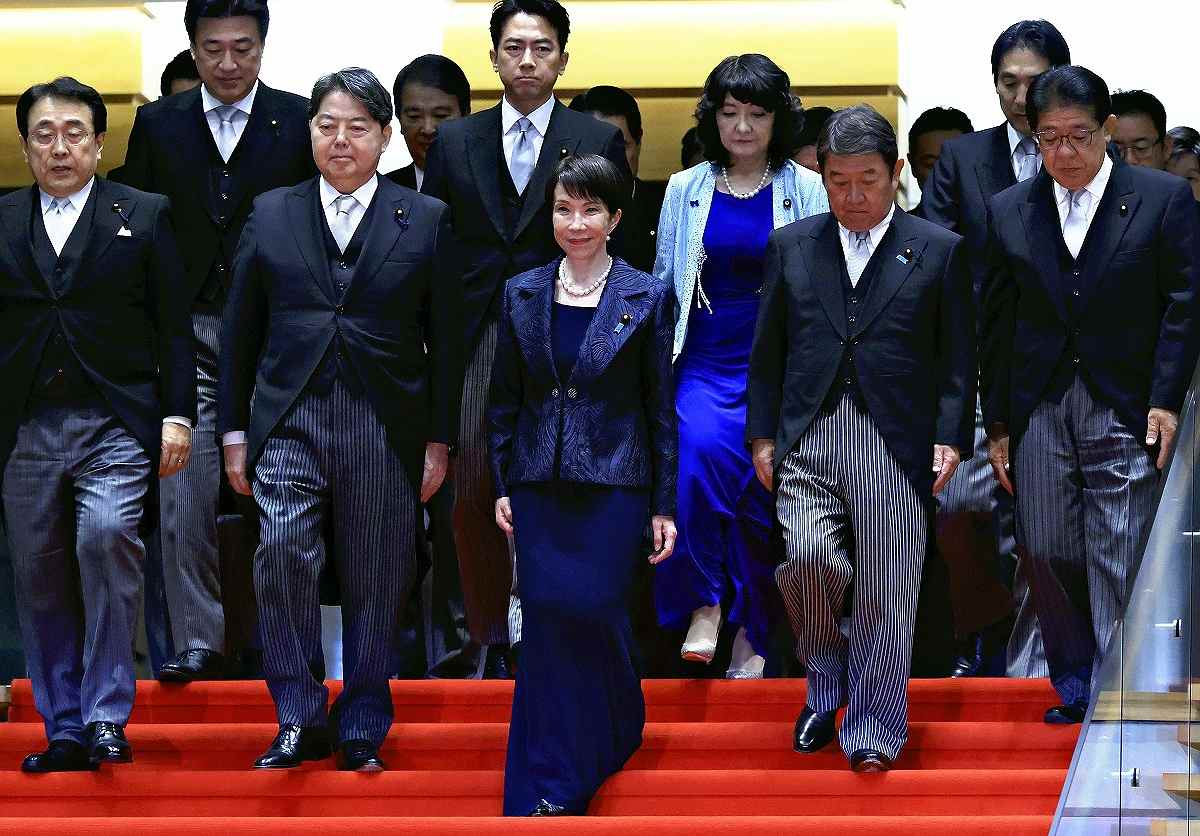
Prime Minister Sanae Takaichi, center, and members of her Cabinet prepare for a photo at the Prime Minister’s Office in Tokyo on Tuesday.
16:28 JST, October 22, 2025
Prime Minister Sanae Takaichi has demonstrated a “united party front” by appointing her rivals in the Liberal Democratic Party’s presidential election to key posts in her new Cabinet and balancing appointments among current and defunct factions.
Announced Tuesday, the Cabinet lineup also shows a leaning toward conservatives. Takaichi aims to solidify her party base before tackling the extraordinary Diet session.
“Japan is facing a major crisis. Starting today, I expect ministers to fulfill their duties at full speed and in top gear,” Takaichi said at a press conference on Tuesday night.
She summoned LDP lawmakers to the Prime Minister’s Office on Tuesday evening to appoint them to their ministry posts. During those meetings, she instructed newly appointed Defense Minister Shinjiro Koizumi to “further accelerate” policy implementation.
Takaichi made a quick decision to include her election rivals in the new Cabinet, including Koizumi, Yoshimasa Hayashi and Toshimitsu Motegi.
Koizumi was her strongest opponent in the presidential race run-off, making his appointment as a key minister essential for building party unity. “Koizumi’s side must think that he’s gotten a good role,” a person close to Takaichi said, acknowledging that he had been shown full consideration.
Regarding Hayashi, a senior LDP official close to the prime minister said, “She gave him the post of internal affairs and communications minister so he could travel nationwide,” believing that would help Hayashi become LDP president in the future.
The average age of the new Cabinet members, including Takaichi, is 59.4 years old, about four years younger than the 63.6 years at the start of the Cabinet of former Prime Minister Shigeru Ishiba in 2024.
This rejuvenation comes from the appointment of three ministers in their 40s, including Koizumi, to create a sense of freshness. A Diet member close to Takaichi said, “This time, it’s a personnel arrangement that encompasses all generations and is balanced.”
Takaichi also strove for balance among the LDP faction led by LDP Vice President Taro Aso and the five other now-defunct factions, picking at least one member from each group.
Consideration was likewise shown for Ishiba — Ryosei Akazawa, who served as economic revitalization minister under Ishiba and represented Japan in tariff negotiations with the United States, was named economy, trade and industry minister. By keeping Akazawa involved in trade policy, Takaichi also tried to demonstrate continuity in the administration.
When forming the LDP executive lineup on Oct. 7, Takaichi drew largely from the Aso faction and the now-defunct faction led by Motegi, which supported Takaichi in the runoff vote for the LDP presidential election, causing simmering discontent within the party.
To deflect such criticism, the prime minister personally chose the Cabinet lineup with meticulous care.
With the outcome of the prime ministerial election uncertain, Takaichi kept her Cabinet plans a tight secret. A leak ahead of time would have risked displeasing the Japan Innovation Party, which had agreed to form a coalition government.
On Monday night, when some ministerial candidates were notified in advance, Takaichi explicitly warned them not to disclose the information. The prime minister did not reveal the full details of the appointments even to lawmakers who are close to her, and some potential ministers still did not know their posts early on Tuesday.
The Cabinet appointments also rewarded people who supported Takaichi in the party presidential election. The job of finance minister went to Satsuki Katayama, one of the people who provided the endorsements required for her to run.
The prime minister also named Hitoshi Kikawada, who played a leading role in her campaign, as minister in charge of measures against the declining birth rate, Kikawada’s first-ever cabinet appointment.
With the launch of a new coalition government with the JIP, the role of liaison between the government and the ruling parties becomes more crucial than ever.
To handle this matter, Takaichi appointed close associates in the Diet to posts including chief cabinet secretary and two of the three deputy chief cabinet secretaries — one from the House of Representatives and the other from the House of Councillors. Another such person was made a special advisor to the prime minister.
This creates a framework in which Takaichi can have someone to consult with at any time.
For the time being, Takaichi will likely run the administration by gauging reactions both within and outside the LDP through these trusted confidants. A veteran LDP member said, “The key will be whether she can make a good start in handling Diet affairs in the current extraordinary Diet session, while maintaining the sense of freshness in the new Cabinet.”







Most Read
Popular articles in the past 24 hours
-
TEPCO to Reactivate Nuclear Reactor at Kashiwazaki-Kariwa Power P...
-

Tae Hitoto Leads Japanese Cyclists Planning Trip Around Taiwan to...
-

Travel Across PokéPark KANTO, Searching Far and Wide for Your Fav...
-
Japan’s Govt Sets Goal for World’s No. 3 in Number of Highly Cite...
-

Israeli Ambassador to Japan Speaks about Japan’s Role in the Reco...
-
Japan's Ginkakuji Temple to Increase Admission Fees for 1st Time ...
-
Australian Woman Died of Asphyxiation in Nagano Ski Lift Accident...
-
TMSC to Produce 3-Nanometer Semiconductors in Japan's Kumamoto Pr...
Popular articles in the past week
-

Man Infected with Measles May Have Come in Contact with Many Peop...
-
Australian Woman Dies After Mishap on Ski Lift in Nagano Prefectu...
-
Foreign Snowboarder in Serious Condition After Hanging in Midair ...
-

Chinese Embassy in Japan Reiterates Call for Chinese People to Re...
-
Narita Airport, Startup in Japan Demonstrate Machine to Compress ...
-
Toyota Motor Group Firm to Sell Clean Energy Greenhouses for Stra...
-
Beer Yeast Helps Save Labor, Water Use in Growing Rice; Govt Hope...
-
Japan Tourism Agency Calls for Strengthening Measures Against Ove...
Popular articles in the past month
-

Univ. in Japan, Tokyo-Based Startup to Develop Satellite for Disa...
-

JAL, ANA Cancel Flights During 3-day Holiday Weekend due to Blizz...
-

Japan Institute to Use Domestic Commercial Optical Lattice Clock ...
-

China Eyes Rare Earth Foothold in Malaysia to Maintain Dominance,...
-
China Confirmed to Be Operating Drilling Vessel Near Japan-China ...
-
Japan, Qatar Ministers Agree on Need for Stable Energy Supplies; ...
-
Man Infected with Measles May Have Come in Contact with Many Peop...
-
Australian Woman Dies After Mishap on Ski Lift in Nagano Prefectu...
Top Articles in Politics
-
Japan Tourism Agency Calls for Strengthening Measures Against Overtourism
-
Japan Seeks to Enhance Defense Capabilities in Pacific as 3 National Security Documents to Be Revised
-
Japan’s Prime Minister: 2-Year Tax Cut on Food Possible Without Issuing Bonds
-
Japan-South Korea Leaders Meeting Focuses on Rare Earth Supply Chains, Cooperation Toward Regional Stability
-

Voters Using AI to Choose Candidates in Japan’s Upcoming General Election; ChatGPT, Other AI Services Found Providing Incorrect Information
JN ACCESS RANKING
-
Univ. in Japan, Tokyo-Based Startup to Develop Satellite for Disaster Prevention Measures, Bears
-
JAL, ANA Cancel Flights During 3-day Holiday Weekend due to Blizzard
-
Japan Institute to Use Domestic Commercial Optical Lattice Clock to Set Japan Standard Time
-
China Eyes Rare Earth Foothold in Malaysia to Maintain Dominance, Counter Japan, U.S.
-
Japan, Qatar Ministers Agree on Need for Stable Energy Supplies; Motegi, Qatari Prime Minister Al-Thani Affirm Commitment to Cooperation