
Toyota’s Woven City Sets Stage for Advanced Technology Experiments, Aims for Advancements in Multiple Directions
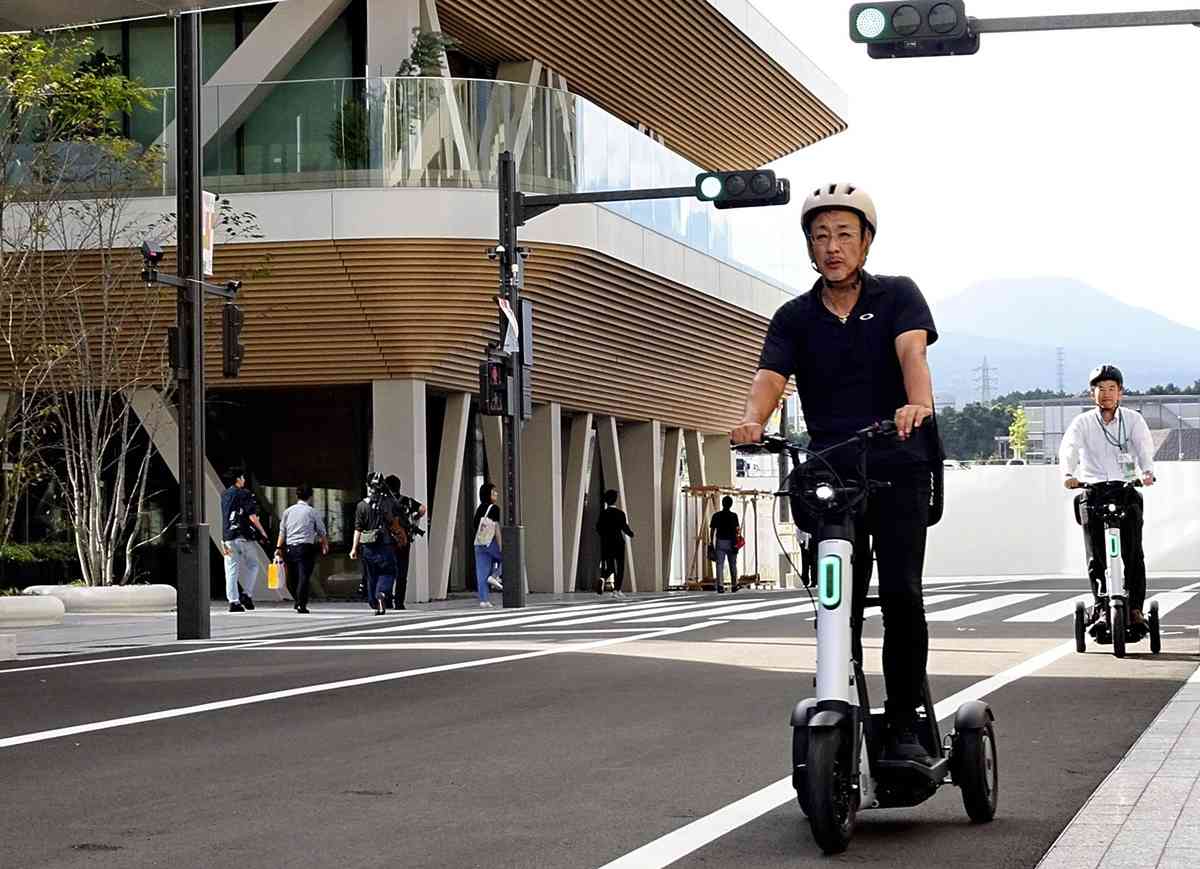
People riding three-wheeled electric vehicles drive along a road in Woven City in Susono, Shizuoka Prefecture, on Thursday.
1:00 JST, September 28, 2025
Toyota Motor Corp. on Thursday officially launched Woven City, a cutting-edge demonstration site where participants including companies from a range of industries will work together to develop new products and services.
The site in Susono, Shizuoka Prefecture, will host experiments on auto-related technologies such as autonomous driving and other diverse themes including food, educational methods and air conditioning.
“What we will spark here at Woven City is kakezan [multiplication],” Toyota Motor Chairman Akio Toyoda said at an event held Thursday to mark the opening. Toyoda emphasized that the vision behind the site was that multiple companies working together would bolster their development capabilities and enable them to contribute to society.
Toyota is among the 20 companies and individual “inventors” participating in the project. Major air conditioner manufacturer Daikin Industries, Ltd. will conduct experiments to create “pollen-free spaces,” and coffee product maker UCC Japan Co. will use cameras to analyze the movements of cafe users to investigate the effect of coffee on people’s creativity and productivity. Toyota has high hopes that harnessing the technologies and knowledge of each participating company will help lead to the development of new products and services.
Toyota reportedly chose the site’s name to reflect the automaker’s aspirations for weaving together the participants’ various abilities and viewpoints.
“This could become a nexus between the auto industry and companies in totally unrelated fields,” said Takaki Nakanishi, an analyst and chief executive officer at Nakanishi Research Institute, Co.
Preventing traffic accidents
A demonstration site is a place where companies can test yet-to-be-released products and services with the cooperation of residents. Toyota began laying the groundwork for Woven City, an unusual project for an automaker, in 2020.
Masahiro Fukuda of the research company Fourin, Inc. said, “This initiative reflects Toyota’s financial might and resolve.”
Considerable attention will be paid to the development of autonomous driving technologies. Toyota has a goal of eliminating casualties from traffic collisions and has worked closely with other companies to develop technologies toward such a goal. Toyota aims to launch vehicles equipped with Level 4 automated driving systems, in which the vehicle is autonomous under certain conditions, to the market in fiscal 2027.
Unlike heavily regulated public roads, the roads in Woven City can be equipped with advanced sensors and communication equipment and allow greater freedom to conduct experiments. Toyota has installed traffic signals that respond to the flow of people and traffic volume, and it will work to develop technologies that, in coordination with relevant infrastructure, could prevent traffic accidents.
Automated delivery robots
A broad range of experiments unrelated to automated driving also look set to move forward.
Woven City has three kinds of ground-level roads — one exclusively for pedestrians, one shared by pedestrians and personal mobility vehicles and a dedicated one for vehicles. The roads will be used for experiments involving three-wheeled electric vehicles for single riders. A fourth road network built underground will be the location for experiments involving autonomous delivery robots that carry items and deliver them to homes by elevator.
“There’s no point in making this site a closed space,” said Daisuke Toyoda, senior vice president of Woven by Toyota, Inc., the Toyota subsidiary that operates Woven City. “We’d like to create some new business opportunities.”



Most Read
Popular articles in the past 24 hours
-

Japan's Snow-Clad Beauty: Camellia Flowers Seen in Winter Bloom a...
-
Monkey Strikes Junior High School Girl from Behind in Japan's Yam...
-

Foreign and Security Policy: Political Parties Must Discuss How T...
-
Genichiro Inokuma's Mural in Ueno Station That Gave Hope in Postw...
-

Senior Japanese Citizens Return to University to Gain Knowledge, ...
-
Heavy Snow Linked to 30 Deaths across Japan since Late Jan.; JMA ...
-
Tokyo Police Arrest Head of Resignation Assistance Firm
-
Japan’s Nikkei Stock Average Jumps near 4%, Closes at Record High...
Popular articles in the past week
-

Japan Institute to Use Domestic Commercial Optical Lattice Clock ...
-
Australian Woman Dies After Mishap on Ski Lift in Nagano Prefectu...
-
Foreign Snowboarder in Serious Condition After Hanging in Midair ...
-
Chinese Embassy in Japan Reiterates Call for Chinese People to Re...
-
Narita Airport, Startup in Japan Demonstrate Machine to Compress ...
-
Toyota Motor Group Firm to Sell Clean Energy Greenhouses for Stra...
-

Sakie Yokota, Last Surviving Parent of a North Korea Abductee, Ur...
-
Beer Yeast Helps Save Labor, Water Use in Growing Rice; Govt Hope...
Popular articles in the past month
-
Univ. in Japan, Tokyo-Based Startup to Develop Satellite for Disa...
-
JAL, ANA Cancel Flights During 3-day Holiday Weekend due to Blizz...
-
China Confirmed to Be Operating Drilling Vessel Near Japan-China ...
-
China Eyes Rare Earth Foothold in Malaysia to Maintain Dominance,...
-
Japan Institute to Use Domestic Commercial Optical Lattice Clock ...
-
M6.2 Earthquake Hits Japan's Tottori, Shimane Prefectures; No Tsu...
-
Japan, Qatar Ministers Agree on Need for Stable Energy Supplies; ...
-

Japan, Italy to Boost LNG Cooperation; Aimed at Diversifying Japa...
Top Articles in Business
-
Japan, Italy to Boost LNG Cooperation; Aimed at Diversifying Japan’s LNG Sources
-
Honda to Launch New Electric Motorbike in Vietnam
-

Asics Opens Factory for Onitsuka Tiger Brand in Western Japan
-
Japan’s ANA to Introduce Nationwide Logistics Service Using Drones, Will Be Used to Deliver Supplies in Remote Areas
-
JR Tokai, Shizuoka Pref. Agree on Water Resources for Maglev Train Construction
JN ACCESS RANKING
-
Univ. in Japan, Tokyo-Based Startup to Develop Satellite for Disaster Prevention Measures, Bears
-
JAL, ANA Cancel Flights During 3-day Holiday Weekend due to Blizzard
-
China Confirmed to Be Operating Drilling Vessel Near Japan-China Median Line
-
China Eyes Rare Earth Foothold in Malaysia to Maintain Dominance, Counter Japan, U.S.
-
Japan Institute to Use Domestic Commercial Optical Lattice Clock to Set Japan Standard Time