
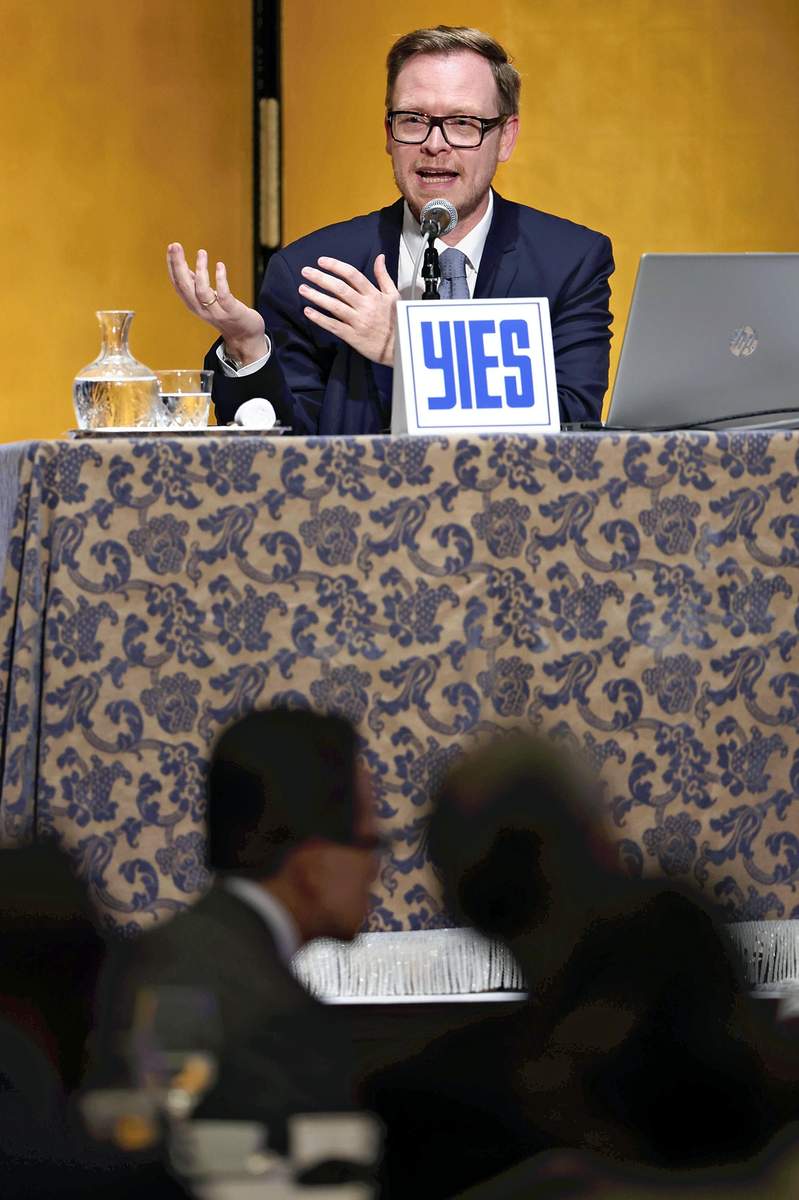
Markus Gabriel speaks at a lecture in Tokyo on Friday.
6:00 JST, September 27, 2025
Markus Gabriel, a renowned philosopher, emphasized the necessity of “ethical capitalism” to counter “authoritarian capitalism” at a lecture held in Tokyo on Friday.
At the lecture organized by the Yomiuri International Economic Society, Gabriel, a professor at the University of Bonn in Germany, said, “Authoritarian capitalism is coming, but it’s not there yet.”
Gabriel added there are two forms of authoritarian capitalism: demagogic and bureaucratic. The first kind poses an internal threat to liberal democracies if they come under the influence of a demagogic figure. Some have said China adopts bureaucratic authoritarian capitalism, though Gabriel himself disagrees, as he does not believe the country is capitalist.
Gabriel also discussed neo-illiberalism, characterizing it with three features: labor suppression, ethno-nationalism and clientelism. Under neo-illiberalism, labor rights would be suppressed or destroyed, he said. He also stressed that “we need good political science to really study” regimes that are not liberal democracies.
The world faces “nested crises,” where several crises “hang together in a spiral … [and] form a typhoon,” according to Gabriel. “If you start from AI … everything will look like an AI problem for you.”
Another topic Gabriel spoke about was the “invisible hand,” which is a metaphor introduced by 18th century economist and philosopher Adam Smith. According to the metaphor, the accumulation of people pursuing their own self-interest may unintentionally bring about beneficial social and economic outcomes.
“I think that what Adam Smith called the ‘invisible hand’ is not a mathematical law of markets. That was just a mistake,” Gabriel said. He instead described the invisible hand as an example of “sympathy” and ethical capitalism.
Gabriel has been advocating ethical capitalism, in which ethics is an essential part of economic activities. At the lecture, he highlighted the importance of the idea by presenting an example of whether to prioritize renewable energy or fossil fuel. He said that it is important to “lead not just in markets but in values.”




Most Read
Popular articles in the past 24 hours
-

Japan's Snow-Clad Beauty: Camellia Flowers Seen in Winter Bloom a...
-
Monkey Strikes Junior High School Girl from Behind in Japan's Yam...
-

Foreign and Security Policy: Political Parties Must Discuss How T...
-
Senior Japanese Citizens Return to University to Gain Knowledge, ...
-
Genichiro Inokuma's Mural in Ueno Station That Gave Hope in Postw...
-
Heavy Snow Linked to 30 Deaths across Japan since Late Jan.; JMA ...
-
Tokyo Police Arrest Head of Resignation Assistance Firm
-

Japan’s Nikkei Stock Average Jumps near 4%, Closes at Record High...
Popular articles in the past week
-

Japan Institute to Use Domestic Commercial Optical Lattice Clock ...
-

Australian Woman Dies After Mishap on Ski Lift in Nagano Prefectu...
-
Foreign Snowboarder in Serious Condition After Hanging in Midair ...
-
Chinese Embassy in Japan Reiterates Call for Chinese People to Re...
-
Narita Airport, Startup in Japan Demonstrate Machine to Compress ...
-

Toyota Motor Group Firm to Sell Clean Energy Greenhouses for Stra...
-

Sakie Yokota, Last Surviving Parent of a North Korea Abductee, Ur...
-

Beer Yeast Helps Save Labor, Water Use in Growing Rice; Govt Hope...
Popular articles in the past month
-
Univ. in Japan, Tokyo-Based Startup to Develop Satellite for Disa...
-
JAL, ANA Cancel Flights During 3-day Holiday Weekend due to Blizz...
-
China Confirmed to Be Operating Drilling Vessel Near Japan-China ...
-
China Eyes Rare Earth Foothold in Malaysia to Maintain Dominance,...
-
Japan Institute to Use Domestic Commercial Optical Lattice Clock ...
-
M6.2 Earthquake Hits Japan's Tottori, Shimane Prefectures; No Tsu...
-
Japan, Qatar Ministers Agree on Need for Stable Energy Supplies; ...
-
Japan, Italy to Boost LNG Cooperation; Aimed at Diversifying Japa...
Top Articles in Business
-
Japan, Italy to Boost LNG Cooperation; Aimed at Diversifying Japan’s LNG Sources
-
Honda to Launch New Electric Motorbike in Vietnam
-

Asics Opens Factory for Onitsuka Tiger Brand in Western Japan
-
Japan’s ANA to Introduce Nationwide Logistics Service Using Drones, Will Be Used to Deliver Supplies in Remote Areas
-
JR Tokai, Shizuoka Pref. Agree on Water Resources for Maglev Train Construction
JN ACCESS RANKING
-
Univ. in Japan, Tokyo-Based Startup to Develop Satellite for Disaster Prevention Measures, Bears
-
JAL, ANA Cancel Flights During 3-day Holiday Weekend due to Blizzard
-
China Confirmed to Be Operating Drilling Vessel Near Japan-China Median Line
-
China Eyes Rare Earth Foothold in Malaysia to Maintain Dominance, Counter Japan, U.S.
-
Japan Institute to Use Domestic Commercial Optical Lattice Clock to Set Japan Standard Time