
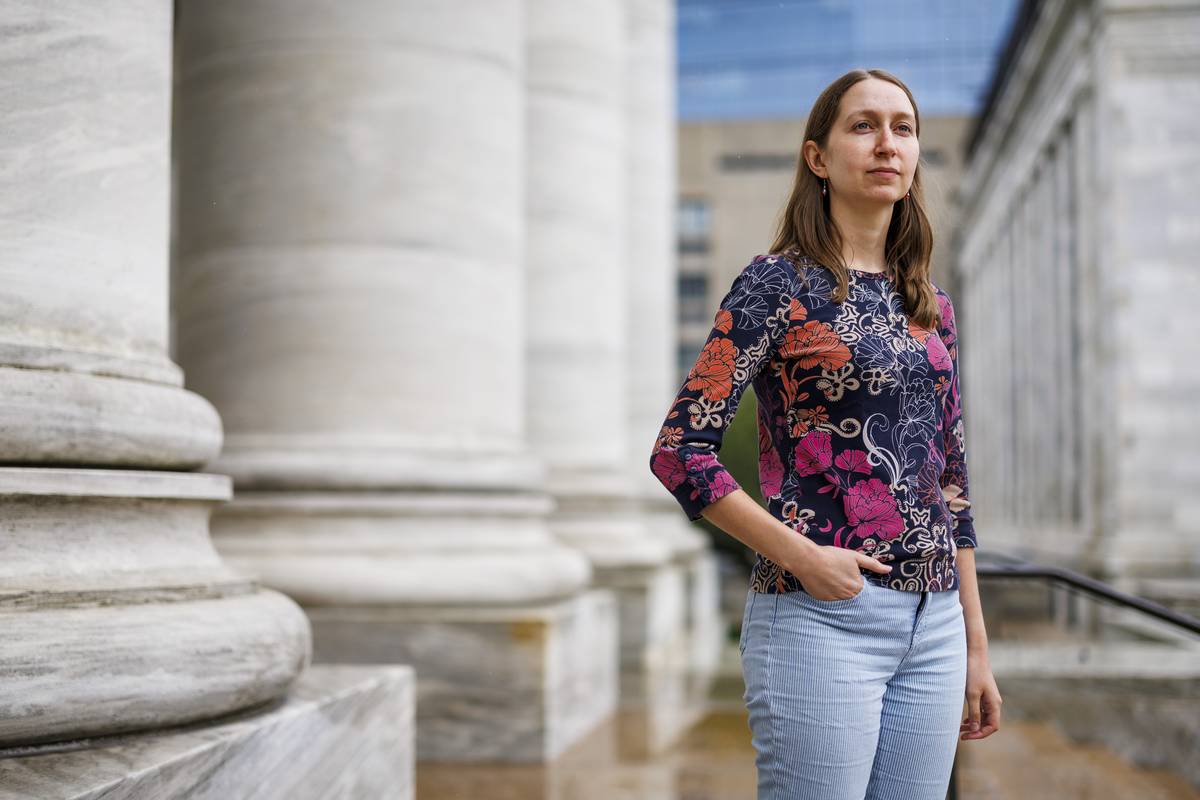
Tal Scully, a PhD candidate in systems biology, at the Harvard Longwood Campus in Boston last week.
15:30 JST, August 25, 2025
BOSTON – When Tal Scully wanted to inspire visitors to her lab at Harvard Medical School, she would show them the sea squirts she was studying. At first glance they look like rubbery little plants. But when seen through the lens of a scientist, they can trigger wonder.
“The first time I looked down a microscope at the beating heart of one of these animals, I felt like I was an explorer,” said Scully, who just finished the seventh year of her PhD studies and is expecting to graduate at the end of this semester. “It was just an amazing experience.”
But the Trump administration’s decision to eliminate billions of dollars in research funding to Harvard and elsewhere – in the name of fighting antisemitism and discrimination on campus – made her question whether her dream of working as an academic scientist in the United States is still possible.
The cuts and uncertainty could disrupt the science pipeline and threaten experiments targeting cancer, autism, quantum physics, military robotics and hundreds of other realms, including Scully’s work in systems biology. At Harvard, more than 700 graduate students and nearly 800 postdoctoral researchers get their salaries, stipends or tuition support from federally funded research, according to court documents. Early-career researchers such as Scully are most at risk.
“It is really easy to destroy scientific infrastructure,” said Shirley Tilghman, a molecular biologist and president emeritus of Princeton University. “It’s really hard to build it back up again, because what you are losing are the young people. … The people who are most vulnerable are the graduate students and the postdoctoral fellows and the young assistant professors who are just getting their careers underway.”
A White House spokesman, Kush Desai, said that the United States is home to the largest publicly and privately funded ecosystem of gold-standard research in the world and that the Trump administration “is strengthening this ecosystem by slashing waste, fraud and abuse in federal research funding – including on DEI projects that only support ideological activism,” and by cracking down on antisemitism on campus.
Scully, who grew up in the United States and has dual Israeli and American citizenship, said she has found Harvard to be a safe place to be Jewish. She heard some accounts of antisemitism from friends and from a sweeping report commissioned by the university, but said she believes the university’s leaders take those concerns very seriously. It wasn’t a significant enough problem to cut off important research, in her view. And she worries that the Trump administration’s actions could turn Jewish people into scapegoats.
“Certainly cutting off that funding is harming Jews and Israelis like me just as much” as everyone else, she said.
Wondrous biology
Scully has long wanted to be a scientist; she loves learning, and chasing unanswered questions. She has been just as certain that she wanted a career in academic research – science for the public good, rather than science to make a profit.
That kind of research is almost always dependent on federal funding; the U.S. government has for more than 75 years valued the knowledge that can result from sustained inquiry.
At Harvard, she and her colleagues chose sea squirts because they are the invertebrate animals most closely related to humans, and they wanted to study the evolution of immune cells (their findings suggest that sea squirt cells have strategies for fighting infections that might not exist in human immune cells). But Scully also found the creatures quite beautiful and fascinating, with wondrous, strange biology: They can form colonies that share blood. Their heartbeats can reverse direction.
In graduate school, she came to understand that it’s not obvious where the questions of basic science, the kinds of questions she was asking in the lab, will lead. Even within the span of her doctoral program, she was able to see, with excitement, her own fundamental work open new avenues for research that could one day help patients.
The horizon is typically long between the first questions and impact on patients, making it untenable for private industry to fund most basic research. But when a breakthrough does come, it can be a huge step forward – not just tweaking a drug, but a whole new approach to how to treat or prevent a disease.
The reason this kind of science deserves the scale of funding that it has received for decades is because it has the potential to impact people’s health and quality of life, Scully said. But she sees another value, in the knowledge, the inspiration, the sense of wonder science can bring.
“We find meaning in art,” she said. “We can find meaning in exploration and curiosity in a similar way.”
‘Lost generation’
In January, with a year left in her program, Scully began looking for postdoctoral research positions. Then the Trump administration announced drastic cuts to research funding rates. She didn’t know quite what to make of it. But she began to worry.
In March, she was shocked when the Trump administration froze $400 million in research funding to Columbia University – an unprecedented targeting of a single school.
She knew Harvard was also under threat.
In April, the university’s president, Alan Garber, announced that Harvard had received a list of demands from the Trump administration – many of which had nothing to do with antisemitism, despite coming from a federal task force convened to combat antisemitism. Garber said the university would not “surrender its independence or relinquish its constitutional rights.”
Scully was elated and relieved. But within hours, the Trump administration announced it was freezing $2.2 billion in research funding to Harvard. And that was just the beginning of a multiagency barrage of actions, with the administration launching investigations, threatening to block international students and scholars from campus and to revoke the university’s nonprofit status, and Harvard filing a lawsuit in response.
It made for a strange emotional arc, Scully said: the thrilling certainty that the school was resisting, followed rapidly by the realization that researchers had been volunteered to be on the front lines.
She knew some people who left labs, not by choice, and others who chose more stable options. International students were on edge, wondering if the university’s lawsuit would protect them, or if they would be forced out of the country before they finished their degrees and their research. Scully worried she could be asked to leave early because of the funding cuts, before she finished her papers.
In May, Harvard announced it would provide $250 million in bridge funding this year as it fought in court to get the federal dollars restored.
Scully had hoped for an interview for a postdoc position at another school, but it was dependent on grant approval that had stalled. An interview at Harvard was delayed, then canceled when all of the principal investigator’s grants were terminated.
By July, many of the labs in her department were shrinking. Some contracts weren’t renewed, or were reduced to just a few months rather than a year. She moved her desk, because the three grouped around hers were all empty.
People are panicking, said Henri Garrison-Desany, who was a research fellow in public health at Harvard but amid hiring and funding freezes spent this summer teaching yoga. “I’m just really sad about how much it is turning research back decades in the span of months,” he said, “and really derailing people’s careers.”
The government had been a trusted partner, said Elisabeth Stelson, a postdoctoral research fellow at Harvard’s school of public health, but it now seems to be harming the things scientists care about most.
People are watching years of their life’s work evaporate so quickly, she said. “We feel like the lost generation.”
Scully had long expected to work in the United States, where her parents live, where she went to college, where many of her friends are and where there are so many excellent labs. She had never questioned that the kind of job she wanted would exist here, because there has been strong bipartisan support for research for decades.
But now, on top of Harvard’s problems, she was reading about massive funding cuts to federal research agencies being debated in Congress.
“This has been a huge shock and a huge shift in the way that I’ve been thinking about what’s next for me,” she said.
It made her sad for the country, as well. So many breakthroughs have been made by researchers here on visas, drawn by the country’s reputation. Her own parents followed that path, coming here from England for their postdocs, inspired by the certainty that the United States was indisputably the best place for science.
“I think we’re going to lose that,” she said. Even if the funding were restored tomorrow, “a lot of the damage has already been done.”




Most Read
Popular articles in the past 24 hours
-

Man Infected with Measles May Have Come in Contact with Many Peop...
-

Tokyo Had 65,000 More People Move In Than Out In 2025; Osaka Area...
-
Green Tea Exports Hit Record High in 2025 Amid Growing Demand, Li...
-
Russia: Visa Required for Visiting Graves in Northern Territories...
-
Earthquake with Magnitude 4.8 Occurs off Japan’s Ibaraki Pref., S...
-

Hunting for Small Details in PokéPark KANTO, Keep a Sharp Eye Out...
-
Not Ready for Robots in Homes? The Maker of a Friendly New Humano...
-

Astronomers Unveil Map of Dark Matter’s Distribution
Popular articles in the past week
-
Australian Woman Dies After Mishap on Ski Lift in Nagano Prefectu...
-
Foreign Snowboarder in Serious Condition After Hanging in Midair ...
-
Chinese Embassy in Japan Reiterates Call for Chinese People to Re...
-
Narita Airport, Startup in Japan Demonstrate Machine to Compress ...
-

Toyota Motor Group Firm to Sell Clean Energy Greenhouses for Stra...
-

Sakie Yokota, Last Surviving Parent of a North Korea Abductee, Ur...
-

Beer Yeast Helps Save Labor, Water Use in Growing Rice; Govt Hope...
-
Japan Tourism Agency Calls for Strengthening Measures Against Ove...
Popular articles in the past month
-
Univ. in Japan, Tokyo-Based Startup to Develop Satellite for Disa...
-
JAL, ANA Cancel Flights During 3-day Holiday Weekend due to Blizz...
-
China Confirmed to Be Operating Drilling Vessel Near Japan-China ...
-

China Eyes Rare Earth Foothold in Malaysia to Maintain Dominance,...
-

Japan Institute to Use Domestic Commercial Optical Lattice Clock ...
-
M6.2 Earthquake Hits Japan's Tottori, Shimane Prefectures; No Tsu...
-
Japan, Qatar Ministers Agree on Need for Stable Energy Supplies; ...
-
Japan, Italy to Boost LNG Cooperation; Aimed at Diversifying Japa...
Top Articles in News Services
-

Prudential Life Expected to Face Inspection over Fraud
-
Arctic Sees Unprecedented Heat as Climate Impacts Cascade
-

South Korea Prosecutor Seeks Death Penalty for Ex-President Yoon over Martial Law (Update)
-
Trump Names Former Federal Reserve Governor Warsh as the Next Fed Chair, Replacing Powell
-

Suzuki Overtakes Nissan as Japan’s Third‑Largest Automaker in 2025
JN ACCESS RANKING
-
Univ. in Japan, Tokyo-Based Startup to Develop Satellite for Disaster Prevention Measures, Bears
-
JAL, ANA Cancel Flights During 3-day Holiday Weekend due to Blizzard
-
China Confirmed to Be Operating Drilling Vessel Near Japan-China Median Line
-
China Eyes Rare Earth Foothold in Malaysia to Maintain Dominance, Counter Japan, U.S.
-
Japan Institute to Use Domestic Commercial Optical Lattice Clock to Set Japan Standard Time