
Mt. Takao Sees More Incidents than Mt. Fuji; Responding to Foreign Climbers Proving to Be Challenging
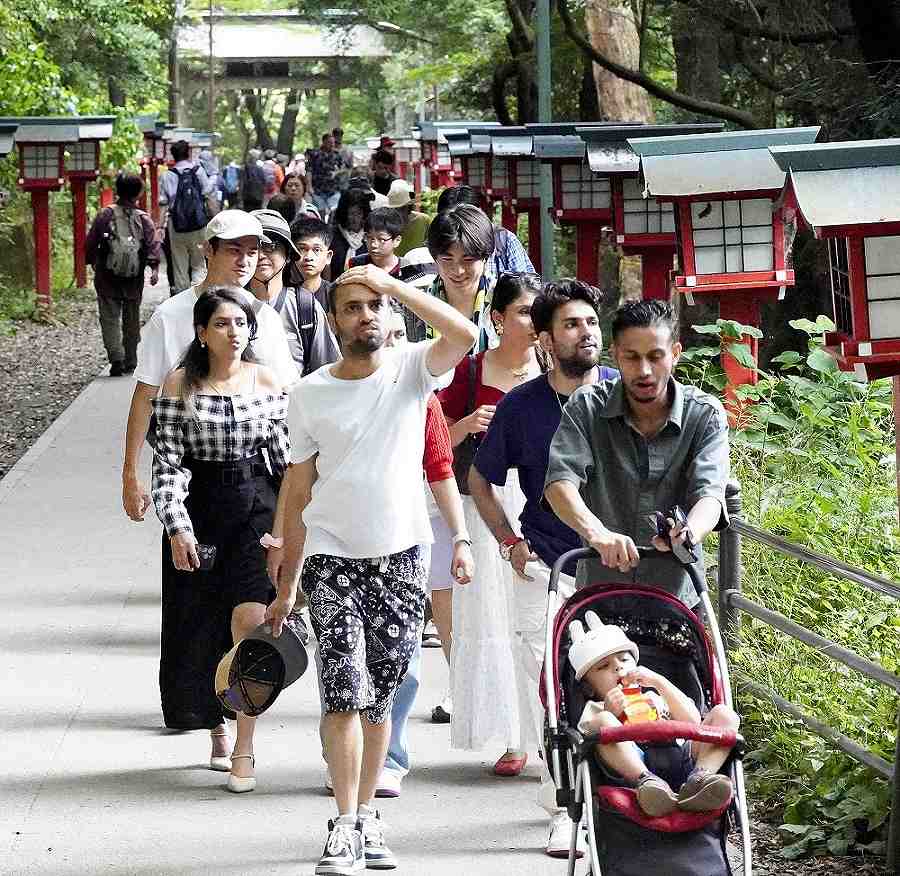
Many foreigners are seen on Mt. Takao in Tokyo on Friday.
17:47 JST, August 16, 2025
With the peak season for summer mountain climbing in full swing, people are flocking to mountains close to city centers. Climbers are being required to exercise the utmost caution to avoid getting lost or involved in an accident, even on low-lying mountains. Care should also be taken to avoid getting heatstroke.
Police are calling on climbers to come up with plans that allow for adjustments to be made and to prepare for climbs with the right equipment and enough supplies.
On Friday, with the Bon holiday season underway, Mt. Takao in Hachioji, Tokyo, was crowded with mainly young climbers and families. It takes only about an hour from central Tokyo to reach stations near the foot of the 599-meter mountain, which attracts around 3 million visitors a year.
The mercury climbed above 30 C on Friday, and what stuck out the most on Mt. Takao were climbers dressed in casual clothing. A second-year high schooler was seen at the foot of the mountain after he had climbed down. The 16-year-old young man from Chofu, Tokyo, was wearing a pair of sandals. He said he came alone without water or a change of clothes.
There was a female tourist from overseas wearing high heels and accompanied by a man pushing a stroller. He said they wanted to climb as high as they could.
There are cable cars and chairlifts along Mt. Takao’s climbing routes, and the mountain is considered to be suitable for children and novice climbers. However, its accident numbers are among the worst in the country. Last year, 131 people got lost or were involved in other incidents on Mt. Takao, exceeding the 83 people on Mt. Fuji and the 66 people on the Hotaka mountain range in the Northern Japanese Alps.
Takao Police Station of the Metropolitan Police Department said that it has dispatched officers about 50 times this year to respond to incidents on Mt. Takao and nearby mountains. There were cases in which climbers had become exhausted and were unable to stand on their way down the mountain. In other cases, climbers had fallen and were unable to move. Over half of the cases involved people over the age of 50, the station said.
According to the National Police Agency, there were a total of 2,946 incidents on mountains last year, with 3,357 people getting lost or involved in other accidents. Both figures were the third highest since 1961 when the statistics started. Thirty percent of the cases were “getting lost,” the highest percentage, followed by “falling” and “slipping down.”
As the hot summer days continue, care must be taken to avoid getting heatstroke. a man in his 30s suddenly began vomiting on a climbing route on Mt. Takao this month. He was taken to a hospital by ambulance and was believed to have suffered from heatstroke.
Climbers should remain vigilant even on low-lying mountains. In July, a man in his 60s became separated from his party of two and got lost in the Dennasawa valley — a famous spot for stream scrambling in western Tokyo surrounded by low-lying mountains of 400 to 600 meters. Rescue workers found the man, a veteran climber, the following morning thanks to a small device he was carrying.
Foreign climbers
Foreign climbers are on the rise, and responding to them has become a challenge. Last year, 135 inbound foreigners got lost or were involved in other incidents on mountains, according to the NPA. This is the second highest such figure after 145 in 2023.
In April, a Chinese university student in his 20s was rescued twice on Mt. Fuji within a period of a few days. The man reportedly returned to the site of the first incident to collect his cellphone and other belongings and got involved in another incident.
Local governments and other organizations are enhancing their efforts to respond to foreign climbers.
The Shizuoka prefectural government has started to require those who plan to climb Mt. Fuji to learn climbing safety via a multilingual app.
The Yamanashi prefectural police require climbers, including foreigners, to submit their climbing plans for mountains in the prefecture.
On Mt. Takao, messages reminding people to take caution to avoid heatstroke are announced in English and Chinese, in addition to Japanese.




Popular Articles
Popular articles in the past 24 hours
-
Sumo Scene / What’s in a Sumo Name? The Reason Why the New Year T...
-
Court Rules Life in Prison for Tetsuya Yamagami, Defendant in Fat...
-

Japan Operator to Convert All Lotteria Fast Food Restaurant Outle...
-

Preparations for Lower House Election: Such an Unprecedented Even...
-

Honda, Returning to Formula One, Unveils Power Unit with New Engi...
-

Japanese Prefecture Buys Historical Map of Takeshima, Receives Tr...
-

Spaniard Draws Manga About Hunter-Turned-Gamer; Foreign Artist Ma...
-

Japan Invited to Join Gaza ‘Board of Peace’
Popular articles in the past week
-

Japan, Italy to Boost LNG Cooperation; Aimed at Diversifying Japa...
-
Train Services in Tokyo Resume Following Power Outage That Suspen...
-

China Eyes Rare Earth Foothold in Malaysia to Maintain Dominance,...
-

Asics Opens Factory for Onitsuka Tiger Brand in Western Japan
-
Radiation Detected from International Mail Package from Vietnam
-

Japan's National Baseball Team Adds 11 Members to Participate in ...
-
Pangasius Catfish Increasingly Featured on Japanese Restaurant Me...
-

Maison&Objet Kicks off Near Paris with Japanese Lighting Designer...
Popular articles in the past month
-
Japan Govt Adopts Measures to Curb Mega Solar Power Plant Project...
-

Core Inflation in Tokyo Slows in December but Stays above BOJ Tar...
-

Major Japan Firms’ Average Winter Bonus Tops ¥1 Mil.
-
Tokyo Zoo Wolf Believed to Have Used Vegetation Growing on Wall t...
-

Univ. in Japan, Tokyo-Based Startup to Develop Satellite for Disa...
-
JAL, ANA Cancel Flights During 3-day Holiday Weekend due to Blizz...
-
‘Fiercest, Most Damaging Invasive Weed’ Spreading in Rivers, Lake...
-
Snow Expected in Tokyo, Neighboring Prefectures from Jan. 2 After...
"Society" POPULAR ARTICLE
-
Tokyo Zoo Wolf Believed to Have Used Vegetation Growing on Wall to Climb, Escape; Animal Living Happily after Recapture
-
JAL, ANA Cancel Flights During 3-day Holiday Weekend due to Blizzard
-
Snow Expected in Tokyo, Neighboring Prefectures from Jan. 2 Afternoon to Jan. 3; 5-Centimeter Snow Fall Expected in Hakone, Tama, and Chichibu Areas
-
Tokyo, Yokohama Observe First Snowfall of Season; 1 Day Earlier than Average Year
-
M6.2 Earthquake Hits Japan’s Tottori, Shimane Prefectures; No Tsunami Threat (Update 4)
JN ACCESS RANKING
-
Japan Govt Adopts Measures to Curb Mega Solar Power Plant Projects Amid Environmental Concerns
-
Core Inflation in Tokyo Slows in December but Stays above BOJ Target
-
Tokyo Zoo Wolf Believed to Have Used Vegetation Growing on Wall to Climb, Escape; Animal Living Happily after Recapture
-
Univ. in Japan, Tokyo-Based Startup to Develop Satellite for Disaster Prevention Measures, Bears
-
JAL, ANA Cancel Flights During 3-day Holiday Weekend due to Blizzard