
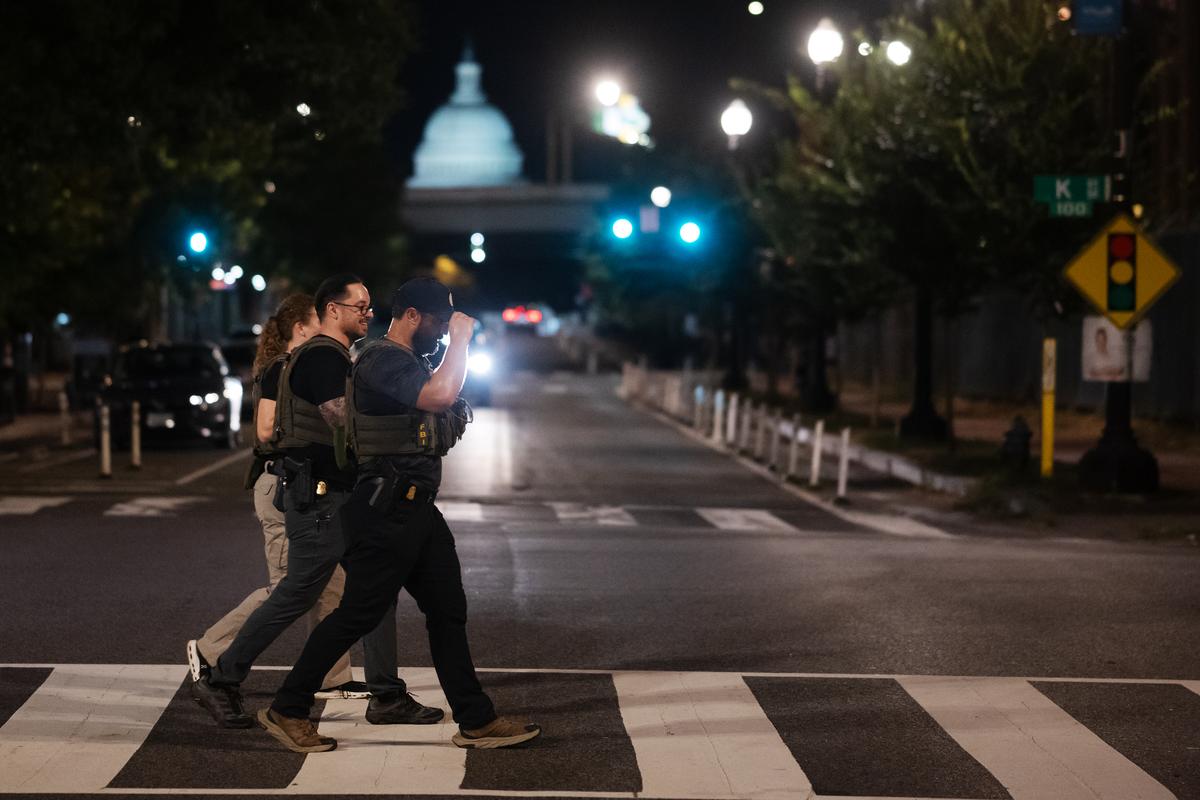
FBI agents patrol the Navy Yard neighborhood on Tuesday in Washington, D.C.
13:06 JST, August 14, 2025
A split screen emerged in the first 48 hours of President Donald Trump’s deployment of federal law enforcement and the National Guard onto D.C. streets: rhetoric from the president painting the city as a crime-addled wasteland, which D.C. Mayor Muriel E. Bowser (D) condemned, and, on the ground, a surge in federal resources bolstering D.C. police – which she and the police chief welcomed.
The impact of Trump’s federal actions came into view Tuesday night, with National Guard troops on the ground and agents from numerous federal agencies roaming D.C. streets from the National Mall to busy corridors in Columbia Heights. The White House said the overnight operation would soon become a 24/7 affair, with a significantly greater National Guard presence – and Trump said he intended to ask Congress to extend the emergency allowing him to federalize D.C. police beyond 30 days.
“We’re going to be asking for extensions on that – long-term extensions, because you can’t have 30 days,” Trump said Wednesday, adding that his administration would be pushing a crime bill to use the city as “a very positive example.”
Spokespeople for Bowser and Attorney General Brian Schwalb (D) declined to comment.
Trump’s executive action represents the most extraordinary federal intervention into the city’s home rule in decades, coming as violent crime is at 30-year lows following a historic spike in 2023, according to D.C. police data.
So far, top D.C. officials said, the order was playing out as more of a collaborative partnership, even as they feared that Trump’s repeated denigrations of the nation’s capital as a dirty city unsafe for residents and visitors could do permanent damage to its image on the national stage.
Bowser encapsulated the parallel reactions as she deployed dual messaging in two public appearances over the course of 15 hours between Tuesday evening and Wednesday morning.
Speaking to community leaders on Zoom on Tuesday night, Bowser called Trump’s actions an “authoritarian push” in her firmest condemnation yet, as she began to more forcefully dispute the disparaging characterization of the District that Trump has repeatedly painted.
“We don’t live in a dirty city. We are not 700,000 scumbags and punks. We don’t have neighborhoods that should be bulldozed. We have to be clear about our story,” Bowser said.
She said “we need to do what we can in our space, in our lane, to protect our city and protect our autonomy” to “get to the other side of this guy.”
But appearing on FOX5 on Wednesday morning, a more tempered Bowser, along with D.C. Police Chief Pamela A. Smith, said a boost in law enforcement efforts from federal partners could help the city further drive down crime and get more guns off the street – mirroring the kind of pragmatic approach the mayor presiding over the deep-blue city has taken for months in the second Trump administration.
“What we want to do is make sure this federal surge is useful for us, and that’s what the chief has been very, very good in working to accomplish,” Bowser said.
“You’re talking about 500 additional personnel in the District of Columbia,” Smith said. “We’re down in numbers with our D.C. police officers. So this enhanced presence is going to impact us in a positive way.”
D.C. Council Chairman Phil Mendelson (D) said in an interview Wednesday that there were “two realities” at play: one asserted from the White House lectern, where Trump said the federal takeover of D.C. police would rescue the city from “crime, bloodshed, bedlam and squalor” – and the other being “what’s actually happening.”
By all indications, he said, federal agencies were not “trying to boss MPD” around and, in fact, were soliciting ideas about how they could be helpful – the type of collaboration Mendelson said he agreed with Bowser is welcome. Smith said Tuesday that she provided a strategic plan to Drug Enforcement Administration head Terry Cole, whom Trump tapped to oversee D.C. police.
“I think collaborating with MPD and providing additional resources can only be for the good,” Mendelson said. “But the president has a national platform, and he’s painted the city as a cesspool of crime. We know that’s not true, but that is damaging to the city.”
Trump continued targeting D.C. on Wednesday as he touted his mission to make the city “safe and beautiful” during an unrelated event at the Kennedy Center. He said he expected Republicans to “unanimously” approve an extension of the emergency in D.C. through a joint resolution – although they typically are subject to the Senate filibuster and would require support of Democrats. But, he added, “I don’t want to call a national emergency – if I have to I will,” suggesting he could consider an alternative route to go around Congress.
Trump said that his administration was working with D.C. police and Bowser – “a very nice woman” – but that “we gotta do the job.”
“She’s been here for many years and the numbers are worse than they ever were,” he said, dismissing data D.C. officials have been citing. He called the movement for statehood “ridiculous” and said he would make D.C. the most beautiful capital city in the world. Calling the city “dirty,” he said he would put a small amount of money toward fix-ups, including road and median improvements.
“We need a beautiful topping by a very talented asphalt-type person, somebody that does the job. When I get contractors I use great contractors,” he said.
The strategy guiding the federal law enforcement surge seemed in flux Wednesday. The surge has surpassed 100 arrests since the operation began Thursday, according to a White House official. The tally from the White House includes serving 10 warrants and 23 immigration enforcement actions. A White House official said Wednesday that there was no estimate of how many National Guard troops are expected to be in D.C. on Wednesday night, although they had originally said more than 400. “Operational details are constantly subject to change,” they said.
When it comes to measuring the federal operation’s success, Bowser said on FOX5 that in her meeting with Attorney General Pam Bondi and other federal partners Wednesday, no clear metric for success was offered.
She said it could include sweeping more illegal guns off the street.
“We certainly want to know what we’re being measured against, and they regard it as a success to have more presence and to take more guns off the street, and we do too. That’s what MPD works on every single day, is taking more guns off the street.”
Agents and officers detailed to the surge have received assignments on a day-to-day basis, according to multiple people familiar with the matter who spoke on the condition of anonymity to discuss operational details. In most cases, federal agents less familiar with policing the city have been paired with D.C. police officers or officers with the U.S. Secret Service Uniformed Division, the people said. About 130 FBI agents have been detailed to the effort, including agents dispatched on temporary assignments from the bureau’s Philadelphia and Baltimore field offices, two people said.
On the first two nights of the operation, they conducted joint patrols with D.C. police officers or assisted in arrests tied to open warrants. FBI Director Kash Patel said on X that agents have been involved with local partners in making at least 18 arrests since Monday evening, including apprehending one suspect wanted for murder as well others wanted for DUI, theft, assault and violating a restraining order. Agents also detained several people for illegal gun possession, he said.
Roughly half of the 800 National Guard troops who were mobilized have processed in, and some of those troops are already on D.C. streets, said an Army official who spoke on the condition of anonymity to provide additional details that had not yet been made public. Those troops began working Tuesday night near the U.S. Park Police station in Anacostia Park and on patrols near high-visibility areas including the national monuments. The troops were not carrying guns but had weapons available if needed, the official said.
The use of the National Guard brings to bear the threats that Trump has lobbed at the city’s autonomy for months and, critics fear, exposes residents to potentially unpredictable encounters with a domestically deployed military force.
While the National Guard was preparing to activate, Bowser spent an hour Tuesday night answering residents’ questions in a video chat live-streamed on social media. She acknowledged that she did not know exactly how the federal resources would be deployed, but she said her expectation was that the National Guard troops would be deployed to federal parks, monuments and federal buildings, while federal law enforcement would be deployed to higher-crime areas of the city.
Even while Bowser and Smith have sounded positive notes about collaboration, residents raised concerns about the potential consequences of having federal law enforcement on city streets and interacting with residents or intimidating children. The mayor pledged to create an avenue for people to report concerning behavior by federal officers, and she said she would think about ways to make the police presence feel less intimidating.
She encouraged parents to keep close tabs on their children, voicing her wariness that any misbehavior involving large groups of teens could become a political target during Trump’s operation.
“I think we have some kids that are not criminals, but they are getting together in big groups and causing some really – they’re causing destruction,” she said. “And so this is the type of thing that makes for good TV. And to be candid, that’s part of the motivation, I think, is to get some good TV and arrests in D.C. So, don’t let your kids be a part of that.”
She also described an apparent tension: While she said she was “really ticked off” about the Trump administration’s incursion on her turf, she also felt the moment demanded pragmatism.
“My jobs are many right now – and part of it is just practically managing us through this crisis,” Bowser said.




Most Read
Most read in the last 24 hours
-

Govt May Revise Law to Allow Export of Defense Equipment for Free
-

Number of Immigration Officer-Escorted Forced Deportations in Jap...
-

Undrafted Japanese Kicker Signs with Raiders; ‘My Appeal Is My Ac...
-

Dutch Man Injured on Closed Mt. Fuji Route, Having Fallen While D...
-

Spring Bear Hunting Gets Fully Underway As Prefectures Deal With ...
-

Tokyo Vice Governor: Sushi Tech Tokyo Garners Tangible Business O...
-

Mother Supports My Sister Too Much, Gives Her Kids Much More Than...
-

Japan to Host Leaders from Major Cities from Around the World for...
Most read in the last 7 days
-
Earthquake Hits Japan's Tohoku Region; 3-meter Tsunami Warning Is...
-
China, South Korea Object to Japanese PM Takaichi's Ritual Offeri...
-
Trump Extends the Ceasefire with Iran but Keeps the Blockade
-

India's Arms Indigenization Quest for Self-Reliance / New Delhi S...
-

¥1,000 Coins to Be Issued to Mark Anniversary of Beginning of Jap...
-

Most Serious Cyberattacks against the UK Now from Russia, Iran an...
-

Trump Opposes United–American Merger, Signals Support for Spirit
-

System Malfunction in Haneda Airport Causes 83 Flight Cancelation...
Most read in the last 30 days
-
Earthquake Hits Japan's Tohoku Region; 3-meter Tsunami Warning Is...
-
Police Find Child's Shoe During Search for Missing Boy in Nantan,...
-
Body Found in Nantan, Kyoto Prefecture, During Search for 11-Year...
-
China, South Korea Object to Japanese PM Takaichi's Ritual Offeri...
-

Cherry Blossoms, Rapeseed Flowers Perform Colorful ‘Duet’ in Niig...
-
Trump Extends the Ceasefire with Iran but Keeps the Blockade
-

Olympic Gold Medal-Winning Figure Skaters Riku-Ryu Announce Retir...
-
Japanese Prime Minister Takaichi Speaks to Pakistani Prime Minist...
Top Articles in News Services
-
Trump Extends the Ceasefire with Iran but Keeps the Blockade
-
Most Serious Cyberattacks against the UK Now from Russia, Iran and China, Cyber Chief Says
-
Trump Opposes United–American Merger, Signals Support for Spirit
-

Florida Launches Criminal Probe into OpenAI and ChatGPT over Deadly Shooting
-
Trump Picks a University of Minnesota Professor to Lead His Economic Council
JN ACCESS RANKING
-
Earthquake Hits Japan’s Tohoku Region; 3-meter Tsunami Warning Issued (Update 1)
-
Police Find Child’s Shoe During Search for Missing Boy in Nantan, Kyoto Prefecture
-
Body Found in Nantan, Kyoto Prefecture, During Search for 11-Year-Old Boy in Area (Update 1)
-
China, South Korea Object to Japanese PM Takaichi’s Ritual Offering to Yasukuni Shrine
-
Cherry Blossoms, Rapeseed Flowers Perform Colorful ‘Duet’ in Niigata
Most read in the last 24 hours
-
Govt May Revise Law to Allow Export of Defense Equipment for Free
-
Number of Immigration Officer-Escorted Forced Deportations in Jap...
-
Undrafted Japanese Kicker Signs with Raiders; ‘My Appeal Is My Ac...
-
Dutch Man Injured on Closed Mt. Fuji Route, Having Fallen While D...
-
Spring Bear Hunting Gets Fully Underway As Prefectures Deal With ...
Most read in the last 7 days
-
Earthquake Hits Japan's Tohoku Region; 3-meter Tsunami Warning Is...
-
China, South Korea Object to Japanese PM Takaichi's Ritual Offeri...
-
Trump Extends the Ceasefire with Iran but Keeps the Blockade
-
India's Arms Indigenization Quest for Self-Reliance / New Delhi S...
-
¥1,000 Coins to Be Issued to Mark Anniversary of Beginning of Jap...
Most read in the last 30 days
-
Earthquake Hits Japan's Tohoku Region; 3-meter Tsunami Warning Is...
-
Police Find Child's Shoe During Search for Missing Boy in Nantan,...
-
Body Found in Nantan, Kyoto Prefecture, During Search for 11-Year...
-
China, South Korea Object to Japanese PM Takaichi's Ritual Offeri...
-
Cherry Blossoms, Rapeseed Flowers Perform Colorful ‘Duet’ in Niig...