
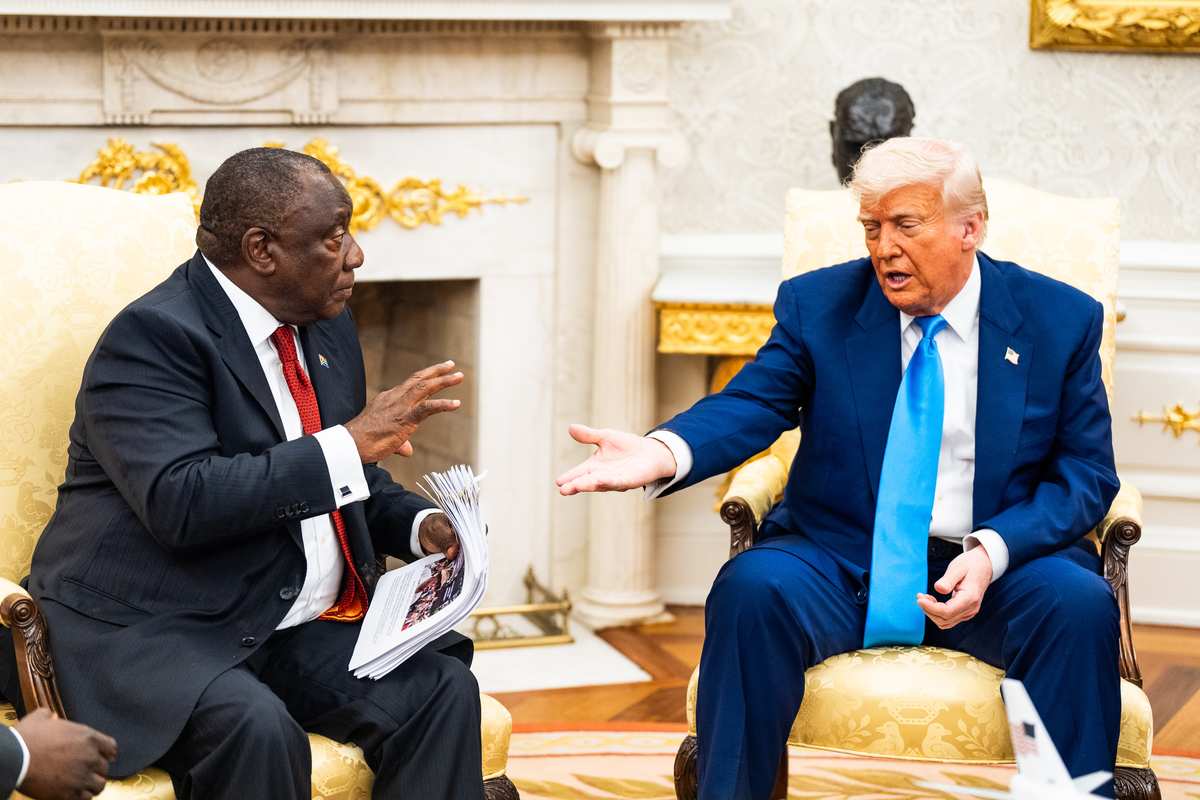
President Donald Trump speaks with President of South Africa Cyril Ramaphosa at the White House in May.
12:21 JST, August 12, 2025
The Trump administration is significantly escalating U.S. government criticism of perceived foes in South Africa and Brazil as the State Department’s political leadership reimagines America’s role in documenting human rights abuses around the world, according to leaked draft documents reviewed by The Washington Post.
The department’s annual human rights reports, which are scheduled to be transmitted to Congress on Tuesday, according to a memo seen by The Post, are expected to target the South African government for its alleged mistreatment of White Afrikaner farmers and the Brazilian government for its alleged persecution of former president Jair Bolsonaro, an ally of President Donald Trump.
Human rights advocates, foreign leaders and other critics of the Trump administration say its claims about both governments are exaggerated. Within the State Department, there is considerable unease, too, over how the writing of these and other country-specific human rights reports were shaped compared with past years, with some saying the process was unduly politicized.
The Post also has reviewed leaked draft reports for El Salvador, Israel and Russia. Those documents eliminate previous descriptions of abuses, including government corruption, prisoner abuse and persecution of LGBTQ+ individuals.
The State Department has declined to comment directly on the draft documents but last week issued a broad defense of the administration’s shift in priorities.
“Governments around the world continue to use censorship, arbitrary or unlawful surveillance and restrictive laws against disfavored voices, often on political and religious grounds,” a senior State Department official, speaking on the condition of anonymity under the agency’s rules, told reporters. “We are committed to having frank conversations … with our allies, our partners and also our adversaries to promote freedom of expression around the world.”
This official also noted that the forthcoming human rights reports had been restructured to remove redundancies and increase readability.
Representatives of the South African and Brazilian embassies in Washington did not respond to requests for comment.
Current and former State Department officials familiar with this year’s human rights reports describe a divisive process with internal disputes over certain countries, including South Africa, resulting in a months-long publication delay as drafts begun during the Biden administration underwent substantial revision.
Uzra Zeya, a top official for human rights at the State Department during the Biden administration who now leads the Human Rights First nonprofit, said that Secretary of State Marco Rubio was seeking to “weaponize and distort human rights policy” in a way that rewards rights-abusing allies while targeting political opponents and critics.
The report for South Africa focuses on what the Trump administration says is the “land expropriation of Afrikaners and further abuses against racial minorities in the country,” the draft documents show. Trump has claimed the country’s White minority faces a “genocide,” though human rights groups, and even some Afrikaner groups, have resoundingly dismissed that as untrue.
Trump lectured South African President Cyril Ramaphosa during a visit to the White House in May, with the U.S. president showing his visitor purported video evidence of what he claimed proved the persecution of Afrikaners. While Ramaphosa acknowledged there were problems with safety in some rural parts of his country, he forcefully rejected the idea that White South Africans were being singled out – and at least one of the images Trump showed during the tense meeting was later found to not show South Africa at all.
That same month, the Trump administration welcomed to the United States about 60 White South Africans as refugees, making a rare exception to its broader halt to refugee resettlement programs for people fleeing war or facing persecution around the world.
The U.S. has also cut aid to South Africa and is planning to boycott November’s meeting of the Group of 20 industrialized countries to be held in Johannesburg. U.S. officials have complained not only of the treatment of White Afrikaners but also South Africa’s support of legal cases against U.S. ally Israel at the International Court of Justice. The draft report includes a lengthy section on antisemitism in South Africa.
According to two people with knowledge of the process, speaking on the condition of anonymity for fear of retribution, career State Department staff pushed back on some of the proposed language in the South Africa report. There were specific concerns, these people said, about use of the word “genocide,” which carries significant legal implications for U.S. policy under domestic and international law.
One person with knowledge of the process said the administration wanted not just to strip down the South Africa draft left by the prior administration but reshape it entirely, highlighting claims of persecution against Afrikaners despite doubts about their veracity.
A Trump political appointee, Samuel Samson, led the draft’s rewriting after Africa subject matter experts in the Bureau of Democracy, Human Rights, and Labor refused to continue their involvement, citing the inclusion of false and misleading information, this person said.
Samson later visited South Africa in July to conduct research, according to local media reports. He did not immediately respond to a request for comment.
In Brazil’s draft report, the State Department accused the country’s left-wing government of “disproportionately suppressing the speech of supporters of former president Jair Bolsonaro,” who is accused of attempting to stay in power with a violent coup. Bolsonaro has denied the charge.
The draft report specifically mentions Brazilian Supreme Court Justice Alexandre de Moraes, stating that he “personally ordered the suspension of more than 100 user profiles on the social media platform X (formerly Twitter)” in a way that impacted Bolsonaro’s supporters on the far right.
The Trump administration expanded U.S. sanctions on Moraes last month, with Rubio alleging the judge had committed “serious human rights abuse, including arbitrary detention involving flagrant denials of fair trial guarantees and violations of the freedom of expression.” Moraes has pledged to ignore the sanctions and continue his work.
Bolsonaro and his allies have appealed to Trump for help as he faces a variety of charges related to the 2022 attempted coup, which occurred roughly two years after Trump’s supporters, hoping to overturn his election defeat in 2020, carried out a violent assault on the U.S. Capitol.
“I always talked about the prosecutions that Trump suffered. If he wants to say something about me, he’ll decide to speak,” Bolsonaro told The Post this year.
Administration officials have defended the shift in U.S. human rights priorities, and it’s not unusual for a new administration respond to different trends, such as perceived attacks on freedom of expression in Europe and other democracies.
The State Department human rights reports are the most comprehensive on the subject compiled by any single body in the world, and they are widely used in both U.S. and international courts. In particular, they are often used in immigration court during hearings on asylum and deportations.
Appearing in front of the Senate Foreign Relations Committee in May, Rubio clashed with Democratic lawmakers, who asked why the State Department had canceled long-standing refugee programs but started a new program that focused specifically on Afrikaners from South Africa.
Rubio said that the South Africans who arrived in the United States “thought they were persecuted” but acknowledged there were millions of others facing persecution around the world who would not be resettled as refugees in the U.S.





Most Read
Popular articles in the past 24 hours
-

Man Infected with Measles May Have Come in Contact with Many Peop...
-
Tokyo Had 65,000 More People Move In Than Out In 2025; Osaka Area...
-
Green Tea Exports Hit Record High in 2025 Amid Growing Demand, Li...
-
Russia: Visa Required for Visiting Graves in Northern Territories...
-

Hunting for Small Details in PokéPark KANTO, Keep a Sharp Eye Out...
-

Japan's Nikkei Stock Average Slips after Sharp Gain as Software F...
-

Not Ready for Robots in Homes? The Maker of a Friendly New Humano...
-
Sapporo Snow Festival Opens with 210 Snow and Ice Sculptures at 3...
Popular articles in the past week
-
Australian Woman Dies After Mishap on Ski Lift in Nagano Prefectu...
-
Foreign Snowboarder in Serious Condition After Hanging in Midair ...
-
Chinese Embassy in Japan Reiterates Call for Chinese People to Re...
-
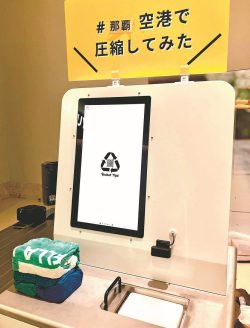
Narita Airport, Startup in Japan Demonstrate Machine to Compress ...
-

Toyota Motor Group Firm to Sell Clean Energy Greenhouses for Stra...
-
Sakie Yokota, Last Surviving Parent of a North Korea Abductee, Ur...
-
Beer Yeast Helps Save Labor, Water Use in Growing Rice; Govt Hope...
-
Japan Tourism Agency Calls for Strengthening Measures Against Ove...
Popular articles in the past month
-

Univ. in Japan, Tokyo-Based Startup to Develop Satellite for Disa...
-
JAL, ANA Cancel Flights During 3-day Holiday Weekend due to Blizz...
-
China Confirmed to Be Operating Drilling Vessel Near Japan-China ...
-

China Eyes Rare Earth Foothold in Malaysia to Maintain Dominance,...
-

Japan Institute to Use Domestic Commercial Optical Lattice Clock ...
-
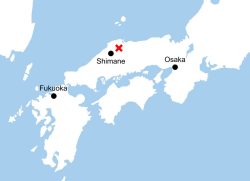
M6.2 Earthquake Hits Japan's Tottori, Shimane Prefectures; No Tsu...
-
Japan, Qatar Ministers Agree on Need for Stable Energy Supplies; ...
-
Japan, Italy to Boost LNG Cooperation; Aimed at Diversifying Japa...
Top Articles in News Services
-

Prudential Life Expected to Face Inspection over Fraud
-
Arctic Sees Unprecedented Heat as Climate Impacts Cascade
-

South Korea Prosecutor Seeks Death Penalty for Ex-President Yoon over Martial Law (Update)
-
Trump Names Former Federal Reserve Governor Warsh as the Next Fed Chair, Replacing Powell
-

Suzuki Overtakes Nissan as Japan’s Third‑Largest Automaker in 2025
JN ACCESS RANKING
-
Univ. in Japan, Tokyo-Based Startup to Develop Satellite for Disaster Prevention Measures, Bears
-
JAL, ANA Cancel Flights During 3-day Holiday Weekend due to Blizzard
-
China Confirmed to Be Operating Drilling Vessel Near Japan-China Median Line
-
China Eyes Rare Earth Foothold in Malaysia to Maintain Dominance, Counter Japan, U.S.
-
Japan Institute to Use Domestic Commercial Optical Lattice Clock to Set Japan Standard Time