
More Public Libraries, Free Books for Children Result of Print Culture Law Supporting Japan’s Reading Environment

Speakers discuss the significance of print culture at a forum in Tokyo on Saturday.
6:00 JST, July 29, 2025
This month marks 20 years since the law to promote letters and print culture was enacted and came into effect. The reading environment for the Japanese has improved over the past two decades as the number of public libraries has increased and language education has been strengthened in schools. The situation surrounding publications, however, has become challenging with the ubiquity of digital devices, making nationwide support essential.
“It will be important to have more book lovers and supporters,” Taisho University Specially Appointed Prof. Yoshihiro Katayama, a former internal affairs and communications minister, said Saturday at a forum held in Tokyo to commemorate the 20th anniversary of the law’s implementation.
The law was enacted in July 2005 by a bipartisan group of lawmakers to prevent aliteracy among the public. It requires the central government and municipalities to ensure an adequate number of libraries and foster language skills at school.
Since the law’s implementation, the number of public libraries has increased by about 400 to 3,394 in fiscal 2021. This was followed by the enactment of the revised School Library Law, which mandates that municipalities make efforts to assign school librarians, and the law on promoting improved reading environments for the visually impaired, also called the reading barrier-free law, to create environments where everyone can read. A private qualification for picture book specialists has also been established.
Nobuyuki Isobe, research director at the Japan School Library Association, said the print culture law has “supported language and culture in both visible and invisible ways.”
At school
Initiatives to stabilize reading habits have been implemented under the law’s principles.
One such initiative is Book Start, where municipalities give children books on such occasions as infant checkups. The number of municipalities implementing this program increased from 36 in fiscal 2001 to 1,118 in fiscal 2024.
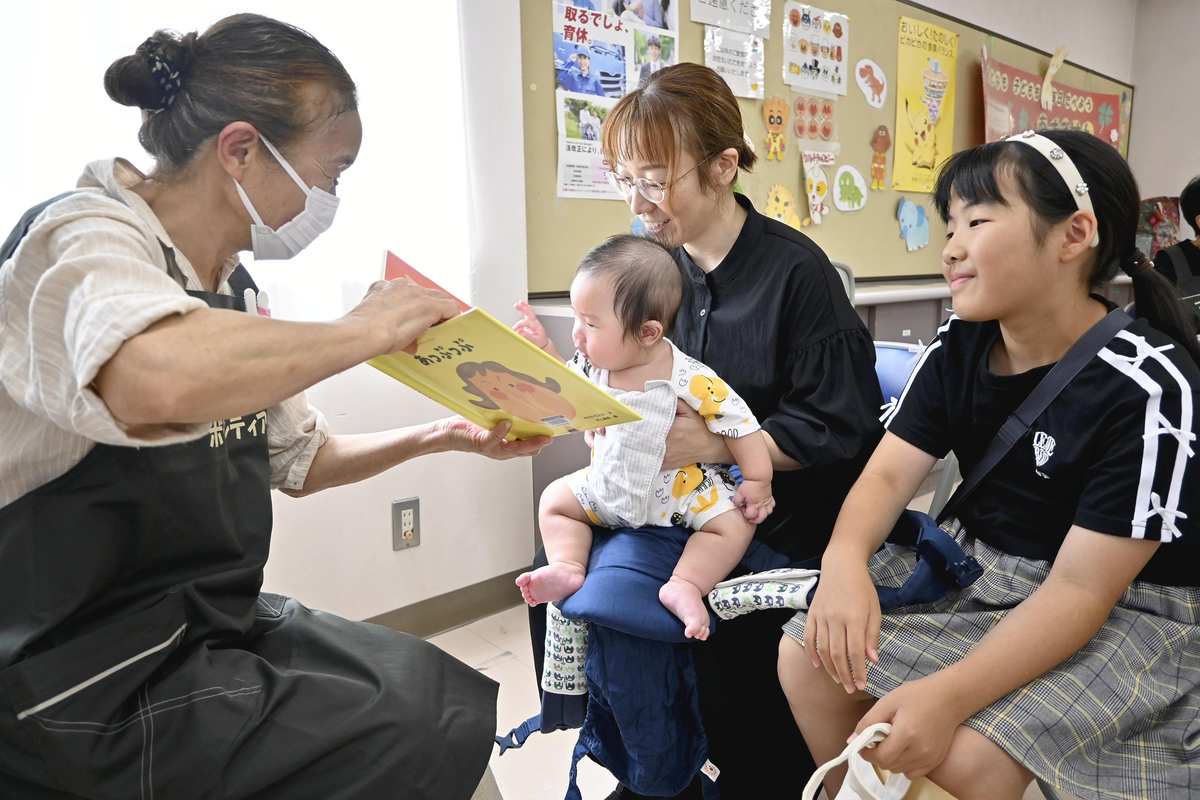
An infant looks at a picture book read aloud in Ushiku, Ibaraki Prefecture, on Wednesday.
Picture books are distributed during infant checkups in Ushiku, Ibaraki Prefecture, and read aloud at the venue, while books are given to children in Yamakita, Kanagawa Prefecture, at health checkups for babies and 3-year-olds and when they enroll at elementary school.
In 2008, the education ministry included “enrichment of language activities” in school curriculum guidelines. Students at one elementary school look up the ecology of insects with books and encyclopedias available in the school library and present their findings in science class.
However, there are regional disparities in reading environments. A Yomiuri Shimbun survey found 256 municipalities — 15% of all municipalities — had no public libraries or bookstores as of fiscal 2024, up by nine from fiscal 2022.
The ratio of librarians dispatched to public school libraries exceeds 70% for both elementary and junior high schools, with some municipalities, such as Fujieda in Shizuoka Prefecture, assigning one librarian to each school. However, 33% of elementary school and 44% of junior high school librarians are assigned to multiple schools, and there are schools where a librarian only comes once a week.
In the internet age
According to a Cultural Affairs Agency survey released last year, 62.6% of men and women aged 16 and older said they do not read any books in a typical month. The most common reason provided by respondents as to why they read fewer books, at 43.6%, was that they spent time using smartphones and other devices instead.
Tablet devices have been distributed to all students at elementary and junior high schools under the government’s GIGA School Program announced at the end of 2019. Progress in the use of such devices drew questions from some teachers in one municipality about the necessity of school libraries, given that information can be accessed online.
“In today’s society where people are easily influenced by readily available online information, it has become more important than ever to engage with proper publications and think about issues from multiple perspectives,” Taisho University Prof. Tatsuya Inai, who specializes in Japanese language education said. “The significance of the print culture law is growing.”








Most Read
Popular articles in the past 24 hours
-

My Spendthrift Mother Constantly Asks Me for Money
-
Japanese Students Use Traditional Pickle to Create Novel Wagashi ...
-

‘Dry Bonsai’ Gives New Life to Withered Trees, Allows Free Artist...
-

McDonald's Japan Raises Prices; Big Mac to Cost ¥500, Double Chee...
-

Nepal Bus Crash Kills 19 People, Injures 25 Including One Japanes...
-

Astellas Collaborates with Vir to Develop Its Experimental Prosta...
-

Japan’s Nikkei Stock Average Rises as AI-Related Stocks Shine; Co...
-

Early-Blooming Kawazu Cherry Blossoms Create Sea of Pink at Park ...
Popular articles in the past week
-

Producer Behind Pop Group XG Arrested for Cocaine Possession
-

Japan PM Takaichi’s Cabinet Resigns en Masse
-

Sanae Takaichi Elected Prime Minister of Japan; Keeps All Cabinet...
-

Japan's Govt to Submit Road Map for Growth Strategy in March, PM ...
-

Bus Carrying 40 Passengers Catches Fire on Chuo Expressway; All E...
-

U.S. Firm to Build Training Hub in Fukushima N-plant for Debris R...
-

Japan, U.S. Name 3 Inaugural Investment Projects; Reached Agreeme...
-

Riku-Ryu Pair Wins Gold Medal: Their Strong Bond Leads to Major C...
Popular articles in the past month
-
Producer Behind Pop Group XG Arrested for Cocaine Possession
-
Japan PM Takaichi’s Cabinet Resigns en Masse
-

Japan Institute to Use Domestic Commercial Optical Lattice Clock ...
-

Man Infected with Measles Reportedly Dined at Restaurant in Tokyo...
-

Israeli Ambassador to Japan Speaks about Japan’s Role in the Reco...
-

Videos Plagiarized, Reposted with False Subtitles Claiming ‘Ryuky...
-

Man Infected with Measles May Have Come in Contact with Many Peop...
-

Prudential Life Insurance Plans to Fully Compensate for Damages C...
Top Articles in Society
-
Producer Behind Pop Group XG Arrested for Cocaine Possession
-
Man Infected with Measles Reportedly Dined at Restaurant in Tokyo Station
-
Man Infected with Measles May Have Come in Contact with Many People in Tokyo, Went to Store, Restaurant Around When Symptoms Emerged
-

Woman with Measles Visited Hospital in Tokyo Multiple Times Before Being Diagnosed with Disease
-

Australian Woman Dies After Mishap on Ski Lift in Nagano Prefecture
JN ACCESS RANKING
-
Producer Behind Pop Group XG Arrested for Cocaine Possession
-
Japan PM Takaichi’s Cabinet Resigns en Masse
-
Japan Institute to Use Domestic Commercial Optical Lattice Clock to Set Japan Standard Time
-
Man Infected with Measles Reportedly Dined at Restaurant in Tokyo Station
-
Israeli Ambassador to Japan Speaks about Japan’s Role in the Reconstruction of Gaza