
Future Rice Prices Remain Uncertain; Influence of Factors Like Weather, Government Buybacks Yet to Be Seen
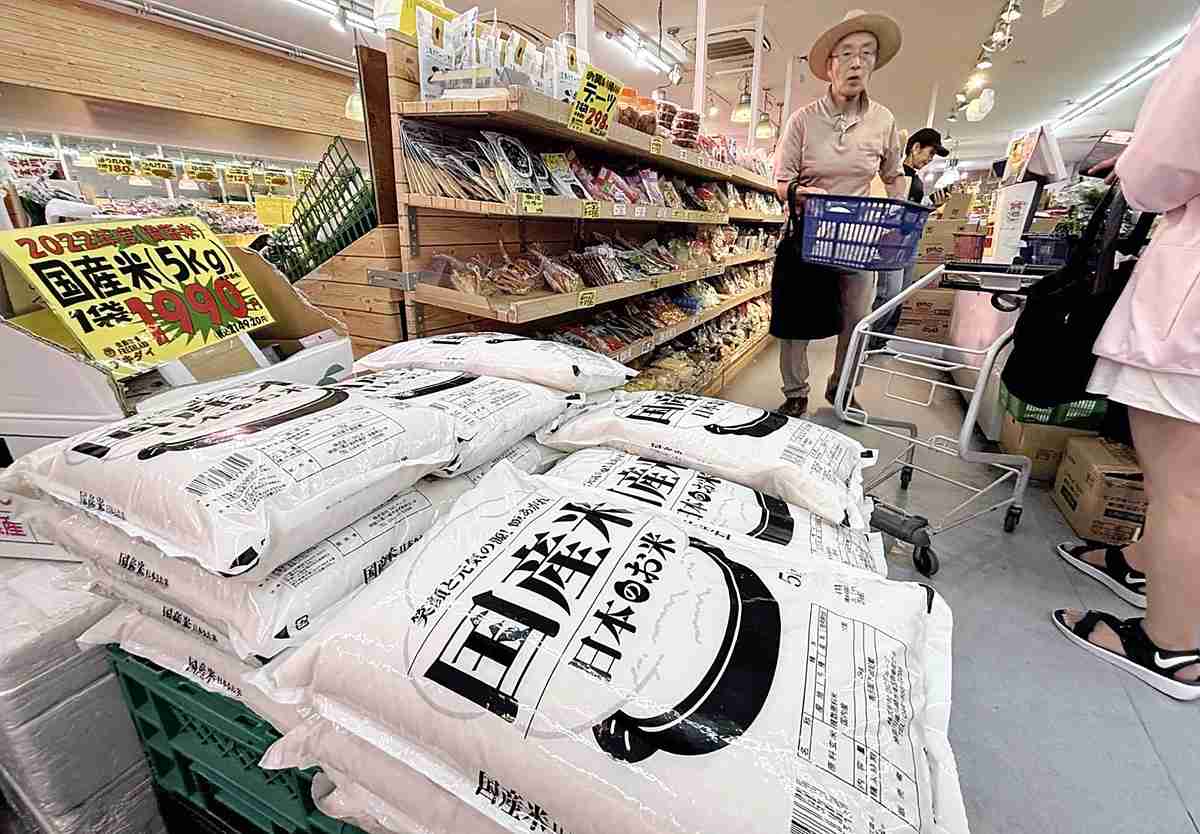
Packs of rice released from government stockpiles under discretionary contracts are seen in a supermarket store in Nerima Ward, Tokyo, on Thursday.
16:56 JST, July 26, 2025
Two months have passed since the government began discretionary contracts with various retailers to release its rice stockpiles into the market. Yet uncertainty remains about the future of rice prices in Japan.
At one point, average prices surged to greater than ¥4,200 for a five-kilogram pack, but they have fallen by about 20% as the shortage of rice has eased.
Newly harvested rice will begin to reach the retail market this autumn, but prices for brand-name rice have remained at high levels, casting doubt on whether rice prices will continue to decrease going forward.
Above ¥3,500
On Thursday afternoon at Akidai Sekimachi Honten, a supermarket in Nerima Ward, Tokyo, about 20 five-kilogram packs of rice were on display, each marked with the phrase “domestically produced rice” and priced at ¥1,990 before tax.
The packs contained old-harvest rice, produced in 2022 and kept in government stockpiles until being released under a discretionary contract this year.
A 51-year-old company employee who purchased one of the packs delightedly.
“Rice has finally become inexpensive enough for me to buy. I have a family of four and we go through rice pretty quickly, so I’m grateful,” he said.
According to the Agriculture, Forestry and Fisheries Ministry, the average retail price for a five-kilogram pack of rice at a supermarket surged to ¥4,285 in May of this year, more than double what it was at the same time in 2024.
But full-fledged sales of government stockpiled rice under discretionary contracts began in June, and the average price has fallen to a little over ¥3,500 this month, marking the first decrease in about half a year.
560,000 tons more
Rice newly harvested this year is planned to begin coming on the market in autumn. The total volume of rice harvested in 2025 is predicted to be 560,000 tons greater than that of 2024. This is partly because many farmers who previously grew grains for purposes such as food processing switched to staple food production as rice prices spiked.
The increase in production volume will likely be the largest since 2004, when the government began tracking this information. The total acreage of farmland being used for rice cultivation will also be at its highest point in five years.
In addition to the production increase, if up to 810,000 tons of government stockpiled rice released through bidding and other channels circulates through the market, it will create a surplus which could drive prices down.
“When market conditions settle down, the government will buy back an amount of rice equal to what was released from the stockpiles,” said Agriculture, Forestry and Fisheries Minister Shinjiro Koizumi.
But if the government buys all of the rice back too quickly, it could put pressure on the supply and demand conditions of the market. It now faces the question of when and how much to buy back.
Advance payments rising
However, there remains significant doubt over whether rice prices will actually fall going forward.
This is partly because local agricultural cooperatives belonging to the JA group have offered higher advanced payment to farmers across the nation.
In Niigata Prefecture, one of the nation’s most important rice production areas, JA Zen-noh Niigata informed rice farmers that its minimum advanced payment amount per 60 kilograms of Koshihikari brand rice harvested this year would be ¥6,000 greater than what it offered last year.
In the Kyushu region, where early rice crops are grown, one JA cooperative raised its offer by about ¥8,000.
Restaurant operators and non-JA grain collection companies, among others, are also rushing to buy this year’s rice harvest. An official of the JA group said, “We won’t be able to collect much rice if we don’t raise our prices.”
Average prices have been brought down by the release of government stocks, but prices of brand-name rice varieties still remain high, at above ¥4,000 per five kilograms. If grain-collecting companies raise their purchase prices, it is inevitable that retail prices will also rise.
If production volumes fail to meet current estimates due to this year’s extremely hot weather, rice prices are likely to be driven up even further.
“For the time being, the race to buy up newly harvested rice from production areas will continue, and rice prices will remain quite high, even after the new crop hits the market,” said Prof. Katsumi Arahata of Japan International University. “It may take several years for rice prices to be stabilized.”


Related Tags




Most Read
Most read in the last 24 hours
-

Trump Extends the Ceasefire with Iran but Keeps the Blockade
-

China, South Korea Object to Japanese PM Takaichi's Ritual Offeri...
-

Florida Launches Criminal Probe into OpenAI and ChatGPT over Dead...
-

Trump Opposes United–American Merger, Signals Support for Spirit
-

Trump Picks a University of Minnesota Professor to Lead His Econo...
-

Japan's ANA to Introduce Fuel Surcharges to Domestic Flights from...
-

Taiwan President Cancels Africa Trip Blaming Chinese Pressure
-

Fired Former UK Official Says He Felt Political Pressure to Appro...
Most read in the last 7 days
-
Earthquake Hits Japan's Tohoku Region; 3-meter Tsunami Warning Is...
-

Olympic Gold Medal-Winning Figure Skaters Riku-Ryu Announce Retir...
-
Trump Extends the Ceasefire with Iran but Keeps the Blockade
-

Japan to Ban Use of Portable Chargers on Airplanes from April 24,...
-
China, South Korea Object to Japanese PM Takaichi's Ritual Offeri...
-

New Challenges Await as Miura-Kihara Retires; Blade Maker, Ex-Coa...
-
Florida Launches Criminal Probe into OpenAI and ChatGPT over Dead...
-
Trump Opposes United–American Merger, Signals Support for Spirit
Most read in the last 30 days
-
Earthquake Hits Japan's Tohoku Region; 3-meter Tsunami Warning Is...
-
Police Find Child's Shoe During Search for Missing Boy in Nantan,...
-
Body Found in Nantan, Kyoto Prefecture, During Search for 11-Year...
-
Cherry Blossoms, Rapeseed Flowers Perform Colorful ‘Duet’ in Niig...
-
Olympic Gold Medal-Winning Figure Skaters Riku-Ryu Announce Retir...
-
Trump Extends the Ceasefire with Iran but Keeps the Blockade
-
Nori Prices Surge in Japan Due to Poor Seaweed Production Amid Ri...
-

Japanese Prime Minister Takaichi Speaks to Pakistani Prime Minist...
Top Articles in Society
-
Earthquake Hits Japan’s Tohoku Region; 3-meter Tsunami Warning Issued (Update 1)
-
Police Find Child’s Shoe During Search for Missing Boy in Nantan, Kyoto Prefecture
-
Body Found in Nantan, Kyoto Prefecture, During Search for 11-Year-Old Boy in Area (Update 1)
-
Cherry Blossoms, Rapeseed Flowers Perform Colorful ‘Duet’ in Niigata
-

Two Women in Osaka Found Lying on Floor Bleeding, Later Pronounced Dead
JN ACCESS RANKING
-
Earthquake Hits Japan’s Tohoku Region; 3-meter Tsunami Warning Issued (Update 1)
-
Police Find Child’s Shoe During Search for Missing Boy in Nantan, Kyoto Prefecture
-
Body Found in Nantan, Kyoto Prefecture, During Search for 11-Year-Old Boy in Area (Update 1)
-
Cherry Blossoms, Rapeseed Flowers Perform Colorful ‘Duet’ in Niigata
-
Olympic Gold Medal-Winning Figure Skaters Riku-Ryu Announce Retirement (Update 1)
Most read in the last 24 hours
-
Trump Extends the Ceasefire with Iran but Keeps the Blockade
-
China, South Korea Object to Japanese PM Takaichi's Ritual Offeri...
-
Florida Launches Criminal Probe into OpenAI and ChatGPT over Dead...
-
Trump Opposes United–American Merger, Signals Support for Spirit
-
Trump Picks a University of Minnesota Professor to Lead His Econo...
Most read in the last 7 days
-
Earthquake Hits Japan's Tohoku Region; 3-meter Tsunami Warning Is...
-
Olympic Gold Medal-Winning Figure Skaters Riku-Ryu Announce Retir...
-
Trump Extends the Ceasefire with Iran but Keeps the Blockade
-
Japan to Ban Use of Portable Chargers on Airplanes from April 24,...
-
China, South Korea Object to Japanese PM Takaichi's Ritual Offeri...
Most read in the last 30 days
-
Earthquake Hits Japan's Tohoku Region; 3-meter Tsunami Warning Is...
-
Police Find Child's Shoe During Search for Missing Boy in Nantan,...
-
Body Found in Nantan, Kyoto Prefecture, During Search for 11-Year...
-
Cherry Blossoms, Rapeseed Flowers Perform Colorful ‘Duet’ in Niig...
-
Olympic Gold Medal-Winning Figure Skaters Riku-Ryu Announce Retir...