
Ishiba Cabinet Approval Rating Plummets to 22% in Japan Following Heavy Loss in House of Councillors Election
16:39 JST, July 23, 2025
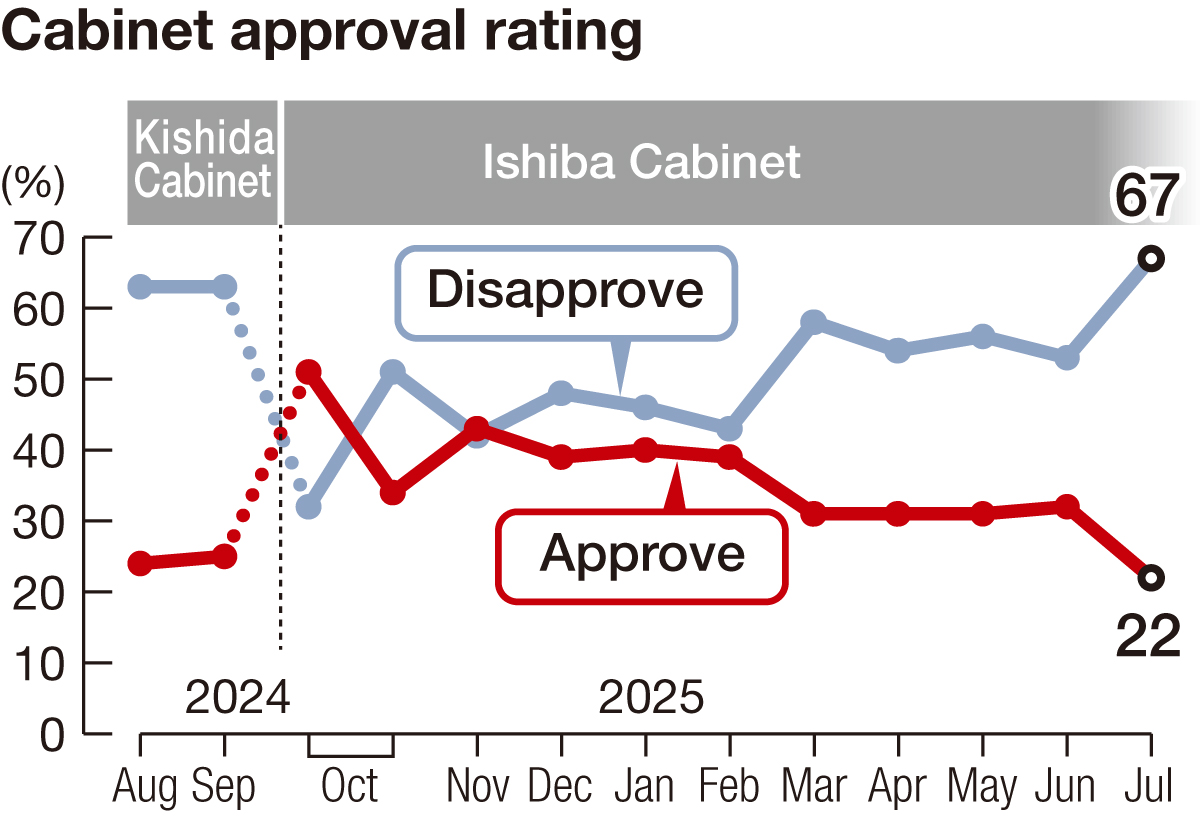
The approval rating for Prime Minister Shigeru Ishiba’s Cabinet plummeted to 22%, compared to 32% in the previous survey in June, in a recent Yomiuri Shimbun survey following the ruling bloc’s heavy loss in the House of Councillors election on Sunday.
The approval rating for the Ishiba Cabinet has fallen to its lowest level since the Cabinet was formed. The survey was conducted on Monday and Tuesday immediately after the election.
The number of seats won by the ruling Liberal Democratic Party and its coalition partner Komeito fell short of the target of 50 seats set by Ishiba, who is also the LDP president, and the ruling bloc eventually lost its majority in the upper house. In the survey, 54% of respondents said that Ishiba should resign after the election loss.
The approval rating of 22% is lower than the lowest rating of 23% during the previous Cabinet of Prime Minister Fumio Kishida, a figure recorded in a June 2024 survey.
According to the results broken down by political party affiliation, 61% of ruling bloc supporters approved the Cabinet, followed by 8% of those support opposition parties, and 14% of voters with no political affiliation.
The disapproval rating rose to 67%, compared to 53% in the previous June survey, exceeding 60% for the first time under the Ishiba Cabinet.
When asked if they thought Ishiba should resign, 67% of respondents age 18 to 39, 61% of those age 40 to 59, and 41% of those age 60 and older responded that he should, with younger people expressing more critical views.
When broken down by political party affiliation, 34% of LDP supporters said Ishiba should resign, followed by 67% of those who support opposition parties and 54% of voters with no political affiliation. A total of 35% of respondents said they did not think Ishiba should resign.
The survey was conducted by calling landline and mobile phone numbers selected via random digit dialing, targeting voters age 18 and older. From the landlines, 408 people were selected from 755 households where a voter was confirmed to reside, and from the mobile numbers, 635 people were selected from 1,830 who responded. A total of 1,043 provided answers.


Related Tags
-250x171.jpg)


Most Read
Popular articles in the past 24 hours
-

TEPCO to Reactivate Nuclear Reactor at Kashiwazaki-Kariwa Power P...
-

Travel Across PokéPark KANTO, Searching Far and Wide for Your Fav...
-

Tae Hitoto Leads Japanese Cyclists Planning Trip Around Taiwan to...
-

Israeli Ambassador to Japan Speaks about Japan’s Role in the Reco...
-

Japan’s Govt Sets Goal for World’s No. 3 in Number of Highly Cite...
-

Japan's Ginkakuji Temple to Increase Admission Fees for 1st Time ...
-
TMSC to Produce 3-Nanometer Semiconductors in Japan's Kumamoto Pr...
-
Sumo Scene / Sumo Matches Watched by Japan's Emperor for 1st Time...
Popular articles in the past week
-

Man Infected with Measles May Have Come in Contact with Many Peop...
-
Australian Woman Dies After Mishap on Ski Lift in Nagano Prefectu...
-
Foreign Snowboarder in Serious Condition After Hanging in Midair ...
-

Chinese Embassy in Japan Reiterates Call for Chinese People to Re...
-
Narita Airport, Startup in Japan Demonstrate Machine to Compress ...
-

Toyota Motor Group Firm to Sell Clean Energy Greenhouses for Stra...
-

Beer Yeast Helps Save Labor, Water Use in Growing Rice; Govt Hope...
-
Japan Tourism Agency Calls for Strengthening Measures Against Ove...
Popular articles in the past month
-

Univ. in Japan, Tokyo-Based Startup to Develop Satellite for Disa...
-

JAL, ANA Cancel Flights During 3-day Holiday Weekend due to Blizz...
-

Japan Institute to Use Domestic Commercial Optical Lattice Clock ...
-

China Eyes Rare Earth Foothold in Malaysia to Maintain Dominance,...
-
China Confirmed to Be Operating Drilling Vessel Near Japan-China ...
-
Man Infected with Measles May Have Come in Contact with Many Peop...
-

Japan, Qatar Ministers Agree on Need for Stable Energy Supplies; ...
-
Australian Woman Dies After Mishap on Ski Lift in Nagano Prefectu...
Top Articles in Politics
-
Japan Tourism Agency Calls for Strengthening Measures Against Overtourism
-

Japan Seeks to Enhance Defense Capabilities in Pacific as 3 National Security Documents to Be Revised
-

Japan’s Prime Minister: 2-Year Tax Cut on Food Possible Without Issuing Bonds
-

Voters Using AI to Choose Candidates in Japan’s Upcoming General Election; ChatGPT, Other AI Services Found Providing Incorrect Information
-
Japan-South Korea Leaders Meeting Focuses on Rare Earth Supply Chains, Cooperation Toward Regional Stability
JN ACCESS RANKING
-
Univ. in Japan, Tokyo-Based Startup to Develop Satellite for Disaster Prevention Measures, Bears
-
JAL, ANA Cancel Flights During 3-day Holiday Weekend due to Blizzard
-
Japan Institute to Use Domestic Commercial Optical Lattice Clock to Set Japan Standard Time
-
China Eyes Rare Earth Foothold in Malaysia to Maintain Dominance, Counter Japan, U.S.
-
Man Infected with Measles May Have Come in Contact with Many People in Tokyo, Went to Store, Restaurant Around When Symptoms Emerged