
Roles of Social Media in Elections: Election Admin Commissions Powerless Against Campaign Obstruction
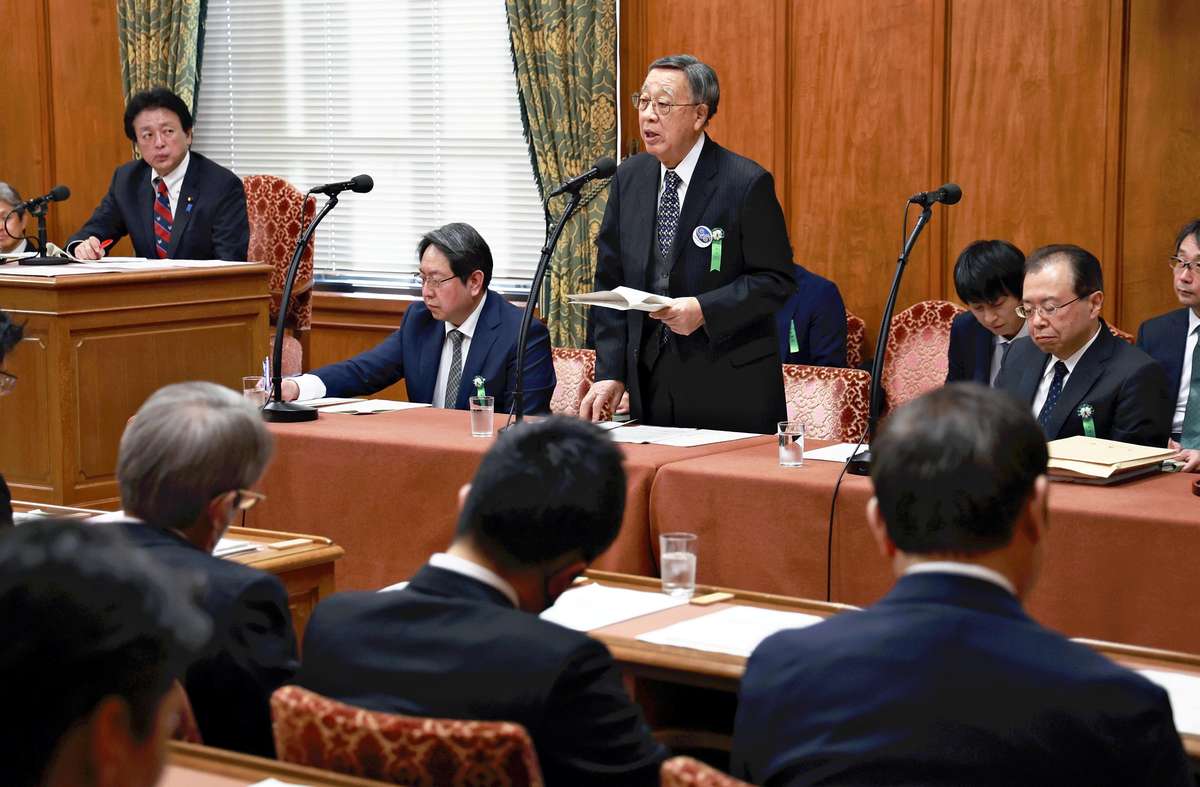
Hideichi Nagata, head of the Hyogo prefectural election administration commission, speaks at the House of Representatives’ Special Committee on Political Reform on Feb. 20.
6:00 JST, March 7, 2025
This is the fourth installment of a series of articles on the impact of social media impacts on elections from the perspective of those involved in election campaigns.
***
From the first day of campaigning for the House of Representatives by-election in Tokyo Constituency No. 15 in April last year, telephones at the election administration commission’s office in Koto Ward, Tokyo, were ringing off the hook. Calls flooded in from people who had watched certain videos on a particular video-sharing site.
“Democracy is under threat,” they complained. “Why aren’t you stopping these malicious acts?”
The video-sharing site in question was the YouTube channel operated by the political group Tsubasa no To. The group’s candidates and other members have repeatedly engaged in obstructive behaviors, following other candidates’ campaign cars in what the group called “car chases” and disrupting other candidates by shouting abuse through loudspeakers during their stump speeches. The group has profited from livestreaming themselves doing these things.
Some candidates were forced to stop making speeches, depriving voters of opportunities to hear candidates’ positions. Obstruction of election campaigns may be in violation of the Public Offices Election Law.
While performing their regular duties, officials of Koto Ward’s election administration commission identified behavior in the group’s videos that they suspected of violating the law and reported it to the Tokyo Metropolitan Police Department.
The group’s chief and two others were arrested and indicted for allegedly violating the Public Offices Election Law. However, this happened only after the election was over. Although the group’s obstructive activities continued through the last stages of campaigning, the ward election administration commission was unable to ask them to stop.
“If the election administration commission had intervened, we might have been seen as interfering with a free election. We had no choice but to be cautious,” said an official of Koto Ward’s election administration commission.
Election administration commissions are tasked with the management and execution of elections and encouraging people to vote, as well as taking care of election-related clerical work, such as setting up polling stations, registering candidates and counting ballots. By contrast, it is the police who respond to election irregularities.
Election administration commissions are responsible for conducting fair elections, but to what extent is a commission allowed to get involved in candidates’ campaign activities?
Half a century ago, there was a court case in which the question of how an election commission should respond to a candidate’s campaign was at issue.
In the 1975 mayoral election for Kazo City, Saitama Prefecture, one candidate put up campaign posters that criticized the incumbent candidate’s policies to combat discrimination against people from buraku or discriminated-against communities.
The city’s election administration commission requested the candidate to remove this language from the posters, claiming that it ran counter to laws meant to eliminate discrimination against such communities. The candidate agreed to delete the wording but was defeated in the election.
The candidate filed suit, claiming that the election was invalid. The trial reached the Supreme Court, which handed down a ruling in 1976.
“There exists no regulation that allows an election administration commission to review political opinions and arguments on election campaign posters and seek their deletion or revision. [These actions] harmed the freedom and fairness of the election,” the ruling said. As a result, the election was declared invalid.
“The ruling clearly showed that there is absolutely no room for election administration commissions to step in the content of candidates’ statements,” said Daisuke Shimizu, a member of a research organization on the electoral system, who formerly served as the head of the elections department of the Tokyo election administration commission.
Recent elections in Japan have seen a series of incidents and phenomena that could not be dealt with under existing laws, such as floods of disinformation and misinformation on social media and candidates selling election poster spaces that had been allocated to them.
Last year’s Hyogo gubernatorial election was preceded by whistleblowing accusations against Gov. Motohiko Saito of having bullied his subordinates.
Messages smearing prefectural assembly members who had pursued Saito and the allegations against him were spread on social media. The prefecture’s election administration commission reportedly received complaints from people, who claimed that certain social media posts were not true and that the election commission should issue guidance.
“It is the work of the police to decide whether an act is in violation of the Public Offices Election Law, and the election administration commission cannot do it,” said Hideichi Nagata, head of the commission, who attended the lower house’s Special Committee on Political Reform on Feb. 20.
“In the Hyogo gubernatorial election, more than a few voters were at a loss as to what they should believe in and whom they should vote for. I believe that legislation is needed to address these limitations on the law as it exists,” he added.
If it becomes possible to restrict the use of social media during the campaign period, this will presumably settle some of the confusion that exists surrounding elections.
“Even if these legal loopholes are closed, there still remain concerns that people might find other gaps and cause further irregularities, but it will work as a deterrent,” said a senior official of a local government election administration commission. “All we can do is continue to make efforts to inform the public about the new rules in an easy-to-understand way so that people will follow them.




Most Read
Popular articles in the past 24 hours
-

‘Dry Bonsai’ Gives New Life to Withered Trees, Allows Free Artist...
-

McDonald's Japan Raises Prices; Big Mac to Cost ¥500, Double Chee...
-

Nepal Bus Crash Kills 19 People, Injures 25 Including One Japanes...
-

Japan’s Nikkei Stock Average Rises as AI-Related Stocks Shine; Co...
-

Aggression against Ukraine: Malignant Precedent Must Not Be Set t...
-
Joruri Bunraku Narrative Performed in Honor of Donald Keene by La...
-

Astellas Collaborates with Vir to Develop Its Experimental Prosta...
-

Early-Blooming Kawazu Cherry Blossoms Create Sea of Pink at Park ...
Popular articles in the past week
-

Producer Behind Pop Group XG Arrested for Cocaine Possession
-

Japan PM Takaichi’s Cabinet Resigns en Masse
-

Sanae Takaichi Elected Prime Minister of Japan; Keeps All Cabinet...
-

Japan's Govt to Submit Road Map for Growth Strategy in March, PM ...
-

Bus Carrying 40 Passengers Catches Fire on Chuo Expressway; All E...
-
Japan, U.S. Name 3 Inaugural Investment Projects; Reached Agreeme...
-

Riku-Ryu Pair Wins Gold Medal: Their Strong Bond Leads to Major C...
-
Tokyo Skytree's Elevator Stops, Trapping 20 People; All Rescued (...
Popular articles in the past month
-
Producer Behind Pop Group XG Arrested for Cocaine Possession
-
Japan PM Takaichi’s Cabinet Resigns en Masse
-

Japan Institute to Use Domestic Commercial Optical Lattice Clock ...
-

Man Infected with Measles Reportedly Dined at Restaurant in Tokyo...
-

Israeli Ambassador to Japan Speaks about Japan’s Role in the Reco...
-

Videos Plagiarized, Reposted with False Subtitles Claiming ‘Ryuky...
-

Man Infected with Measles May Have Come in Contact with Many Peop...
-

Prudential Life Insurance Plans to Fully Compensate for Damages C...
Top Articles in Society
-
Producer Behind Pop Group XG Arrested for Cocaine Possession
-
Man Infected with Measles Reportedly Dined at Restaurant in Tokyo Station
-
Man Infected with Measles May Have Come in Contact with Many People in Tokyo, Went to Store, Restaurant Around When Symptoms Emerged
-

Woman with Measles Visited Hospital in Tokyo Multiple Times Before Being Diagnosed with Disease
-
Australian Woman Dies After Mishap on Ski Lift in Nagano Prefecture
JN ACCESS RANKING
-
Producer Behind Pop Group XG Arrested for Cocaine Possession
-
Japan PM Takaichi’s Cabinet Resigns en Masse
-
Japan Institute to Use Domestic Commercial Optical Lattice Clock to Set Japan Standard Time
-
Man Infected with Measles Reportedly Dined at Restaurant in Tokyo Station
-
Israeli Ambassador to Japan Speaks about Japan’s Role in the Reconstruction of Gaza