
Social Media and Elections: Lessons from Hyogo / Recent Japan Elections Illustrate Power of Social Media; Sympathy Widely Spreads for ‘Victim’ Candidates
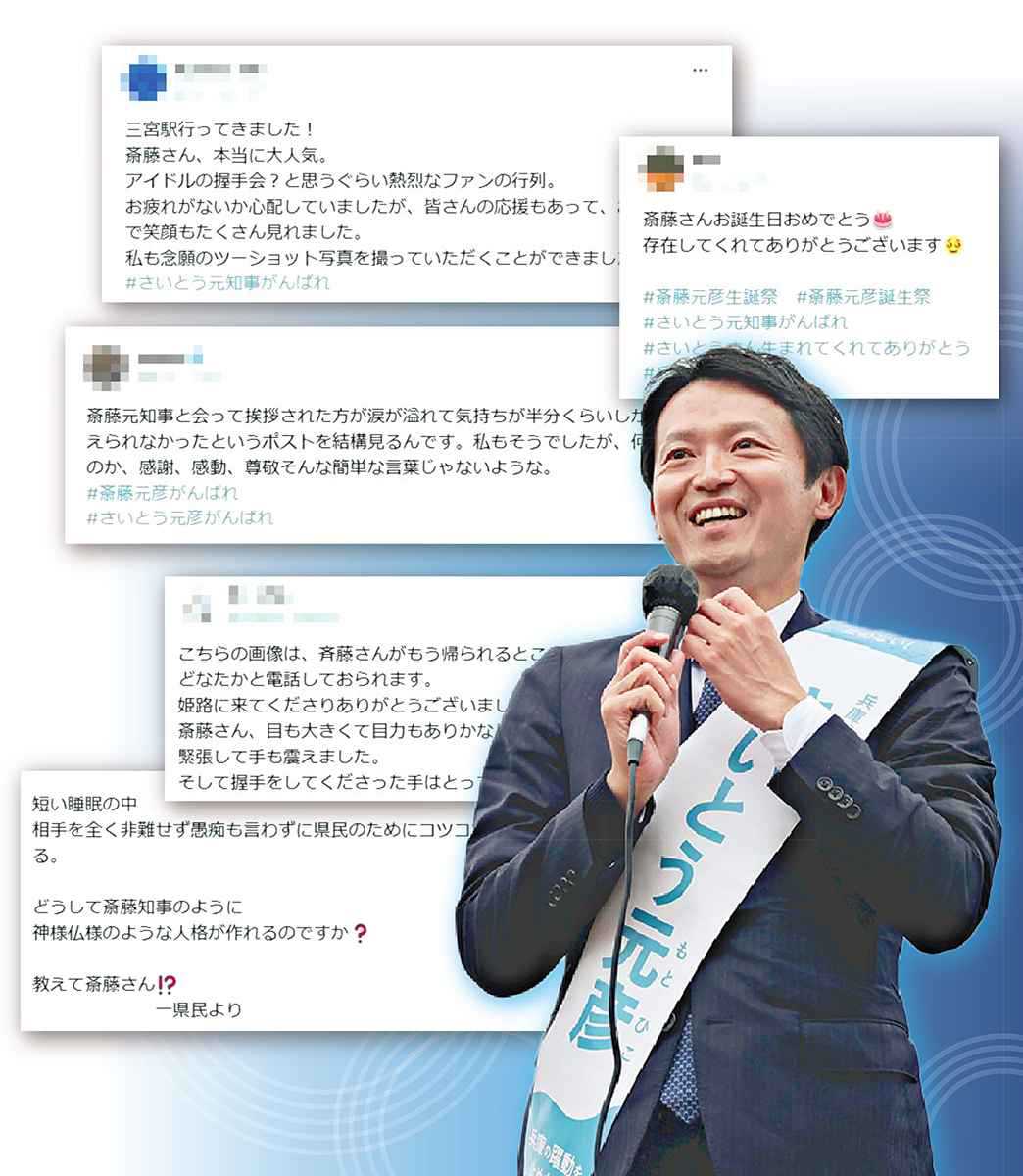
Many posts on the X social media platform treated Motohiko Saito as if he were an idol. The image is partially modified.
6:00 JST, November 29, 2024
This is the third and final installment in a series examining how social media is impacting elections.
***
“I saw myself in Saito,” said a 53-year-old female volunteer handling crowd control for a street speech by former Hyogo Gov. Motohiko Saito in Higashinada Ward, Kobe, on Nov. 11. Campaigning for the Hyogo gubernatorial election was underway, and the woman explained why she had joined Saito’s reelection bid.
About five years ago, a false rumor spread in the woman’s workplace, and she was almost forced to quit as a result. When she saw Saito being criticized on TV shows over accusations of harassment, she recalled herself at that time.
The woman looked through social media and came to believe that Saito had been set up. “Media outlets criticize him because a powerful force worked behind the scenes,” she said.
On-site, digital volunteers aid Saito
Saito’s main supporters were volunteers who gathered via social media.
The volunteers were led by a 65-year-old man in Akashi, Hyogo Prefecture, who is active under the name of “Yusuke Gojo.” According to Gojo, their efforts began when 10 people met near a station where Saito was promoting himself to passersby on Oct. 2, two days after he lost his position as governor.
They created a group on the Line messaging app independent from Saito’s camp and sought volunteers through the X social media platform.
As a result, about 500 “on-site” volunteers strove to support Saito by handling crowd control at his street speeches, taking videos and photos, and doing other work for him. About 400 other “digital” volunteers, including people from outside the prefecture, were in charge of social media activities such as editing videos and other content and posting them online.
“Many of them were dissatisfied with media reports about Saito,” Gojo said.
Shinji Ishimaru, 42, the former mayor of Akitakata, Hiroshima Prefecture, also saw this kind of increase in volunteers via social media. Ishimaru finished second in the Tokyo gubernatorial election in July.
What Saito and Ishimaru had in common was the perceived simplicity of their situations.
When Ishimaru was the mayor of Akitakata, he drew people’s attention because he clashed with municipal assembly members. In the Tokyo gubernatorial election, Ishimaru stressed that he would break with old politics.
Saito was likewise viewed as a victim of bullying, as the Hyogo prefectural assembly unanimously passed a no-confidence vote against him.
That view spread further as Takashi Tachibana, 57, the leader of the anti-NHK political group who also ran in the Hyogo gubernatorial election, expressed his support for Saito.
Saito himself gradually came to try to appeal to voters’ emotions, saying things such as “If I keep working hard, someone will recognize it.”
Fan community created?
Tami Yanagisawa, an associate professor of religious studies at Kwansei Gakuin University, said a fandom might have been created.
Fandom indicates a community of passionate fans who share common interests. Not only do they root for a person or thing, they also actively promote the appeal of that person or thing to others.
Fans who engage in “oshikatsu” activities, the act of passionately supporting favorite pop culture figures, are one example of fandom. If fans identify with someone, actively talk about them and spread posts about them on social media, a fandom gets bigger and stronger.
During Saito’s street speeches, some audiences cheered and said things like “You’re cool.” Posts with the hashtag #saitosanumaretekuretearigato (thank you for having been born, Mr. Saito) went viral on X.
“Fandom in itself is not a bad thing. However, if the purported simplicity of a situation is used to create a strong fandom, public opinion could be manipulated. People should see information while being aware that there are various different views,” Yanagisawa said.
At the same time, social media can encourage people to participate in politics.
In the Hyogo gubernatorial election, voter turnout was 55.65%, up 14.55 percentage points from the previous election. A Yomiuri Shimbun exit poll found that people who consulted social media to decide who to vote for gave the most importance to the “policies and pledges” of candidates.
Many people are believed to have become interested in the election via social media and learned about candidates’ policies.
A 72-year-old woman in Amagasaki, Hyogo Prefecture, used social media to gather information for the first time. “I sometimes felt nervous because I didn’t know what was right, but I was able to read policies advocated by candidates and the various opinions of other people, which helped me decide who to vote for,” she said.
Shinichi Yamaguchi, an associate professor of econometrics at the International University of Japan, said: “Social media has the advantage of allowing users to become familiar with politics and elections. While there are issues such as false information, we as a society should think about measures to address such issues and promote the use of social media.”
What kind of relationship should there be between elections and social media? That is the significant question we face.







Most Read
Popular articles in the past 24 hours
-

Moai Statue Shows Lasting Bond Between Miyagi Pref. Town, Easter ...
-

Milano Cortina 2026: Japan’s Oguri Wins Para Snowboard Silver at ...
-
Japan's Defense Ministry: North Korea Appears to Have Fired Balli...
-

National Intelligence Council: Proposed Body Must Be Utilized To ...
-

Aichi Fisheries Cooperatives Use Smart Tech to Farm Triploid Oyst...
-
Teachers Support Students’ Inquiry Learning behind the Scenes
-
Japan's Lower House Passes Budget Proposal; Could Be Delayed in U...
-

CARTOON OF THE DAY (March 14)
Popular articles in the past week
-

Japan Figure Skating Legend Yuzuru Hanyu Is Proud Disaster Surviv...
-

Govt to Utilize ODA for Ensuring Economic Security; Securing Ener...
-
15 Measles Patients Confirmed in Tokyo in Past 6 Days; 1 May Have...
-

Massive Sewer Pipe Found Jutting Out of Highway in Osaka
-

Japan Govt to Tighten Requirements to Receive Permanent Residency...
-
JR Tokai Breaks Ground on Yamanashi Maglev Station; Will Be Part ...
-

Power Outage Forces About 980 Passengers in Yokohama to Walk to T...
-

Beckoning Cats Get Makeover to Fit Modern Lifestyles with Sleek D...
Popular articles in the past month
-

Producer Behind Pop Group XG Arrested for Cocaine Possession
-

Japan PM Takaichi’s Cabinet Resigns en Masse
-

Man Infected with Measles Reportedly Dined at Restaurant in Tokyo...
-

Videos Plagiarized, Reposted with False Subtitles Claiming ‘Ryuky...
-
Japan Figure Skating Legend Yuzuru Hanyu Is Proud Disaster Surviv...
-

iPS Treatments Pass Key Milestone, but Broader Applications Far f...
-

Sanae Takaichi Elected Prime Minister of Japan; Keeps All Cabinet...
-

Nepal Bus Crash Kills 19 People, Injures 25 Including One Japanes...
Top Articles in Society
-
Producer Behind Pop Group XG Arrested for Cocaine Possession
-
Man Infected with Measles Reportedly Dined at Restaurant in Tokyo Station
-
15 Measles Patients Confirmed in Tokyo in Past 6 Days; 1 May Have Come into Contact with Many in Shibuya
-

Bus Carrying 40 Passengers Catches Fire on Chuo Expressway; All Evacuate Safely
-

Ibaraki Pref.’s 1st Foreign Bus Driver Hired in Tsukuba
JN ACCESS RANKING
-
Producer Behind Pop Group XG Arrested for Cocaine Possession
-
Japan PM Takaichi’s Cabinet Resigns en Masse
-
Man Infected with Measles Reportedly Dined at Restaurant in Tokyo Station
-
Videos Plagiarized, Reposted with False Subtitles Claiming ‘Ryukyu Belongs to China’; Anti-China False Information Also Posted in Japan
-
Japan Figure Skating Legend Yuzuru Hanyu Is Proud Disaster Survivor and Gold Medalist, Vows to Continue Support Efforts