
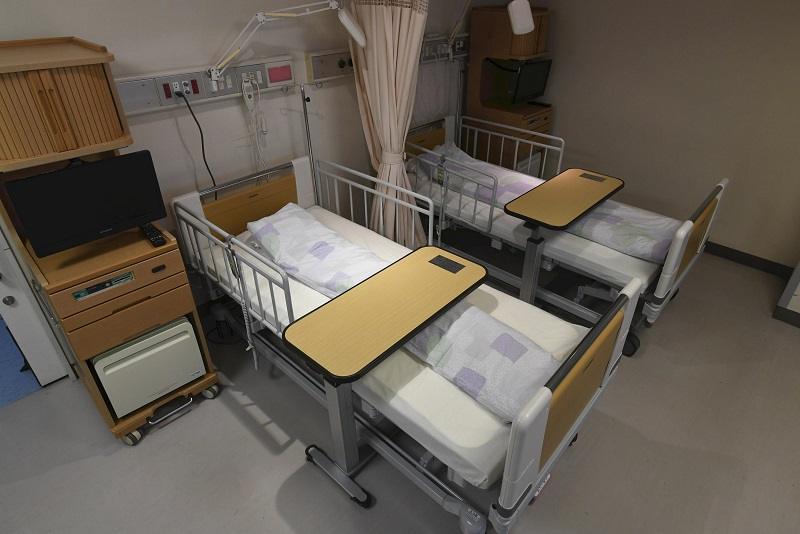
Hospital beds for elderly COVID-19 patients are seen at a temporary medical facility in Arakawa Ward, Tokyo, in February.
17:27 JST, April 4, 2022
The approval rating for the Cabinet of Prime Minister Fumio Kishida has remained relatively high since it launched six months ago, thanks to its position on Russia and its management of coronavirus infections.
The Cabinet has taken a firm stance against Russia since the country invaded Ukraine, and successfully avoided a collapse of the medical system despite the highest number of coronavirus infections.
The biggest challenge in the past six months has been how to respond to the sixth wave of infections caused by the omicron variant. Although the government was criticized for the delay in the third round of vaccinations and the shortage of antigen test kits, it was able to avoid declaring a state of emergency because it had expanded hospital beds for COVID-19 patients based on lessons learned from the fifth wave.
The omicron variant is also less likely to cause serious symptoms compared to the previously dominant delta variant, and that has contributed to the medical system’s stability. In the end, the surge of infections did not result in a fatal blow to the administration.
Policies have been implemented steadily through the efforts of Prime Minister’s Office officials. A team of secretaries led by Executive Secretary to the Prime Minister Takashi Shimada, who is a former vice minister of economy, trade and industry, deals with domestic affairs, while Takeo Akiba, secretary general of the National Security Secretariat and former vice minister for foreign affairs, coordinates details among ministries and agencies on diplomatic matters. Deputy Chief Cabinet Secretary Seiji Kihara, who is Kishida’s close aide, takes the initiative in sensitive matters before Kishida makes the final decision.
This bottom-up approach has enabled the administration to respond flexibly to challenges like the sixth wave.
Kishida is also supported for his handling of the Russia-Ukraine situation, according to the latest Yomiuri Shimbun survey.
At a summit meeting of the Group of Seven industrialized nations in Brussels on March 24, U.S. President Joe Biden was among the world leaders who expressed appreciation for Kishida’s decision to impose strict sanctions on Russia in alignment with the West, saying that he would like to pay his respects to Kishida for his leadership.
Since the Cabinet of former Prime Minister Shinzo Abe, the Japanese government has refrained from taking a firm stance on Russia — compared to the United States and European countries — out of consideration for negotiations over the northern territories.
However, Kishida had instructed officials to change this long-standing government policy even before the Russian invasion started, saying that it was “a fight to maintain the international order.”



Most Read
Popular articles in the past 24 hours
-

3 Brazilians Arrested for Stealing Toyota Land Cruiser; Trio Also...
-
Special Diet Session to Consider Budget, Proposed National Intell...
-
Japan, U.S. Name 3 Inaugural Investment Projects; Reached Agreeme...
-

Japan’s Nikkei Stock Average Rises on Tech Rally and Takaichi's S...
-

Security Services Law Unconstitutional: Do Not Restrict Career Ch...
-
New Leader of Japan's CRA Opposition Party Faces Challenge of For...
-
Takaichi Expected to Express Desire for Constitutional Revision P...
-

Tokyo Exhibition Featuring VR Walk Through 2025 Osaka-Kansai Expo...
Popular articles in the past week
-

Japan PM Takaichi’s Cabinet Resigns en Masse
-

Man Infected with Measles Reportedly Dined at Restaurant in Tokyo...
-

Videos Plagiarized, Reposted with False Subtitles Claiming ‘Ryuky...
-

Sanae Takaichi Elected 105th Prime Minister of Japan; Keeps All C...
-
Japan's Govt to Submit Road Map for Growth Strategy in March, PM ...
-

Milano Cortina 2026: Figure Skaters Riku Miura, Ryuichi Kihara Pa...
-

Tokyo’s New Record-Breaking Fountain Named ‘Tokyo Aqua Symphony’
-

Bus Carrying 40 Passengers Catches Fire on Chuo Expressway; All E...
Popular articles in the past month
-
Japan PM Takaichi’s Cabinet Resigns en Masse
-

Japan Institute to Use Domestic Commercial Optical Lattice Clock ...
-

Israeli Ambassador to Japan Speaks about Japan’s Role in the Reco...
-
Man Infected with Measles Reportedly Dined at Restaurant in Tokyo...
-

Man Infected with Measles May Have Come in Contact with Many Peop...
-

Prudential Life Insurance Plans to Fully Compensate for Damages C...
-
Videos Plagiarized, Reposted with False Subtitles Claiming ‘Ryuky...
-
Woman with Measles Visited Hospital in Tokyo Multiple Times Befor...
Top Articles in Politics
-
Japan PM Takaichi’s Cabinet Resigns en Masse
-
Sanae Takaichi Elected 105th Prime Minister of Japan; Keeps All Cabinet Appointees from Previous Term
-
Japan’s Govt to Submit Road Map for Growth Strategy in March, PM Takaichi to Announce in Upcoming Policy Speech
-

LDP Wins Historic Landslide Victory
-

LDP Wins Landslide Victory, Secures Single-party Majority; Ruling Coalition with JIP Poised to Secure Over 300 seats (UPDATE 1)
JN ACCESS RANKING
-
Japan PM Takaichi’s Cabinet Resigns en Masse
-
Japan Institute to Use Domestic Commercial Optical Lattice Clock to Set Japan Standard Time
-
Israeli Ambassador to Japan Speaks about Japan’s Role in the Reconstruction of Gaza
-
Man Infected with Measles Reportedly Dined at Restaurant in Tokyo Station
-
Man Infected with Measles May Have Come in Contact with Many People in Tokyo, Went to Store, Restaurant Around When Symptoms Emerged