
Upper House Begins Deliberations on Joint Custody; Looking to Clarify Family Court Role, Decision-making Process

The Diet Building in Chiyoda Ward, Tokyo
17:36 JST, April 26, 2024
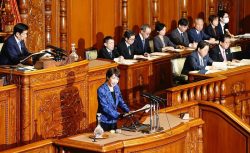
The House of Councillors’ Judicial Affairs Committee began deliberations on Thursday for a bill for Civil Code revision centered on a proposal for the introduction of a joint custody system in which both parents have legal custody of their child or children after divorce.
Opposition parties call for clarifying criteria for a family court to determine whether joint or sole custody should be granted and specifying the range of circumstances in which one parent will be allowed to exercise independent parental rights, among other demands.
Under the current Civil Code, parental custody is granted to only one of the parents after divorce. The bill revises the current system to allow divorced parents to choose joint custody if they agree to do so.
If the bill is passed into law during the current Diet session, the new system will be implemented by fiscal 2026, allowing couples divorced before the implementation to switch to joint custody by filing a request with a family court.
“We will review the current provision to ensure the interests of the child, considering circumstances such as the increasingly diverse ways of raising children,” Justice Minister Ryuji Koizumi said.
Opposition parties especially see the proposed criteria for the family court to choose sole custody as problematic.
According to the bill, if parents fail to reach an agreement on custody of their child or children after divorce, a family court will determine custody arrangements. The bill also stipulates that, if there is a risk of domestic violence or child abuse, the court must choose sole custody.
During Thursday’s deliberations, there were many questions about how the risk of domestic violence or child abuse would be recognized.
Hiroe Makiyama, a member of the Constitutional Democratic Party of Japan, pointed out that the family court does not always make appropriate decisions, given that it is often difficult to find evidence of harm received behind closed doors.
“Various circumstances should be considered, regardless of whether objective evidence is present or not,” Koizumi said.
Regarding the information provided by public institutions from which suspected victims of abuse sought help, “Such information will be taken into account as an important element to determine the facts,” Koizumi said.







Most Read
Popular articles in the past 24 hours
-
Japan Seeks to Counter China's Expanding Influence in Pacific by ...
-

Exhibition Featuring Yoshiharu Tsuge’s Manga World Underway in Ch...
-

Tokyo Skytree Observation Deck Remains Closed for Inspection afte...
-

Japanese Watermelon Shipments Starts in Leading Production Distri...
-

Impact on Japanese Economy Unclear with Trump’s New Tariffs, Shif...
-

Takeshima Day: Persistently Demanding Resolution from South Korea...
-

Hanzomon Line Service Suspended between Kudanshita, Oshiage Stati...
-

CARTOON OF THE DAY (February 25)
Popular articles in the past week
-

Producer Behind Pop Group XG Arrested for Cocaine Possession
-

iPS Treatments Pass Key Milestone, but Broader Applications Far f...
-

Japan, U.S. Name 3 Inaugural Investment Projects; Reached Agreeme...
-

Tokyo Skytree's Elevator Stops, Trapping 20 People; All Rescued (...
-

Director Naomi Kawase's New Film Explores Heart Transplants in Ja...
-

Japan’s Major Real Estate Firms Expanding Overseas Businesses to ...
-

Milano Cortina 2026: Japanese Figure Skater Kaori Sakamoto’...
-

Baby Monkey Punch Captures Hearts at Chiba Pref. Zoo, on Social M...
Popular articles in the past month
-
Producer Behind Pop Group XG Arrested for Cocaine Possession
-

Japan PM Takaichi’s Cabinet Resigns en Masse
-

Japan Institute to Use Domestic Commercial Optical Lattice Clock ...
-

Man Infected with Measles Reportedly Dined at Restaurant in Tokyo...
-

Israeli Ambassador to Japan Speaks about Japan’s Role in the Reco...
-

Videos Plagiarized, Reposted with False Subtitles Claiming ‘Ryuky...
-

Man Infected with Measles May Have Come in Contact with Many Peop...
-

Prudential Life Insurance Plans to Fully Compensate for Damages C...
Top Articles in Politics
-
Japan PM Takaichi’s Cabinet Resigns en Masse
-

Sanae Takaichi Elected Prime Minister of Japan; Keeps All Cabinet Appointees from Previous Term
-

Japan’s Govt to Submit Road Map for Growth Strategy in March, PM Takaichi to Announce in Upcoming Policy Speech
-

LDP Wins Historic Landslide Victory
-

LDP Wins Landslide Victory, Secures Single-party Majority; Ruling Coalition with JIP Poised to Secure Over 300 seats (UPDATE 1)
JN ACCESS RANKING
-
Producer Behind Pop Group XG Arrested for Cocaine Possession
-
Japan PM Takaichi’s Cabinet Resigns en Masse
-
Man Infected with Measles Reportedly Dined at Restaurant in Tokyo Station
-
Israeli Ambassador to Japan Speaks about Japan’s Role in the Reconstruction of Gaza
-
Videos Plagiarized, Reposted with False Subtitles Claiming ‘Ryukyu Belongs to China’; Anti-China False Information Also Posted in Japan