
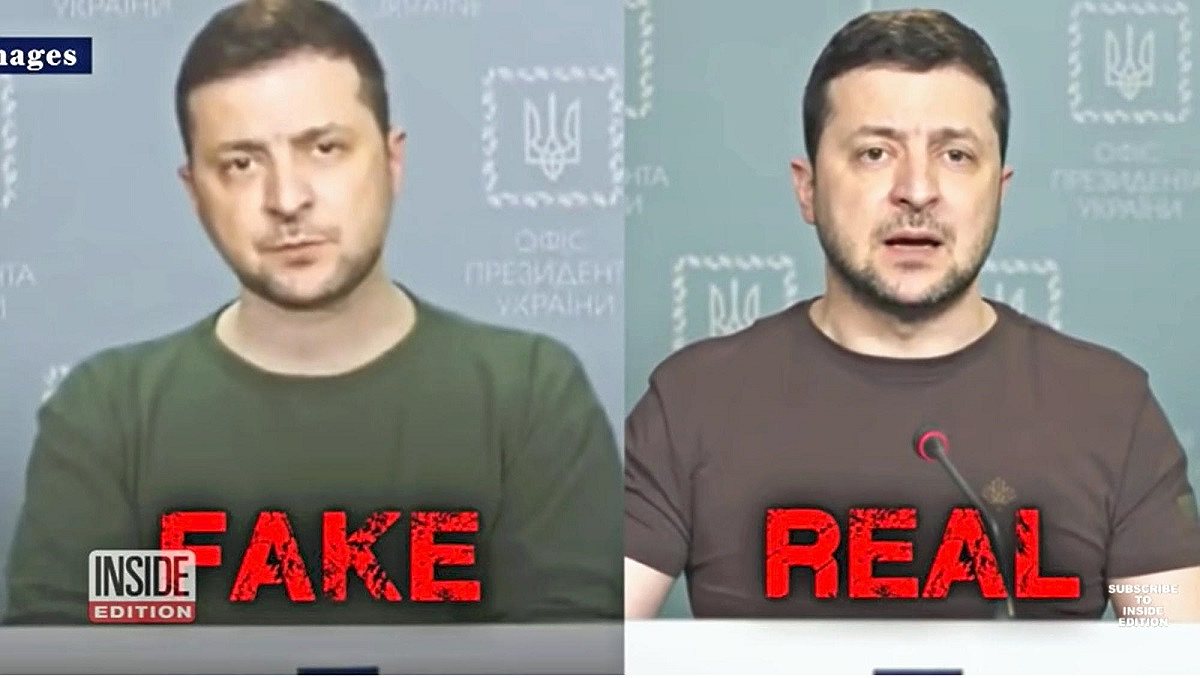
Ukrainian President Volodymyr Zelenskyy, right, speaks in a screenshot captured from the YouTube channel of U.S. news program “Inside Edition.” The image on the left is a deepfake.
15:59 JST, August 30, 2023
A method to restore deepfakes to the original content has been developed by a National Institute of Informatics team.
The misuse of these convincingly realistic fake videos created using artificial intelligence software has become an issue affecting society. For example, a person’s face can be replaced by that of a celebrity or politician and the voice and facial expressions can seem to show something the celebrity or politician never said or did.
Ahead of the U.S. presidential election next year, controversy has arisen after the campaigns of former U.S. Donald President Trump and current Florida Gov. Ron DeSantis posted fake videos on social media in an attempt to manipulate voters’ impressions. Both are vying to win the Republican Party’s nomination for the White House.
In recent years, it has become increasingly easy to generate deepfakes using apps and other computer programs. As technology for creating deepfakes becomes more sophisticated, it becomes more difficult to detect what is being faked.
Given the situation, the Japanese government has supported through subsidies and other assistance the efforts of universities and research institutes to develop technology to detect fake videos.
The team at NII, which is under the jurisdiction of the Education, Culture, Sports, Science and Technology Ministry, will look to use its method on deepfakes of public institutions and celebrities.
The method involves embedding data identifiers about a person’s facial features. Even if the face is merged with that of a different person, the information in the video can be used as clues to restore the original face.
The team said it tested its method on about 200 deepfakes and successfully restored most of them highly accurately.
“Like a vaccine administered in advance to fight off an illness, our method can be used as a ‘cyber vaccine’ to prevent the misuse of fake videos,” said team leader Isao Echizen, the director of NII’s Information and Society Research Division.
There are of course still issues to be dealt with when using the method. For example, the method cannot restore a video if the person is not facing forward or if the image is dark.
As the team continues to improve the accuracy of its method, it is considering offering the technology upon request from enterprises and other outside entities.
Toshihiko Yamasaki, a University of Tokyo professor and expert on deepfake research, called the institute’s method “an achievement that can serve to deter the misuse of fake videos.”
“If more complex information is embedded in a video, security is likely to be further enhanced,” he said.


Most Read
Popular articles in the past 24 hours
-

Hunting for Small Details in PokéPark KANTO, Keep a Sharp Eye Out...
-
Japan, Thailand Bolster Cooperation to Combat Human Trafficking; ...
-

TEPCO’s Restructuring Plan: Develop Business Partnership Plans fo...
-
Sapporo Snow Festival Opens with 210 Snow and Ice Sculptures at 3...
-

Japan's Nikkei Stock Average Slips after Sharp Gain as Software F...
-
Shogi Star Sota Fujii Earns Record ¥200 Million Plus, Reigns as M...
-

Seeking Shelter from Trump's Fury, U.S. Trade Partners Reach Deal...
-
Levels of Enthusiasm Differ within Japan's Ruling Parties on Expo...
Popular articles in the past week
-
Australian Woman Dies After Mishap on Ski Lift in Nagano Prefectu...
-
Foreign Snowboarder in Serious Condition After Hanging in Midair ...
-
Chinese Embassy in Japan Reiterates Call for Chinese People to Re...
-
Narita Airport, Startup in Japan Demonstrate Machine to Compress ...
-

Toyota Motor Group Firm to Sell Clean Energy Greenhouses for Stra...
-

Man Infected with Measles May Have Come in Contact with Many Peop...
-

Beer Yeast Helps Save Labor, Water Use in Growing Rice; Govt Hope...
-
Japan Tourism Agency Calls for Strengthening Measures Against Ove...
Popular articles in the past month
-
Univ. in Japan, Tokyo-Based Startup to Develop Satellite for Disa...
-
JAL, ANA Cancel Flights During 3-day Holiday Weekend due to Blizz...
-
China Confirmed to Be Operating Drilling Vessel Near Japan-China ...
-

China Eyes Rare Earth Foothold in Malaysia to Maintain Dominance,...
-

Japan Institute to Use Domestic Commercial Optical Lattice Clock ...
-
M6.2 Earthquake Hits Japan's Tottori, Shimane Prefectures; No Tsu...
-

Japan, Qatar Ministers Agree on Need for Stable Energy Supplies; ...
-
Japan, Italy to Boost LNG Cooperation; Aimed at Diversifying Japa...
Top Articles in Society
-
JAL, ANA Cancel Flights During 3-day Holiday Weekend due to Blizzard
-
Australian Woman Dies After Mishap on Ski Lift in Nagano Prefecture
-
Record-Breaking Snow Cripples Public Transport in Hokkaido; 7,000 People Stay Overnight at New Chitose Airport
-
Foreign Snowboarder in Serious Condition After Hanging in Midair from Chairlift in Nagano Prefecture
-
Train Services in Tokyo Resume Following Power Outage That Suspended Yamanote, Keihin-Tohoku Lines (Update 4)
JN ACCESS RANKING
-
Univ. in Japan, Tokyo-Based Startup to Develop Satellite for Disaster Prevention Measures, Bears
-
JAL, ANA Cancel Flights During 3-day Holiday Weekend due to Blizzard
-
China Confirmed to Be Operating Drilling Vessel Near Japan-China Median Line
-
China Eyes Rare Earth Foothold in Malaysia to Maintain Dominance, Counter Japan, U.S.
-
Japan Institute to Use Domestic Commercial Optical Lattice Clock to Set Japan Standard Time