
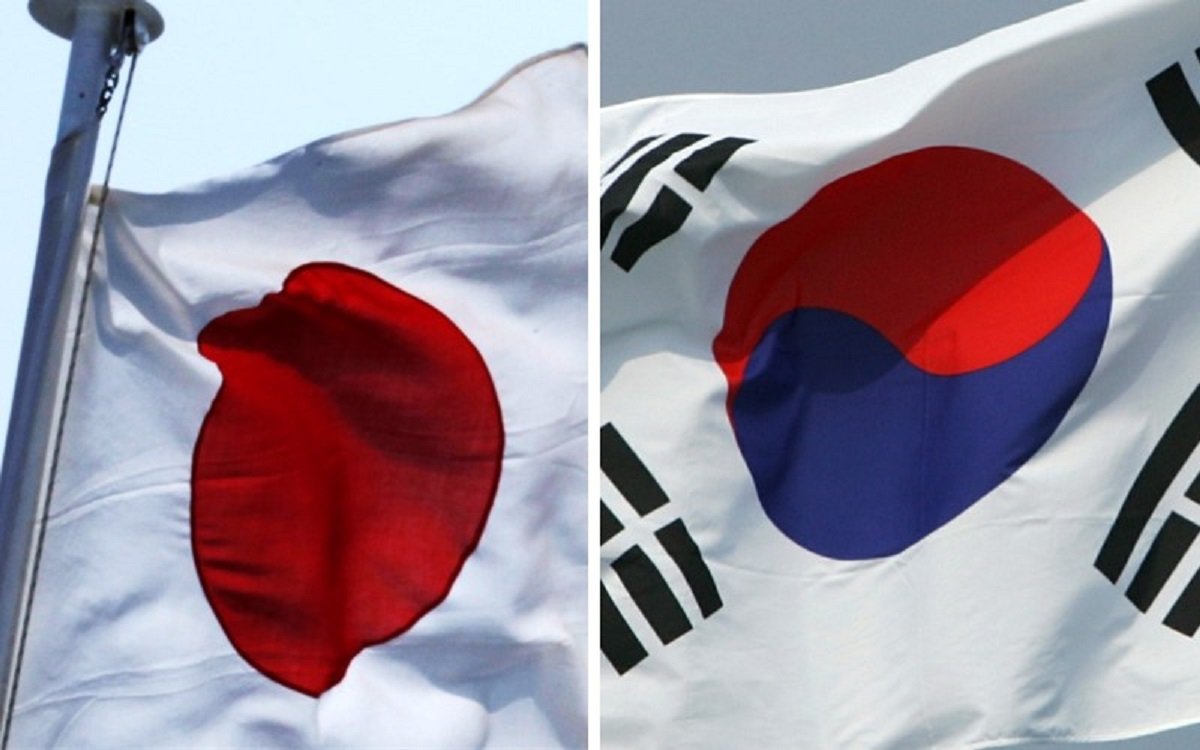
The Japanese flag (L) and South Korean flag (R)
17:04 JST, January 19, 2021
Following South Korean President Moon Jae-in’s speech regarding lawsuits involving former wartime requisitioned workers, the Japanese government is waiting for South Korea’s next move, to see whether Seoul will come up with a solution acceptable to Tokyo.
“Seoul has not referred to any concrete solutions, therefore its stance remains basically unchanged,” a senior Japanese government official said.
The 1965 Agreement on the Settlement of Problems concerning Property and Claims and on Economic Cooperation between the two countries stipulates that problems and claims had been resolved “completely and finally.” Based on this agreement, Japan provided South Korea with economic cooperation worth $500 million — $300 million in grants and $200 million in loans.
Tokyo has been demanding that Seoul resolve the issue, claiming that the South Korean court ruling ordering Japanese companies to pay damages to former requisitioned workers violates the agreement.
The Japanese government cannot concede its firm position that the Japan side is not liable to pay compensation. Even if South Korea proposes a solution in which Japanese companies are spared the financial burden, the Japanese government is unlikely to accept it if the proposal is based on the premise that Japan is liable.
Regarding the Seoul Central District Court’s ruling ordering the Japanese government to pay compensation to former comfort women, Japan does not even recognize the trial itself. Japan argues that it violates the principle of sovereign immunity under international law, in which the acts of a certain state are not tried in the courts of another state.
Regarding Moon’s remarks, in which he expressed his intention to confer with the Japanese side about the ruling, a person close to the Japanese Foreign Ministry said: “This is not an issue that can be resolved through bilateral talks. South Korea has no option but to lobby the plaintiffs and others to invalidate the lawsuit.”
Prime Minister Yoshihide Suga referred to South Korea as an “important neighbor” in his policy speech on Monday. In contrast, he called it “an extremely important neighboring country” in his first policy speech in October last year, and former Prime Minister Shinzo Abe used a similar phrase in his policy speech in January 2020.
The latest wording represents a “downgrading” of South Korea and appears to reflect distrust toward that nation, which has not rectified violations of international law.





Most Read
Most read in the last 24 hours
-
Promote Support, Respect to Help Prevent Harassment of Athletes
-

Yamato Museum Reopens in Hiroshima Pref. Following Extensive Reno...
-
Japanese Govt to Set Up Panel on Widening Access to Sports Broadc...
-

New Budget Framework for Investments: Work to Achieve Both Growth...
-
Toyota Unveils New Development Hub in Woven City Repurposed from ...
-
Elegant Weeping Cherry Blossoms on Display at Water Purification ...
-
Fukui: Dinosaur Faculty Building Unveiled in Japanese University'...
-
Man Admits to Abandoning Wife's Body in Zoo Incinerator in Hokkai...
Most read in the last 7 days
-
Earthquake Hits Japan's Tohoku Region; 3-meter Tsunami Warning Is...
-
China, South Korea Object to Japanese PM Takaichi's Ritual Offeri...
-

Trump Extends the Ceasefire with Iran but Keeps the Blockade
-

India's Arms Indigenization Quest for Self-Reliance / New Delhi S...
-
Japan to Ban Use of Portable Chargers on Airplanes from April 24,...
-
¥1,000 Coins to Be Issued to Mark Anniversary of Beginning of Jap...
-

Most Serious Cyberattacks against the UK Now from Russia, Iran an...
-

Trump Opposes United–American Merger, Signals Support for Spirit
Most read in the last 30 days
-
Earthquake Hits Japan's Tohoku Region; 3-meter Tsunami Warning Is...
-
Police Find Child's Shoe During Search for Missing Boy in Nantan,...
-
Body Found in Nantan, Kyoto Prefecture, During Search for 11-Year...
-
Cherry Blossoms, Rapeseed Flowers Perform Colorful ‘Duet’ in Niig...
-
China, South Korea Object to Japanese PM Takaichi's Ritual Offeri...
-
Trump Extends the Ceasefire with Iran but Keeps the Blockade
-

Olympic Gold Medal-Winning Figure Skaters Riku-Ryu Announce Retir...
-
Japanese Prime Minister Takaichi Speaks to Pakistani Prime Minist...
Top Articles in Politics
-
India’s Arms Indigenization Quest for Self-Reliance / New Delhi Sticks to Its ‘All-Alignment’ Guns Even after Iran Warship Attack
-
Japan Aims to Enhance Deterrence, Defense Industry by Allowing Exports of Weapons
-
Former Japan PM Murayama’s Farewell Ceremony Held; Former Deputy PM Kono Vows to ‘Carry on Path Toward Peace’
-

Chinese Warships Cruise Past Japanese Islands in Retaliation for MSDF Ship Using Taiwan Strait
-

Japan’s PM Takaichi Seeks to Advance Policies Bearing Her Own ‘Color,’ Eyes Amending Constitution, Building Strong Economy
JN ACCESS RANKING
-
Earthquake Hits Japan’s Tohoku Region; 3-meter Tsunami Warning Issued (Update 1)
-
Police Find Child’s Shoe During Search for Missing Boy in Nantan, Kyoto Prefecture
-
Body Found in Nantan, Kyoto Prefecture, During Search for 11-Year-Old Boy in Area (Update 1)
-
Cherry Blossoms, Rapeseed Flowers Perform Colorful ‘Duet’ in Niigata
-
China, South Korea Object to Japanese PM Takaichi’s Ritual Offering to Yasukuni Shrine
Most read in the last 24 hours
-
Promote Support, Respect to Help Prevent Harassment of Athletes
-
Yamato Museum Reopens in Hiroshima Pref. Following Extensive Reno...
-
Japanese Govt to Set Up Panel on Widening Access to Sports Broadc...
-
New Budget Framework for Investments: Work to Achieve Both Growth...
-
Toyota Unveils New Development Hub in Woven City Repurposed from ...
Most read in the last 7 days
-
Earthquake Hits Japan's Tohoku Region; 3-meter Tsunami Warning Is...
-
China, South Korea Object to Japanese PM Takaichi's Ritual Offeri...
-
Trump Extends the Ceasefire with Iran but Keeps the Blockade
-
India's Arms Indigenization Quest for Self-Reliance / New Delhi S...
-
Japan to Ban Use of Portable Chargers on Airplanes from April 24,...
Most read in the last 30 days
-
Earthquake Hits Japan's Tohoku Region; 3-meter Tsunami Warning Is...
-
Police Find Child's Shoe During Search for Missing Boy in Nantan,...
-
Body Found in Nantan, Kyoto Prefecture, During Search for 11-Year...
-
Cherry Blossoms, Rapeseed Flowers Perform Colorful ‘Duet’ in Niig...
-
China, South Korea Object to Japanese PM Takaichi's Ritual Offeri...