
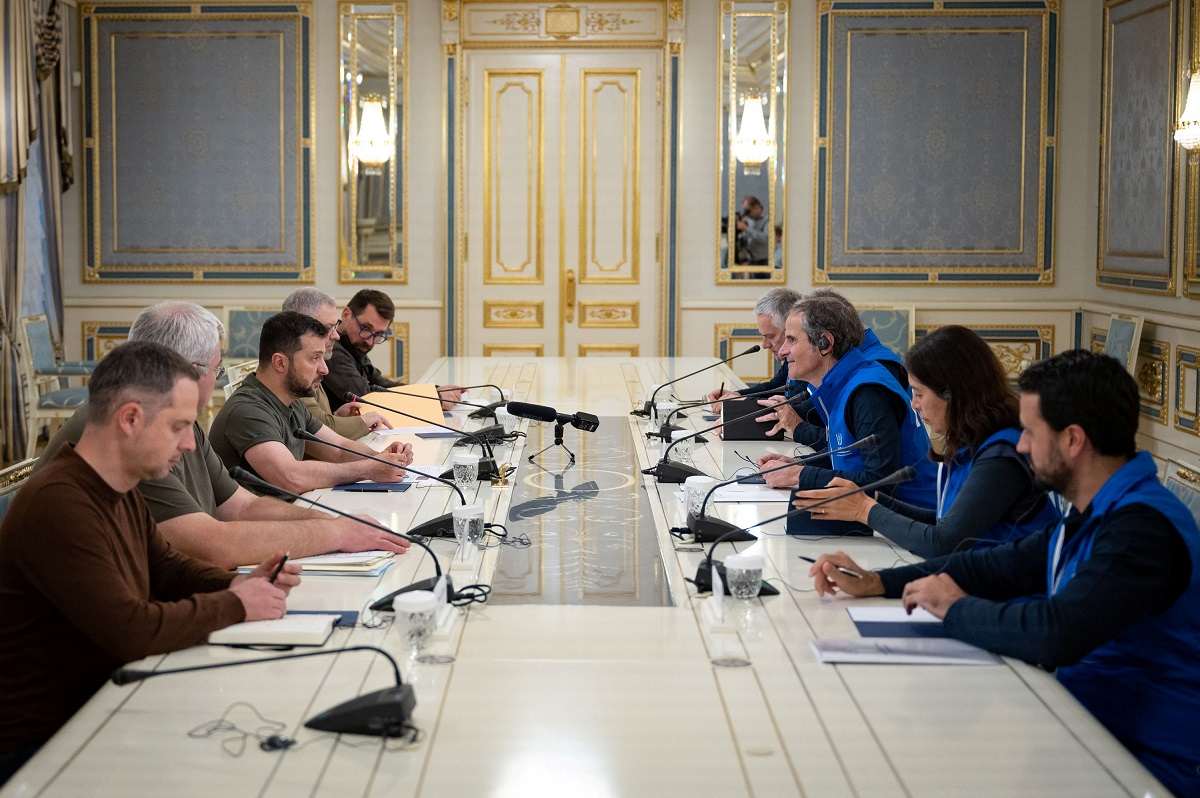
International Atomic Energy Agency (IAEA) Director General Rafael Grossi and Ukraine’s President Volodymyr Zelenskiy attend a meeting, amid Russia’s attack on Ukraine, in Kyiv, Ukraine June 13, 2023.
11:22 JST, June 14, 2023
KYIV (Reuters) – U.N. nuclear chief Rafael Grossi visited Kyiv on Tuesday, where he met President Volodymyr Zelenskiy before traveling to Ukraine’s Russian-occupied Zaporizhzhia nuclear plant near where a huge river dam was destroyed last week.
The International Atomic Energy Agency (IAEA) said on Sunday it needed access to a site near the plant to check water levels after the reservoir lost a large portion of its water because of the destruction of the Kakhovka dam downstream.
Both sides have accused each other of sabotaging the dam, leading to catastrophic flooding. Western countries say they are still gathering evidence but believe Ukraine would have had no reason to inflict such a disaster on itself.
Russian forces captured the hydroelectric dam and the nuclear plant in southern Ukraine shortly after their February 2022 invasion.
The Zaporizhzhia nuclear plant uses a cooling pond to keep its six reactors from potentially disastrous overheating.
Ukraine’s nuclear energy company said on Tuesday that the level of the pond was stable and that the water was high enough.
As of Tuesday morning, the water level stood at 16.67 meters (54.69 feet), which Energoatom said was “quite enough to meet the needs of the station.”
Speaking to reporters in Kyiv, Grossi said there was no immediate danger but that it was a “serious situation.”
“It is a step in the wrong direction,” he said. “It is yet another step into the weakening of the safety net that one has in any nuclear power plant.”
Grossi said his visit to the facility, Europe’s largest, on Tuesday evening would provide a more accurate assessment of the risk.
The Kakhovka reservoir was normally used to refill the pond but cannot do so now because of its falling water level, Ukrainian nuclear authorities have said.
Instead, the pond, which is separated from the reservoir, can be replenished using deep underground wells, they said.
The water in the pond is also expended very slowly because the reactors are not producing power and water does not evaporate quickly during the cooling process.
Grossi also said he was “very concerned” that the nuclear plant could be caught in Ukraine’s counteroffensive to retake Russian-occupied territory.
He added that there was no sign Russian forces had moved heavy military equipment to the site, but that his visit would aim to clarify that.
“We do not have any indication at this point, but it could not be excluded,” he said.









Most Read
Popular articles in the past 24 hours
-
Milano Cortina 2026: Japanese Gold Medalist Figure Skater Miura S...
-

Yokohama to Test Out Renewable-Powered Offshore Floating Data Cen...
-
Japan’s Takaichi Speaks on New U.S. Tariff in Upper House, Says P...
-

Ishinomaki Man Plush Toy Offers Hope to Children in Times of Disa...
-
Japan Authorities Begin On-site Inspection of Japanese Microsoft ...
-

Japan's Takaichi Lets LDP Lawmakers Choose Gifts for Election Suc...
-

Nikkei Tops 59,000 for First Time
-

Dodgers' Roki Sasaki Erratic in First Spring Training Outing, Giv...
Popular articles in the past week
-

Producer Behind Pop Group XG Arrested for Cocaine Possession
-

iPS Treatments Pass Key Milestone, but Broader Applications Far f...
-

Japan, U.S. Name 3 Inaugural Investment Projects; Reached Agreeme...
-

Tokyo Skytree's Elevator Stops, Trapping 20 People; All Rescued (...
-

Japan’s Major Real Estate Firms Expanding Overseas Businesses to ...
-
Milano Cortina 2026: Japanese Gold Medalist Figure Skater Miura S...
-

Baby Monkey Punch Captures Hearts at Chiba Pref. Zoo, on Social M...
-

Milano Cortina 2026: Japanese Figure Skater Kaori Sakamoto’...
Popular articles in the past month
-
Producer Behind Pop Group XG Arrested for Cocaine Possession
-

Japan PM Takaichi’s Cabinet Resigns en Masse
-

Japan Institute to Use Domestic Commercial Optical Lattice Clock ...
-

Man Infected with Measles Reportedly Dined at Restaurant in Tokyo...
-

Israeli Ambassador to Japan Speaks about Japan’s Role in the Reco...
-

Videos Plagiarized, Reposted with False Subtitles Claiming ‘Ryuky...
-

Man Infected with Measles May Have Come in Contact with Many Peop...
-

Prudential Life Insurance Plans to Fully Compensate for Damages C...
Top Articles in News Services
-
Survey Shows False Election Info Perceived as True
-
Hong Kong Ex-Publisher Jimmy Lai’s Sentence Raises International Outcry as China Defends It
-
Japan’s Nikkei Stock Average Touches 58,000 as Yen, Jgbs Rally on Election Fallout (UPDATE 1)
-
Japan’s Nikkei Stock Average Falls as US-Iran Tensions Unsettle Investors (UPDATE 1)
-

Trump Names Former Federal Reserve Governor Warsh as the Next Fed Chair, Replacing Powell
JN ACCESS RANKING
-
Producer Behind Pop Group XG Arrested for Cocaine Possession
-
Japan PM Takaichi’s Cabinet Resigns en Masse
-
Man Infected with Measles Reportedly Dined at Restaurant in Tokyo Station
-
Israeli Ambassador to Japan Speaks about Japan’s Role in the Reconstruction of Gaza
-
Videos Plagiarized, Reposted with False Subtitles Claiming ‘Ryukyu Belongs to China’; Anti-China False Information Also Posted in Japan