
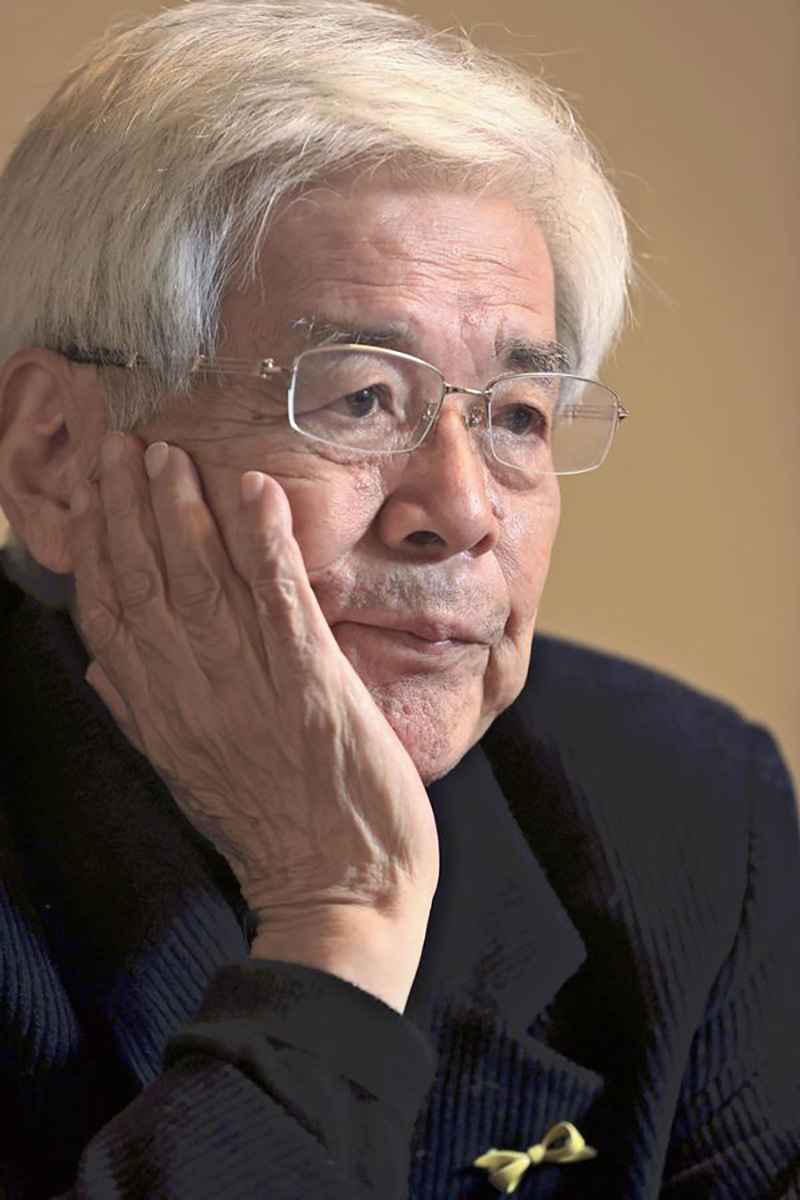
“As I get older, I become more realistic on a daily basis,” Takeshi Yoro said during a recent interview in Shinjuku Ward, Tokyo.
10:21 JST, February 3, 2022
Critic and anatomist Takeshi Yoro, the author of the longtime best-selling book “Baka no Kabe” (What a fool believes), had his new book published in late December. Titled “Hito no Kabe” (Homo sapiens’ wall), the book demonstrates that at age 84, Yoro has yet to stop looking for the essence of things with a distinctive, critical eye.
This attitude has attracted many readers to his “Kabe” series of books.
The first of the series was “Baka no Kabe,” in which Yoro discusses various walls people unconsciously put up in their brain that allow them to block information and communication. It was published in 2003 and 4.5 million copies have been printed. The book was reprinted as recently as in November.
In “Hito no Kabe,” Yoro writes, “Life by its very nature doesn’t have essential or urgent purposes, does it?”
Yoro’s question relates to the novel coronavirus pandemic when people have many times been asked to refrain from going out for nonessential, nonurgent purposes. He wrote the book when the virus was first spreading widely in Japan.
The pandemic, he writes, has highlighted several fundamental matters associated with the life of contemporary people.
For example, TV news programs have broadcast electron micrograph images showing the novel coronavirus numerous times. So many people have seen them. Yoro felt uncomfortable seeing these televised images. He started thinking how big the TV newscasters would be if their image was shown in proportion to the virus. His rough estimate was in the magnitude of a million meters.
“One of the blind spots of contemporary people is presented here,” he writes. “With the newscaster and virus shown on the same screen side by side, they both seem taken for granted.”
During a recent interview in Tokyo, Yoro was asked to explain this passage.
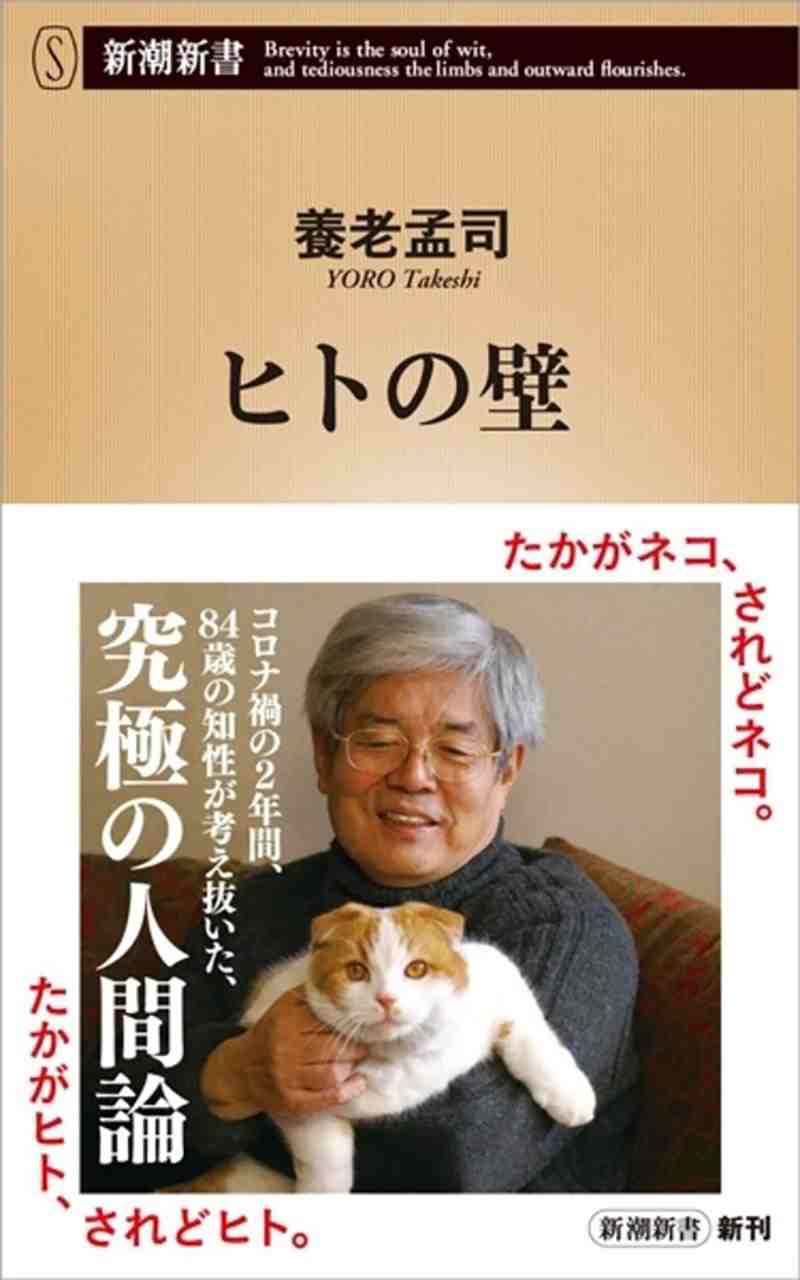
“Hito no Kabe” by Takeshi Yoro, published by Shinchosha in the Shincho Shinsho series
“Senses [which recognize differences] are being neglected for abstractions,” he said. “There is no realistic sense at all. Before we know it, consciousness [which forms generalizations] is becoming dominant.”
Yoro is instinctively concerned that the world we live in is becoming increasingly separated from reality, with the emergence of artificial intelligence and avatars.
“When something deviates from realistic senses, I’m relatively sensitive to it,” he said.
He was originally motivated to write the “Kabe” series when he became aware of a gap between him and the world at large. He first expressed this awareness in “Baka no Kabe,” which stems from his uneasy feeling about Japanese society after the end of World War II.
“I don’t mean [what Japan did in] the past is right. The United States brought in a new system after Japan was defeated in the war, and since then, I’ve always been feeling unease,” Yoro said. “Japanese people must have suffered tangible and intangible stress, but no one says anything about it.”
Yoro said that “Baka no Kabe” continues to draw new readers probably because many people share this feeling of unease.
“As I only said obvious things in the book, I think people feel it is accessible,” he said.
Yoro added that he frankly believes current Japanese society is abnormal, considering its declining child population and increasing suicide rate among young people.
Before writing about Japanese society in the new book, even Yoro needed to think hard about how to set the proper conditions for the discussion. “Globalization” was not it, he said. Being fair and neutral was to Yoro “a deception, of course.” He finally came up with focusing on “Homo sapiens.”
He did not choose “people” because “Homo sapiens” denotes a living creature having a physical entity and therefore one that does not deviate from its true state.
“Whenever I think about things,” Yoro said, “Homo sapiens will always be my basic premise.”




Most Read
Popular articles in the past 24 hours
-

Japanese Shipping Giants Halt Strait of Hormuz Transit as Iran Co...
-

U.S. Launches Attacks on Iran: Avoid Escalation of Conflict by An...
-

Improvement of Japanese Language Schools Lags Rise in Foreigners
-
Rental Lab Space in Tokyo Area More Than Doubles Since 2010, Offe...
-

Sawtooth Roof Factory Stands as Monument to Ashikaga Textile Hist...
-
Parents of Japanese Teen Shot in U.S. Strive for Gun Control
-
Disinformation Spreads About Team Mirai, Ballot Readers; Online P...
-

Bank of Japan Deputy Governor Says Rate Hikes Likely to Continue
Popular articles in the past week
-

Nepal Bus Crash Kills 19 People, Injures 25 Including One Japanes...
-
Milano Cortina 2026: Japanese Gold Medalist Figure Skater Miura S...
-
Tokyo Spends Big on Children, Wins Over Parents
-

McDonald's Japan Raises Prices; Big Mac to Cost ¥500, Double Chee...
-
‘Dry Bonsai’ Gives New Life to Withered Trees, Allows Free Artist...
-

Japan’s Miura, Kihara Announce Withdrawal from Figure Skating Wor...
-
Exhibition Featuring Yoshiharu Tsuge’s Manga World Underway in Ch...
-

Yokohama to Test Out Renewable-Powered Offshore Floating Data Cen...
Popular articles in the past month
-

Producer Behind Pop Group XG Arrested for Cocaine Possession
-

Japan PM Takaichi’s Cabinet Resigns en Masse
-

Man Infected with Measles Reportedly Dined at Restaurant in Tokyo...
-

Israeli Ambassador to Japan Speaks about Japan’s Role in the Reco...
-

Videos Plagiarized, Reposted with False Subtitles Claiming ‘Ryuky...
-

Man Infected with Measles May Have Come in Contact with Many Peop...
-

Prudential Life Insurance Plans to Fully Compensate for Damages C...
-

Woman with Measles Visited Hospital in Tokyo Multiple Times Befor...
Top Articles in Culture
-
BTS to Hold Comeback Concert in Seoul on March 21; Popular Boy Band Releases New Album to Signal Return
-

Director Naomi Kawase’s New Film Explores Heart Transplants in Japan, Production Involved Real Patients, Families
-

Tokyo Exhibition Offers Inside Look at Impressionism; 70 of 100 Works on ‘Interiors’ by Monet, Others on Loan from Paris
-
Traditional Japanese Silk Hakama Tradition Preserved by Sole Weaver in Sendai
-
Exhibition Featuring Yoshiharu Tsuge’s Manga World Underway in Chofu, Tokyo; Unique, Surreal Works Draw Steady Crowds
JN ACCESS RANKING
-
Producer Behind Pop Group XG Arrested for Cocaine Possession
-
Japan PM Takaichi’s Cabinet Resigns en Masse
-
Man Infected with Measles Reportedly Dined at Restaurant in Tokyo Station
-
Israeli Ambassador to Japan Speaks about Japan’s Role in the Reconstruction of Gaza
-
Videos Plagiarized, Reposted with False Subtitles Claiming ‘Ryukyu Belongs to China’; Anti-China False Information Also Posted in Japan