
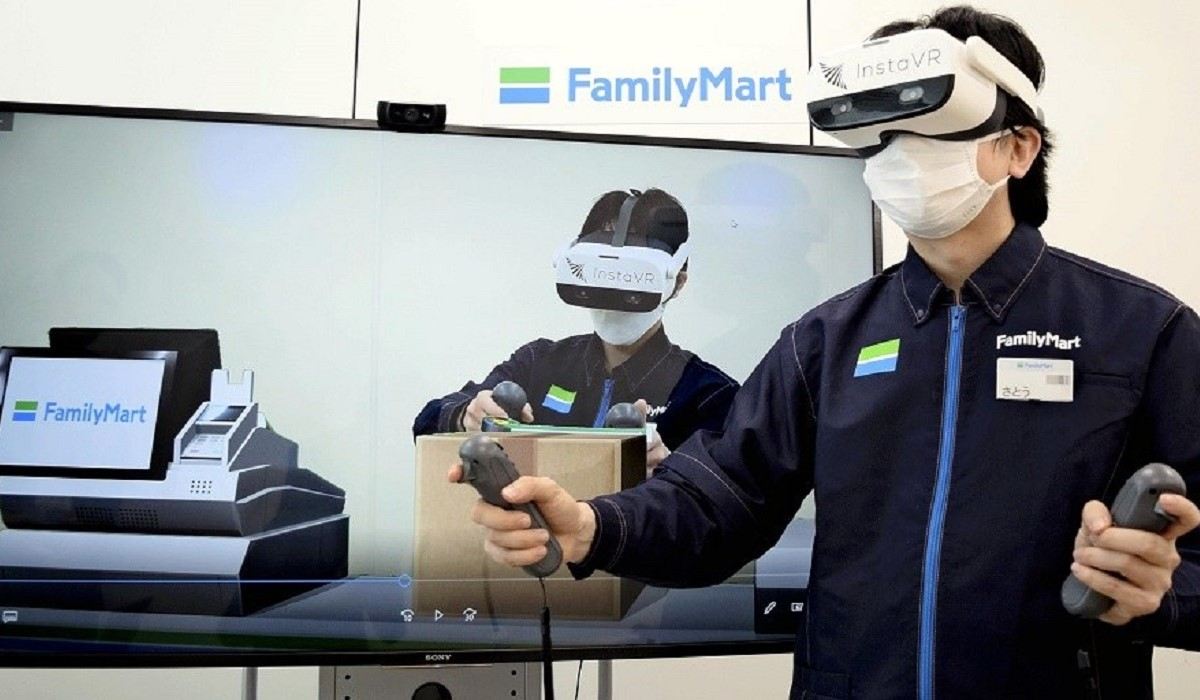
A FamilyMart employee receives virtual reality customer service training in April in Minato Ward, Tokyo.
15:00 JST, May 8, 2023
Hotels, convenience stores and other businesses have increasingly turned to virtual reality to help train their staff amid a growing labor shortage.
VR has an advantage over conventional training manuals and in-person training as it allows staff to repeatedly receive realistic training. The use of VR has attracted attention as a means of maintaining high-quality customer service.
In March, convenience store chain operator FamilyMart Co. introduced VR equipment to give store employees customer service training. The employees wear VR goggles and use a controller to learn various tasks, including using the register, ordering products and accepting orders for delivery.
Conventional training requires an instructor to be present to teach the employees the various customer-related tasks at the convenience stores, but with VR, the trainees can learn on their own, reducing the training time to one-third of the 36 hours normally required. The VR-based training is available in 10 languages, including Japanese, English, Chinese and Vietnamese.
“We hope to improve our customer service, even though we’ve been short-staffed,” said Daisuke Nonaka of the company’s store management operation department.
In January, Kyoto College of Hotel, Tourism and Bridal Management in Kyoto developed a VR-based educational program for hotels and inns. The program walks students through such tasks as working the front desk and taking restaurant reservations. The program is designed in a way so the scenarios change depending on the responses from the trainees, allowing them to learn to handle various situations while interacting with different virtual guests.
The manufacturing, automobile and railway industries have taken the lead in introducing VR-based training in the areas of inspection and repair. VR has become an effective tool to allow staff to physically memorize procedures and safely experience some of the inherent dangers of the job.
Amid a serious labor shortage, the food service and lodging industries have increasingly launched VR training programs to improve efficiency.
The National Institute of Advanced Industrial Science and Technology in Tsukuba, Ibaraki Prefecture, has been researching and developing VR-based training since 2018. In February, the institute established guidelines for VR-based training for customer service. The guidelines include key points regarding reducing training costs, allowing companies to effectively teach their staff without the financial burden.
“The biggest challenge in the food service industry is cultivating staff,” said Takashi Okuma, a research team leader at the institute. “We hope the new technology will help reduce the burden and improve efficiency in the entire industry.”







Most Read
Most read in the last 24 hours
-

Japan Monitoring Situation Surrounding Revocation of Taiwan Presi...
-

Promote Support, Respect to Help Prevent Harassment of Athletes
-

Japan Should Serve as Bridge between Nuclear, Non-nuclear States,...
-

Yamato Museum Reopens in Hiroshima Pref. Following Extensive Reno...
-

Toyota Unveils New Development Hub in Woven City Repurposed from ...
-

Fukui: Dinosaur Faculty Building Unveiled in Japanese University'...
-
Elegant Weeping Cherry Blossoms on Display at Water Purification ...
-
Man Admits to Abandoning Wife's Body in Zoo Incinerator in Hokkai...
Most read in the last 7 days
-
Earthquake Hits Japan's Tohoku Region; 3-meter Tsunami Warning Is...
-

Trump Extends the Ceasefire with Iran but Keeps the Blockade
-

China, South Korea Object to Japanese PM Takaichi's Ritual Offeri...
-

India's Arms Indigenization Quest for Self-Reliance / New Delhi S...
-
Japan to Ban Use of Portable Chargers on Airplanes from April 24,...
-

¥1,000 Coins to Be Issued to Mark Anniversary of Beginning of Jap...
-

Most Serious Cyberattacks against the UK Now from Russia, Iran an...
-

Trump Opposes United–American Merger, Signals Support for Spirit
Most read in the last 30 days
-
Earthquake Hits Japan's Tohoku Region; 3-meter Tsunami Warning Is...
-
Police Find Child's Shoe During Search for Missing Boy in Nantan,...
-
Body Found in Nantan, Kyoto Prefecture, During Search for 11-Year...
-

Cherry Blossoms, Rapeseed Flowers Perform Colorful ‘Duet’ in Niig...
-
Trump Extends the Ceasefire with Iran but Keeps the Blockade
-
China, South Korea Object to Japanese PM Takaichi's Ritual Offeri...
-

Olympic Gold Medal-Winning Figure Skaters Riku-Ryu Announce Retir...
-

Japanese Prime Minister Takaichi Speaks to Pakistani Prime Minist...
Top Articles in Business
-
Foreign Tourists Set New Record in March; 30% Drop in Visitors from Middle East
-

Japan’s ANA to Introduce Fuel Surcharges to Domestic Flights from Fy27, Driven by Rising Fuel Costs, Declining Profits
-
Middle Powers Should Create Alternative to WTO, Says Research Group
-
Toyota Motor to Begin Full-Scale Hydrogen Production in May; Mass Production and Sales of Equipment Planned to Start in 2029
-

Airborne Cellular Stations to Be Tested in Ishikawa, Miyagi; Aim to Ensure Communication During Disasters
JN ACCESS RANKING
-
Earthquake Hits Japan’s Tohoku Region; 3-meter Tsunami Warning Issued (Update 1)
-
Police Find Child’s Shoe During Search for Missing Boy in Nantan, Kyoto Prefecture
-
Body Found in Nantan, Kyoto Prefecture, During Search for 11-Year-Old Boy in Area (Update 1)
-
Cherry Blossoms, Rapeseed Flowers Perform Colorful ‘Duet’ in Niigata
-
Trump Extends the Ceasefire with Iran but Keeps the Blockade
Most read in the last 24 hours
-
Japan Monitoring Situation Surrounding Revocation of Taiwan Presi...
-
Promote Support, Respect to Help Prevent Harassment of Athletes
-
Japan Should Serve as Bridge between Nuclear, Non-nuclear States,...
-
Yamato Museum Reopens in Hiroshima Pref. Following Extensive Reno...
-
Toyota Unveils New Development Hub in Woven City Repurposed from ...
Most read in the last 7 days
-
Earthquake Hits Japan's Tohoku Region; 3-meter Tsunami Warning Is...
-
Trump Extends the Ceasefire with Iran but Keeps the Blockade
-
China, South Korea Object to Japanese PM Takaichi's Ritual Offeri...
-
India's Arms Indigenization Quest for Self-Reliance / New Delhi S...
-
Japan to Ban Use of Portable Chargers on Airplanes from April 24,...
Most read in the last 30 days
-
Earthquake Hits Japan's Tohoku Region; 3-meter Tsunami Warning Is...
-
Police Find Child's Shoe During Search for Missing Boy in Nantan,...
-
Body Found in Nantan, Kyoto Prefecture, During Search for 11-Year...
-
Cherry Blossoms, Rapeseed Flowers Perform Colorful ‘Duet’ in Niig...
-
Trump Extends the Ceasefire with Iran but Keeps the Blockade