
Social Media and Elections: Outdated System / Social Media’s Decisive Role in Mayoral Race Sparks Debate on Use of Internet in Campaigns
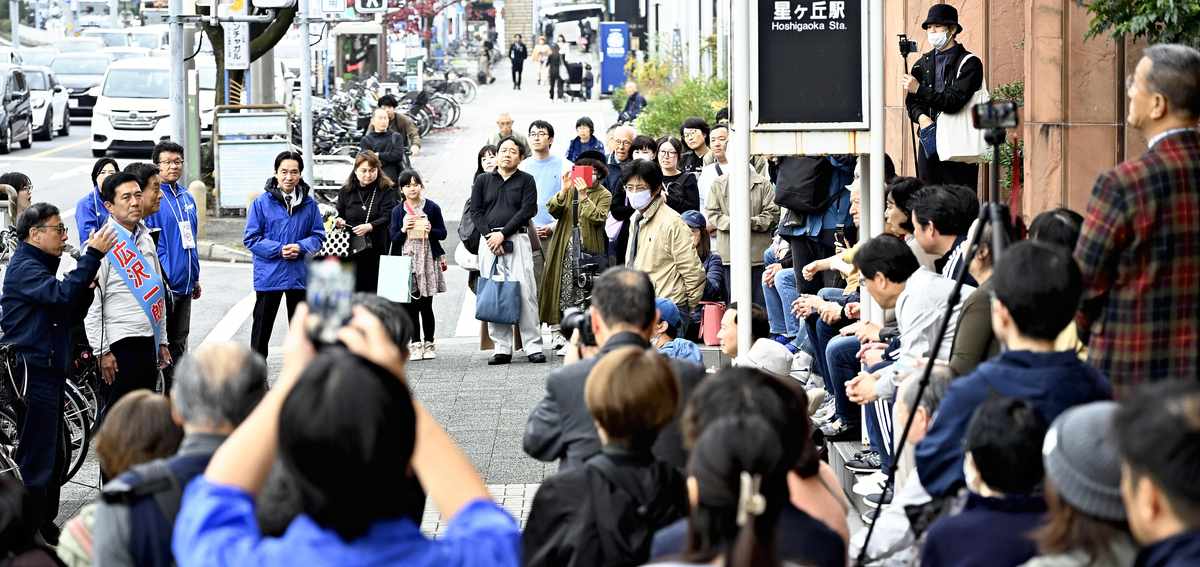
Spectators take pictures of a candidate for the Nagoya mayoral election during a campaign speech in Nagoya in November.
13:22 JST, May 7, 2025
This is the final installment in a series of articles that examines the challenges faced by the nation’s election system, which has been criticized as outdated.
One Sunday in November last year, a week before the Nagoya mayoral election, a crowd of people were seen using their smartphones to film former Nagoya Deputy Mayor Ichiro Hirosawa’s street speech in front of JR Nagoya Station.
Hirosawa, 61, ran as the successor to former Nagoya Mayor Takashi Kawamura, 76, who had just contested the recent House of Representatives election. He was essentially in a showdown with Kohei Otsuka, 65, a former senior vice minister for the Health, Labor and Welfare Ministry. Otsuka was supported by Aichi Gov. Hideaki Omura, 65, and a cross-party alliance of four ruling and opposition parties.
Leveraging Kawamura’s popularity with independent voters, Hirosawa’s campaign posted numerous photos where he posed with Kawamura to X, formerly Twitter. They also allowed YouTubers to do livestreams from their campaign vehicles.
With every successive speech, greater numbers of people appeared, smartphones in hand. And when the ballots were counted, Hirosawa claimed his first election victory, with 392,519 votes, over 130,000 more than Otsuka, despite the former senior vice minister’s significantly stronger organizational backing.
An analysis by The Yomiuri Shimbun using a social media tool from User Local Inc. showed a massive disparity in the use of X hashtags during the election, with the number of posts tagged #hirosawaichiro on X, including reposts, reaching about 145,000 during the election period, far exceeding the roughly 38,000 that were marked with the #otsukakohei hashtag.
“Our message reached voters because of social media,” said Katsuyoshi Tanaka, 41, who was in charge of online strategy for Hirosawa’s campaign.
Restrictions and changes
While Japan’s electoral system provides public funding for campaign materials, including vehicles, posters, political broadcasts and election bulletins, it also imposes detailed restrictions on campaign spending, vehicle numbers and leaflet quantities.
The Internal Affairs and Communications Ministry said that granting unlimited freedom could distort elections, and that certain rules are necessary to ensure fairness and impartiality.
Online campaigning used to be prohibited, compelling parties and candidates to stop updating their websites during election periods.
However, in the aftermath of the 2011 Great East Japan Earthquake, an exception was made, allowing online publication of election bulletins for the benefit of people who relocated to other municipalities, boosting the movement to lift the broader online campaign ban. The ordinary session of the Diet began deliberations on revising the Public Offices Election Law at the end of fiscal 2012.
According to election planner Hiroshi Miura, who testified as a reference witness in the Diet, there was a consensus between the ruling and opposition parties to allow parties, candidates and voters to use websites to solicit votes for specific candidates.
However, discussions regarding the lifting of the ban on using email to solicit votes were contentious. To prevent mass sending of one-sided slanderous emails, they decided to allow only parties and candidates to use email to campaign, but not voters.
Meanwhile, because social media accounts were at that time primarily used like campaign homepages, made for users to access and view of their own volition, these services fell under the category of “websites, etc.” and were not subject to regulation.
“Social media was not very prominent in the political world at the time, and people had no idea that it would come to be used as a means of mass dissemination the way it is now,” Miura said.
Transforming elections
“The lifting of the online campaign ban transformed elections by allowing voters to participate in campaigns,” said Prof. Harumichi Yuasa of Meiji University, who is knowledgeable in electoral systems.
Candidates in elections prior to this had campaigned throughout their constituencies distributing leaflets and making speeches to gain and spread support.
With the online campaign ban lifted, it became possible for voters to take part in election campaigns by doing things like recording and sharing street speeches. Video sharing services, including short-video sites allowing clips ranging from a few seconds to a few minutes, were perfectly suited to this. Social media became a powerful weapon for candidates without organizational or financial power.
But the one-sided delivery of election-related information to unknown masses of people through smartphones led to the proliferation of extreme and unverified information on social media as users sought to attract attention.
There have been a series of cases going beyond the bounds of what was envisioned by the law, such as people taking advantage of existing election systems, like political broadcasts, for their businesses or using social media to attack others.
The Public Offices Election Law includes language to the effect that efforts must be made to ensure that the internet and other tools are used properly, in ways that do not impair the fairness of elections.
“The reality is that actions that run counter to this principle are now left unaddressed. Parties, voters and the government must make continuous efforts to safeguard fair and impartial elections,” Yuasa said.





Most Read
Popular articles in the past 24 hours
-

Masako Ikeda, Voice of Maetel in ‘Galaxy Express 999,' Dies at 87
-

Japan's TEPCO Releases Footage from Fukushima N-Plant Reactor
-
Japan Considering Taking Part in U.S. ‘Golden Dome’ Defense Syste...
-

Japan's Sanyo Shinkansen Suspended Again; Between Okayama, Aioi S...
-

Oil Reserve Releases: G7 Members Unite against Growing Threat
-

Milano Cortina 2026: Japan’s Momoka Muraoka Takes Silver in...
-
46 Evacuated from UAE, Oman on Japanese Govt-chartered Flight
-

Paw Patrol: Larry Marks 15 Years at 10 Downing Street
Popular articles in the past week
-

Japan Figure Skating Legend Yuzuru Hanyu Is Proud Disaster Surviv...
-

Nippon Life Insurance's U.S. Arm Sues OpenAI Over Legal Assistanc...
-

Govt to Utilize ODA for Ensuring Economic Security; Securing Ener...
-
15 Measles Patients Confirmed in Tokyo in Past 6 Days; 1 May Have...
-
Massive Sewer Pipe Found Jutting Out of Highway in Osaka
-
Japan Govt to Tighten Requirements to Receive Permanent Residency...
-

Beckoning Cats Get Makeover to Fit Modern Lifestyles with Sleek D...
-
Japan's 2nd Round of U.S. Investments May Be Worth Over $100 Bill...
Popular articles in the past month
-

Producer Behind Pop Group XG Arrested for Cocaine Possession
-

Japan PM Takaichi’s Cabinet Resigns en Masse
-

Man Infected with Measles Reportedly Dined at Restaurant in Tokyo...
-

Videos Plagiarized, Reposted with False Subtitles Claiming ‘Ryuky...
-
Japan Figure Skating Legend Yuzuru Hanyu Is Proud Disaster Surviv...
-

iPS Treatments Pass Key Milestone, but Broader Applications Far f...
-

Sanae Takaichi Elected Prime Minister of Japan; Keeps All Cabinet...
-

Nepal Bus Crash Kills 19 People, Injures 25 Including One Japanes...
Top Articles in Society
-
Producer Behind Pop Group XG Arrested for Cocaine Possession
-
Man Infected with Measles Reportedly Dined at Restaurant in Tokyo Station
-
15 Measles Patients Confirmed in Tokyo in Past 6 Days; 1 May Have Come into Contact with Many in Shibuya
-

Bus Carrying 40 Passengers Catches Fire on Chuo Expressway; All Evacuate Safely
-

Ibaraki Pref.’s 1st Foreign Bus Driver Hired in Tsukuba
JN ACCESS RANKING
-
Producer Behind Pop Group XG Arrested for Cocaine Possession
-
Japan PM Takaichi’s Cabinet Resigns en Masse
-
Man Infected with Measles Reportedly Dined at Restaurant in Tokyo Station
-
Videos Plagiarized, Reposted with False Subtitles Claiming ‘Ryukyu Belongs to China’; Anti-China False Information Also Posted in Japan
-
Japan Figure Skating Legend Yuzuru Hanyu Is Proud Disaster Survivor and Gold Medalist, Vows to Continue Support Efforts