
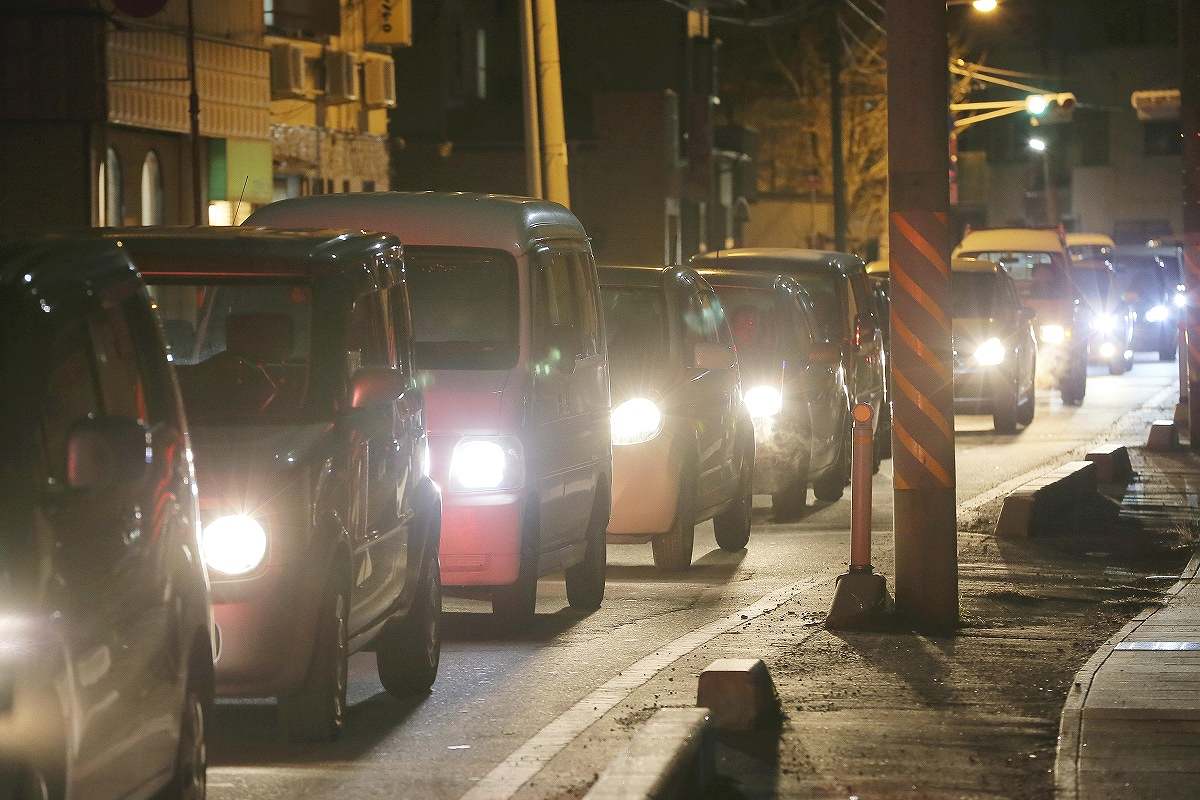
A line of cars evacuate from the coastal area in Ishinomaki, Miyagi Prefecture, on Dec. 7, 2012, when an earthquake measuring lower 5 on the Japanese seismic intensity scale of 7 hit the Tohoku region in the evening.
12:36 JST, January 28, 2021
This is the second installment of a series that looks at points to remember in the event of a tsunami, based on lessons learned from the 2011 Great East Japan Earthquake.
Quick evacuation is a basic principle in the event of a tsunami.
Atsushi Tanaka, a project professor at the University of Tokyo, advises to “take the initiative to evacuate immediately, because that can motivate others to evacuate as well.”
You should head to higher ground for safety when you feel a strong tremor near the sea, or when you feel a relatively small but long-lasting tremor, or when you hear a tsunami warning on the news or through a smartphone disaster prevention app.
If the epicenter is near land, a warning may not be issued before the tsunami hits. On the other hand, if the epicenter is far away, you may not feel a tremor.
Do not use only warnings and large tremors as a guide.
The Japan Meteorological Agency advises the public to evacuate immediately to higher ground or other safer places when tsunami warnings are issued, or to head away from the coast immediately if at sea.
“Never judge that a tremor like this would be OK based on your past experiences, but be brave enough to evacuate assuming the worst,” said Tanaka, who specializes in disaster information theory.
Walking is the basic means of evacuation. Evacuation by car may cause traffic congestions and hinder on-foot evacuation. Use of cars was said to have created chaos during the 2011 Great East Japan Earthquake.
“Avoid driving as much as possible unless you are with elderly or disabled family members who cannot escape on foot, or if the evacuation site is too far to make it in time,” said Takayoshi Iwata, a specially appointed professor at Shizuoka University’s Center for Integrated Research and Education of Natural Hazards.
Iwata, who studies disaster prevention, suggests that local communities discuss ways to prevent traffic jams in advance, such as preparing wheelchairs or talking about car pooling among nearby residents.
If a tsunami occurs while you are driving, get out of the car if you can and evacuate on foot.
You should pull your car over on the roadside so that it would not block passage of emergency vehicles. Turn off the engine, leave the key inside the car and leave the door unlocked.
If you have no choice but evacuate by car, you should drive carefully.
“You have to be aware that you are exposed to a high risk of accidents because traffic lights and railroad crossings may not be working, roads may be damaged or blocked by fallen electric poles,” Iwata said.
You may be hit by the tsunami if you go back home to pick up your disaster bags or try to join your family on the way. It is important for each person to evacuate individually. It is best to decide on a meeting point at an evacuation site in advance.
Tsunami can surge repeatedly, and the first wave is not always the highest. Yoshiaki Kawata, director of the Societal Safety Sciences Center at Kansai University, advises to “stay at an evacuation site until the waves recede and the warning is lifted.”

A tsunami flag






Most Read
Popular articles in the past 24 hours
-

78% Interested in Reconstruction from 2011 Disaster; Concern High...
-

Japan’s Nikkei Stock Average Rise Lifted by AI Stocks, Easing Con...
-

15 Years since Great East Japan Earthquake: How Can Affected Area...
-
2 Mt. Fuji Hikers Identified as Police Warn People Not to Climb i...
-

Parents in Japan to Get Instagram Notifications When Teens Repeat...
-

CARTOON OF THE DAY (March 11)
-

Japan’s Mitsui O.S.K. Lines Container Ship Anchored in Persian Gu...
-

Tokyo Conference 2026 Opens, Discusses Rebuilding Multilateralism...
Popular articles in the past week
-

Ibaraki Pref.'s 1st Foreign Bus Driver Hired in Tsukuba
-

Nippon Life Insurance's U.S. Arm Sues OpenAI Over Legal Assistanc...
-

Govt to Utilize ODA for Ensuring Economic Security; Securing Ener...
-
Amid Strait of Hormuz Blockade, Shipping Companies Scramble to Ge...
-
Japan Govt Survey Finds Just 10% of Workers Want Working Hours to...
-

Japan's 2nd Round of U.S. Investments May Be Worth Over $100 Bill...
-

Beckoning Cats Get Makeover to Fit Modern Lifestyles with Sleek D...
-

Imperial Family Watches World Baseball Classic Game Against Austr...
Popular articles in the past month
-

Producer Behind Pop Group XG Arrested for Cocaine Possession
-

Japan PM Takaichi’s Cabinet Resigns en Masse
-

Man Infected with Measles Reportedly Dined at Restaurant in Tokyo...
-

Videos Plagiarized, Reposted with False Subtitles Claiming ‘Ryuky...
-

iPS Treatments Pass Key Milestone, but Broader Applications Far f...
-

Sanae Takaichi Elected Prime Minister of Japan; Keeps All Cabinet...
-

Nepal Bus Crash Kills 19 People, Injures 25 Including One Japanes...
-

South Korea Tightens Rules on Foreigners Buying Homes in Seoul Me...
Top Articles in Society
-
Producer Behind Pop Group XG Arrested for Cocaine Possession
-
Man Infected with Measles Reportedly Dined at Restaurant in Tokyo Station
-

Bus Carrying 40 Passengers Catches Fire on Chuo Expressway; All Evacuate Safely
-

Tokyo Skytree’s Elevator Stops, Trapping 20 People; All Rescued (Update 1)
-
Ibaraki Pref.’s 1st Foreign Bus Driver Hired in Tsukuba
JN ACCESS RANKING
-
Producer Behind Pop Group XG Arrested for Cocaine Possession
-
Japan PM Takaichi’s Cabinet Resigns en Masse
-
Man Infected with Measles Reportedly Dined at Restaurant in Tokyo Station
-
Videos Plagiarized, Reposted with False Subtitles Claiming ‘Ryukyu Belongs to China’; Anti-China False Information Also Posted in Japan
-
iPS Treatments Pass Key Milestone, but Broader Applications Far from Guaranteed