
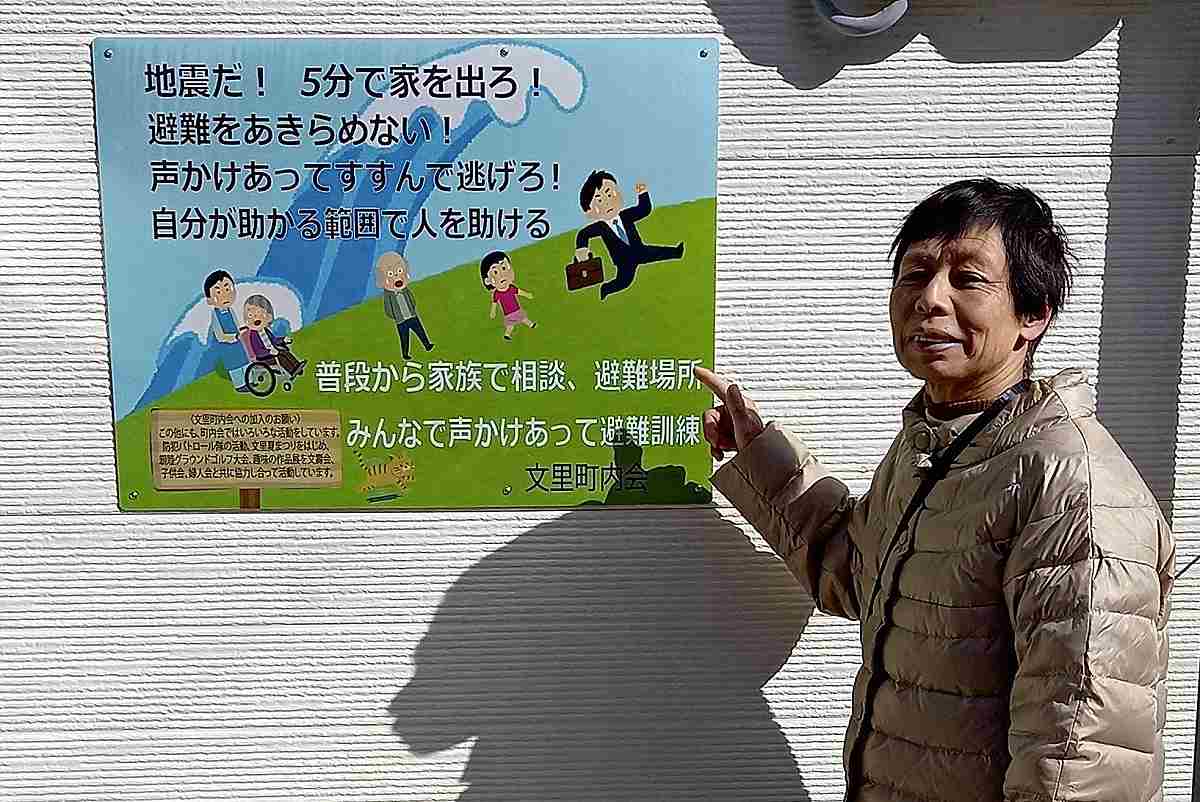
A signboard with reminders to evacuate in case of tsunami when earthquakes strike has been installed in the Mori district in Tanabe, Wakayama Prefecture.
13:20 JST, January 27, 2021
The 2011 Great East Japan Earthquake deeply implanted in people’s minds the importance of tsunami preparedness and countermeasures. As a possible Nankai Trough earthquake in the future may cause more serious damage, this three-part series looks at points to remember in the event of a tsunami. The following is part one.
Written on signboards in the Mori district of Tanabe, Wakayama Prefecture, is the following: “It’s an earthquake! Leave your house in five minutes! Don’t give up trying to evacuate!”
Created by the district’s neighborhood association, the signboards are meant to increase residents’ awareness of tsunami. The association also distributes to each household stickers with the same reminders.
The idea behind these warnings is for residents to know how to act and respond when earthquakes strike.
These measures have been taken based on the prediction that if a massive Nankai Trough earthquake occurs, the Mori district along the Pacific coast may be hit by the first wave of tsunami in about 20 minutes.
“We need to think about taking shelter on a regular basis to save our lives,” said association head Hatsue Shintaku.
At a local summer festival that many residents attend, a map is displayed to show the locations of emergency evacuation sites in the district, such as higher ground and the tsunami evacuation tower. The participants are invited to place small stickers on such sites marked on the map near their homes to become aware of the locations. The expectation is that residents will also know the locations of other evacuation sites from the map.
“We aren’t necessarily at home when tsunami occur,” Shintaku said. “I want the residents to know where as many shelters are as possible, just in case.”
■ Obtain hazard maps
“We have a limited window for evacuation between the time an earthquake occurs to the time tsunami arrive,” said Fumihiko Imamura, director of Tohoku University’s International Research Institute of Disaster Science and a specialist of tsunami engineering. “It’s imperative to know the locations of evacuation sites in advance.”
Such information can be obtained from hazard maps made by local governments. These maps mark emergency evacuation sites, along with areas prone to flooding in case of tsunami, the length of time until they arrive, their expected heights, and related information.
As evacuation in the event of tsunami means moving to places that are higher rather than farther away, higher ground and tall buildings are designated as evacuation sites. Knowing where multiple emergency evacuation sites are and alternative evacuation routes to these sites will also help as these routes may be made impassable if, say, walls collapse along the road.
In some areas, signs with pictograms have been installed to guide people to emergency evacuation sites. These might also be useful when needing to take shelter in unfamiliar places.
■ Beware of rivers, too
Tsunami travel not only from the ocean but also along rivers. During the Great East Japan Earthquake, some areas were hit by tsunami going upstream, resulting in many casualties to areas upriver.
“Living away from the ocean doesn’t guarantee safety from tsunami,” said Hiroyasu Yasuda, an associate professor specializing in river engineering at Niigata University’s Research Institute for Natural Hazards and Disaster Recovery.
It is necessary to confirm on hazard maps which river areas might be prone to flooding during a tsunami and know multiple evacuation sites and evacuation routes in advance.
There are also possibilities that tsunami higher than the predicted heights may arrive or areas along rivers may be affected more broadly than what has been projected due to the earthquake causing riverbanks or levees to collapse.
Furthermore, situations may change in such a way that a chosen evacuation site may turn out to be unsafe.
“Every individual, volunteer disaster prevention organization and neighborhood association need to prepare for various possible situations, free from preconceptions, so that their ideas can facilitate evacuation when necessary,” Tohoku University’s Imamura said.


Related Tags





Most Read
Popular articles in the past 24 hours
-

Japan Figure Skating Legend Yuzuru Hanyu Is Proud Disaster Surviv...
-

Hawaii Museum on Tsunami Including Japan's 2011 Disaster at Risk ...
-

Japan Train Company to Increase Fares, Including in Tokyo Metropo...
-

Japan’s Mitsui O.S.K. Lines Container Ship Anchored in Persian Gu...
-

Struggling Onosato Pulls out of Spring Tourney
-

Japan’s Mitsui O.S.K. Lines Container Ship Anchored in Persian Gu...
-

Tail of ANA Plane Struck Runway During Landing in Houston; No Inj...
-

Iran Targets Busiest International Airport as Top UN Body Demands...
Popular articles in the past week
-
Japan Figure Skating Legend Yuzuru Hanyu Is Proud Disaster Surviv...
-

Nippon Life Insurance's U.S. Arm Sues OpenAI Over Legal Assistanc...
-

Ibaraki Pref.'s 1st Foreign Bus Driver Hired in Tsukuba
-
Govt to Utilize ODA for Ensuring Economic Security; Securing Ener...
-
Massive Sewer Pipe Found Jutting Out of Highway in Osaka
-
Amid Strait of Hormuz Blockade, Shipping Companies Scramble to Ge...
-

Beckoning Cats Get Makeover to Fit Modern Lifestyles with Sleek D...
-
Japan Govt Survey Finds Just 10% of Workers Want Working Hours to...
Popular articles in the past month
-

Producer Behind Pop Group XG Arrested for Cocaine Possession
-

Japan PM Takaichi’s Cabinet Resigns en Masse
-

Man Infected with Measles Reportedly Dined at Restaurant in Tokyo...
-

Videos Plagiarized, Reposted with False Subtitles Claiming ‘Ryuky...
-

iPS Treatments Pass Key Milestone, but Broader Applications Far f...
-

Sanae Takaichi Elected Prime Minister of Japan; Keeps All Cabinet...
-
Nepal Bus Crash Kills 19 People, Injures 25 Including One Japanes...
-
South Korea Tightens Rules on Foreigners Buying Homes in Seoul Me...
Top Articles in Society
-
Producer Behind Pop Group XG Arrested for Cocaine Possession
-
Man Infected with Measles Reportedly Dined at Restaurant in Tokyo Station
-

Bus Carrying 40 Passengers Catches Fire on Chuo Expressway; All Evacuate Safely
-
Ibaraki Pref.’s 1st Foreign Bus Driver Hired in Tsukuba
-
Tokyo Skytree’s Elevator Stops, Trapping 20 People; All Rescued (Update 1)
JN ACCESS RANKING
-
Producer Behind Pop Group XG Arrested for Cocaine Possession
-
Japan PM Takaichi’s Cabinet Resigns en Masse
-
Man Infected with Measles Reportedly Dined at Restaurant in Tokyo Station
-
Videos Plagiarized, Reposted with False Subtitles Claiming ‘Ryukyu Belongs to China’; Anti-China False Information Also Posted in Japan
-
iPS Treatments Pass Key Milestone, but Broader Applications Far from Guaranteed