
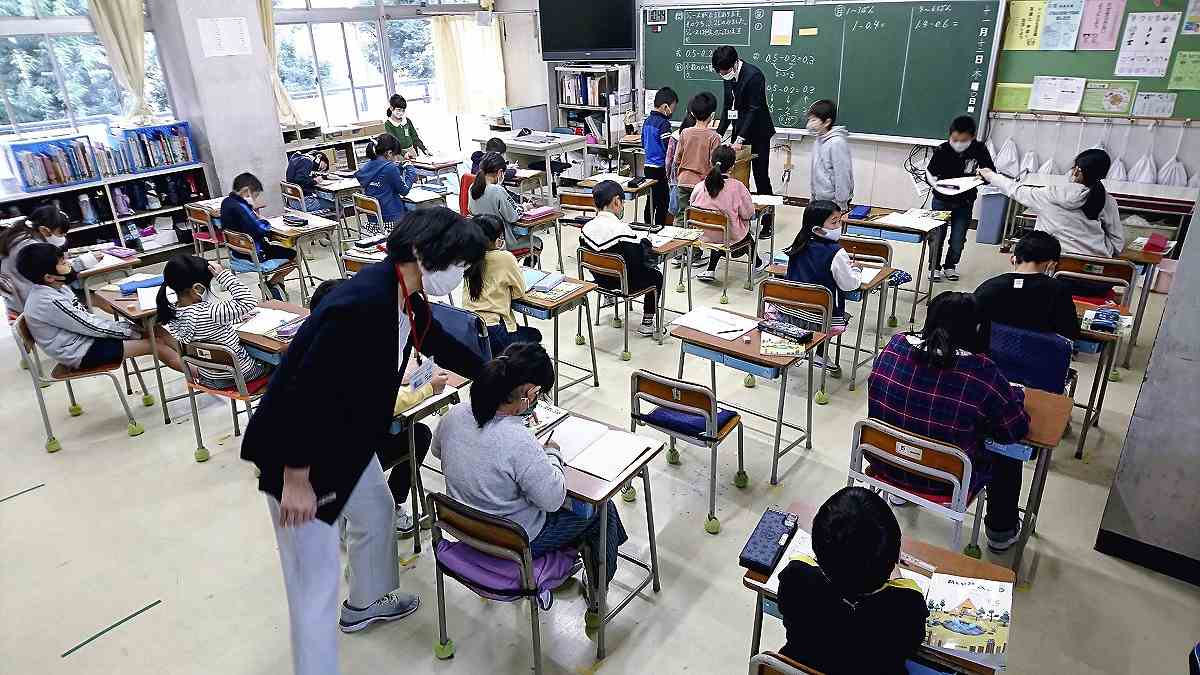
Children sit keeping distance between them in the classroom at Hirosawa Elementary School in Wako, Saitama Prefecture, which has already set its class size limit at 35 students for some grades.
11:08 JST, December 20, 2020
Introducing class size limits of 35 students for all grades at elementary schools has raised expectations that it will help boost children’s academic standards, while there are also concerns over securing enough teachers and classrooms.
Education, Culture, Sports, Science and Technology Minister Koichi Hagiuda and Finance Minister Taro Aso agreed Thursday to introduce the move, which marks the first change to class sizes in most grades in about 40 years.
“This will lead to improved academic performance by children,” Hagiuda said at a press conference after his meeting with Aso. “We want to realize learning experiences that will bring out the potential of all children.”
The education ministry plans to submit to next year’s ordinary Diet session a draft amendment to a law that stipulates the maximum number of students per class. In the 2021 school year, the maximum number of students in public elementary school second-grade classes will be lowered from the current level of 40 to 35. This upper limit of 35 is scheduled to be introduced for all grades by the 2025 school year.
Japanese school classes have a large number of students by international standards. According to a report held by the Organization for Economic Cooperation and Development, Japan had the third-highest number of students per class out of 33 countries. Workers on the education front line have for years been calling for the upper limit to be reduced, due to concerns that having a large number of students per teacher could negatively impact on their learning.
The way subjects are taught in the classroom also has been changing in recent times. Under the new curriculum guidelines for this school year, elementary schools have started new style classes incorporating “active learning,” which places a greater emphasis on students having discussions and presenting their views. There are growing expectations that having smaller class sizes also will help teachers provide fine-tune support to their students also in this new approach of learning.
“Enabling teachers to spend more time with each student will help not only on the academic side of things, but also allow teachers to more closely supervise issues such as bullying and truancy,” a senior education ministry official said.
■ More classrooms needed
However, increasing the number of classes will force schools to find more classrooms to accommodate students.
The population of Nagareyama, Chiba Prefecture, has been increasing, partly due to its convenient location for people working in Tokyo. The enrollment of the municipal Ootakanomori Elementary School is forecast to reach about 3,000 students in the early 2020s, and a new elementary school is scheduled to open in the next school year.
The new school was designed on the assumption that each fourth-, fifth- and sixth-grade class would have 38 students. “We’ll think about how to handle this situation by checking estimates of student numbers at each school and how many classrooms can be provided,” an official of Nagareyama’s board of education said.
Chuzan Elementary School in Kagoshima City has more than 1,400 students. The school has three prefab buildings on its grounds to cope with its growing number of pupils. “We’ll need more classrooms if we have smaller class sizes, but we’ve got no more room to put new buildings,” a teacher at the school told The Yomiuri Shimbun.
■ Lighter workload
More classes will obviously require more teachers. Ensuring the quality of teachers is maintained is an issue that will need to be addressed.
The education ministry has estimated that when the 35-student cap is introduced for all grades, over 13,500 additional teachers will be needed.
An OECD report on teacher working hours released in June 2019 revealed that Japanese elementary and junior high school teachers were the longest among the countries it surveyed. The applicant-to-hire ratio for teachers at public elementary schools has been declining, and this figure in fiscal 2019 was 2.8-to-1 – equal with the previous low recorded in fiscal 1991.
“Some students avoid this career due to their impression that teaching is tough because they have to deal with parents and do other tasks,” said a board of education official of Fukuoka Prefecture, where the ratio has fallen to 1.3-to-1. “Introducing class size limits of 35 students could lighten the burden teachers shoulder. We want to make it widely known that how teachers work will change.”
Waseda University Prof. Hiroyuki Tanaka, an expert on education methods, believes smaller class sizes will have positive benefits.
“If a teacher has fewer students in their class, they will have a lighter workload,” Tanaka said. “Whether making the move to smaller class sizes will be a success hinges on the ability of schools to bring in good teachers. To achieve this, more reforms should be made to how educators work at schools, and this in turn should lead to higher-quality lessons.”
■ Ministries wrangled until last minute
By Hironari Akiyama / Yomiuri Shimbun Staff Writer
The education and finance ministries had been butting heads over reducing the maximum class size at public elementary schools. Negotiations on this issue continued right up until Wednesday evening — the day before the two ministers held their meeting.
The Education, Culture, Sports, Science and Technology Ministry has been plugging away at the issue of making class sizes smaller for many years. However, after the maximum number of students per class was lowered from 45 to 40 in the 1980 school year, the only other change came for the 2011 school year, when the number was capped at 35 students but only for elementary school first-grade classes.
The Finance Ministry had opposed any further reduction. The ministry claimed the latest research indicated that cutting class sizes further would have a “limited impact” on improving students’ academic performance.
The decision by both ministries to compromise on a limit of 35 students per class came against a backdrop of Japan’s chronically low birthrate. According to the Internal Affairs and Communications Ministry, in Japan there were about 15.08 million children aged under 15 as of June. The National Institute of Population and Social Security Research projects the population of this age group will dip below 10 million in 2056. Gradually moving toward smaller class sizes will avoid teachers’ large surplus in the future and ensure there is no huge increase in the education budget.
The education ministry’s long-standing position has been that smaller classes will be useful in providing more detailed instruction to students. In addition, according to government sources, Prime Minister Yoshihide Suga showed some backing for education minister Koichi Hagiuda’s assertion that a certain physical distance needed to be kept between children as part of efforts to prevent the spread of the novel coronavirus. These factors also apparently nudged the Finance Ministry toward accepting the lower limit of 35 students per class.






Most Read
Popular articles in the past 24 hours
-

Japan Figure Skating Legend Yuzuru Hanyu Is Proud Disaster Surviv...
-

Hawaii Museum on Tsunami Including Japan's 2011 Disaster at Risk ...
-

Japan Train Company to Increase Fares, Including in Tokyo Metropo...
-

Japan’s Mitsui O.S.K. Lines Container Ship Anchored in Persian Gu...
-

Struggling Onosato Pulls out of Spring Tourney
-

Japan’s Mitsui O.S.K. Lines Container Ship Anchored in Persian Gu...
-

Tail of ANA Plane Struck Runway During Landing in Houston; No Inj...
-

Iran Targets Busiest International Airport as Top UN Body Demands...
Popular articles in the past week
-
Japan Figure Skating Legend Yuzuru Hanyu Is Proud Disaster Surviv...
-

Nippon Life Insurance's U.S. Arm Sues OpenAI Over Legal Assistanc...
-

Ibaraki Pref.'s 1st Foreign Bus Driver Hired in Tsukuba
-
Govt to Utilize ODA for Ensuring Economic Security; Securing Ener...
-
Massive Sewer Pipe Found Jutting Out of Highway in Osaka
-

Amid Strait of Hormuz Blockade, Shipping Companies Scramble to Ge...
-

Beckoning Cats Get Makeover to Fit Modern Lifestyles with Sleek D...
-
Japan Govt Survey Finds Just 10% of Workers Want Working Hours to...
Popular articles in the past month
-

Producer Behind Pop Group XG Arrested for Cocaine Possession
-

Japan PM Takaichi’s Cabinet Resigns en Masse
-

Man Infected with Measles Reportedly Dined at Restaurant in Tokyo...
-

Videos Plagiarized, Reposted with False Subtitles Claiming ‘Ryuky...
-

iPS Treatments Pass Key Milestone, but Broader Applications Far f...
-

Sanae Takaichi Elected Prime Minister of Japan; Keeps All Cabinet...
-

Nepal Bus Crash Kills 19 People, Injures 25 Including One Japanes...
-
South Korea Tightens Rules on Foreigners Buying Homes in Seoul Me...
Top Articles in Society
-
Producer Behind Pop Group XG Arrested for Cocaine Possession
-
Man Infected with Measles Reportedly Dined at Restaurant in Tokyo Station
-

Bus Carrying 40 Passengers Catches Fire on Chuo Expressway; All Evacuate Safely
-
Ibaraki Pref.’s 1st Foreign Bus Driver Hired in Tsukuba
-
Tokyo Skytree’s Elevator Stops, Trapping 20 People; All Rescued (Update 1)
JN ACCESS RANKING
-
Producer Behind Pop Group XG Arrested for Cocaine Possession
-
Japan PM Takaichi’s Cabinet Resigns en Masse
-
Man Infected with Measles Reportedly Dined at Restaurant in Tokyo Station
-
Videos Plagiarized, Reposted with False Subtitles Claiming ‘Ryukyu Belongs to China’; Anti-China False Information Also Posted in Japan
-
iPS Treatments Pass Key Milestone, but Broader Applications Far from Guaranteed