
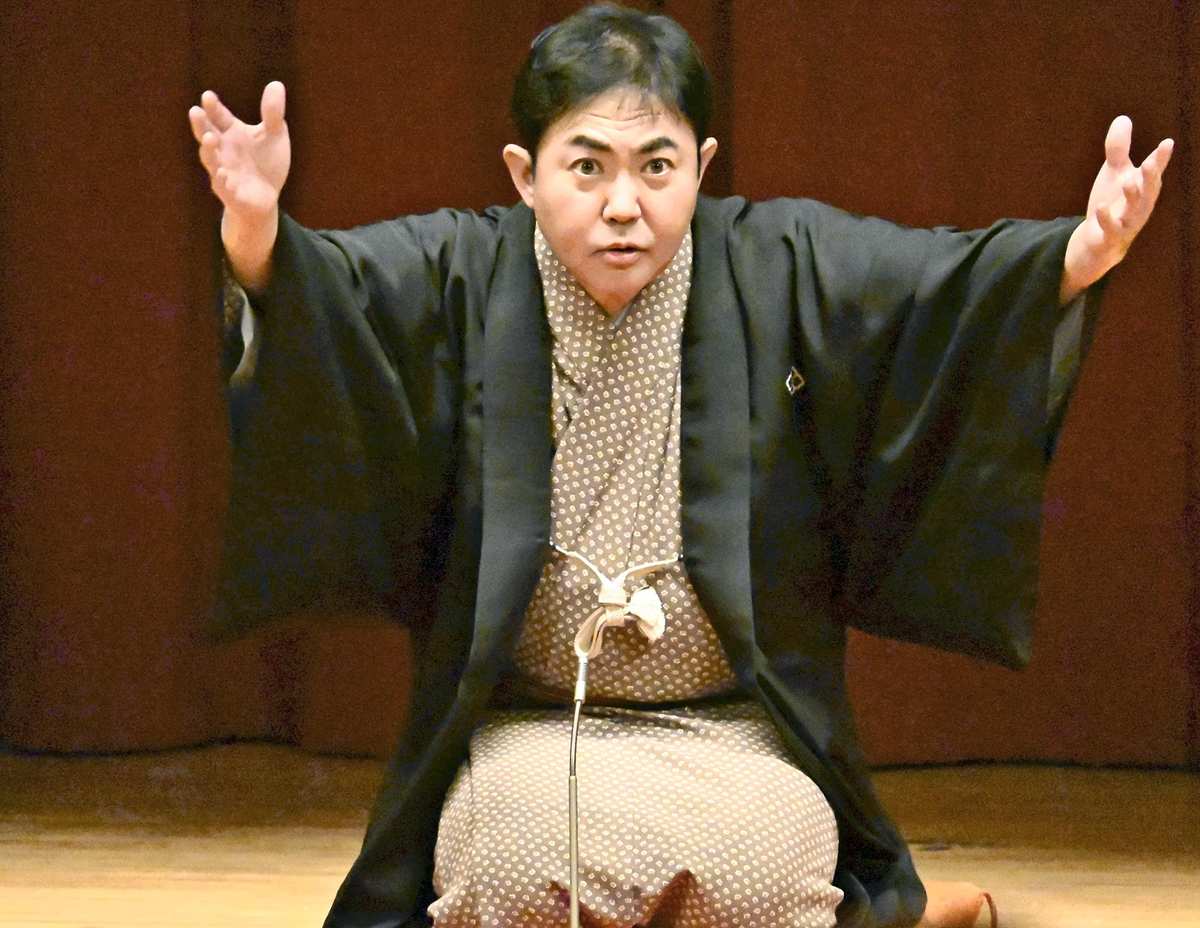
The second-generation Hayashiya Sanpei performs a rakugo in Koto Ward, Tokyo, on Sunday.
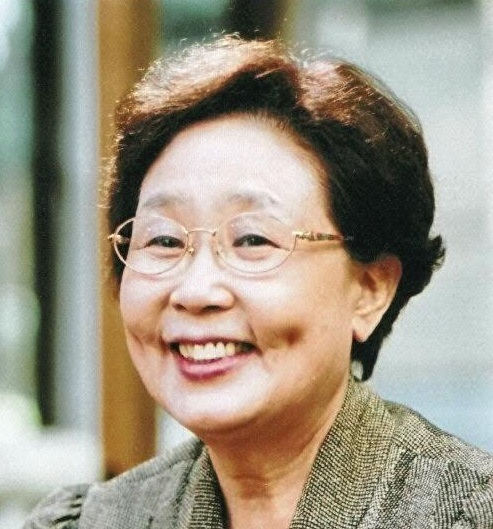
Kayoko Ebina
15:50 JST, March 10, 2026
Rakugo storyteller Hayashiya Sanpei is seeking to pass on the history of the Great Tokyo Air Raid by performing a wartime piece, as he looks to fulfill the wishes of his late mother.
Tuesday marks the 81st anniversary of the Great Tokyo Air Raid, which claimed about 100,000 lives overnight. Late last year, 55-year-old Hayashiya Sanpei — the second to hold this performing name, his father being the first — lost his mother, Kayoko Ebina, who was age 92.
Ebina had long dedicated herself to sharing her experiences of the massive bombing, which left her an orphan.
In the Great Tokyo Air Raid, U.S. B-29s indiscriminately bombed the capital in the early hours of March 10, 1945, in the final stages of World War II.
Large numbers of incendiary bombs were dropped on densely populated areas where there were many wooden houses, including in what are now Sumida, Koto and Taito wards.
About 100,000 people were killed, 270,000 houses burned down and 1 million people were affected.
Ahead of the anniversary on Tuesday, the first since his mother passing, Sanpei was determined to keep the memory of the tragedy alive by weaving her experiences into his performances.
“Normally, my mother would be here to speak, but on Dec. 24 last year, she rode off on Santa Claus’ sleigh into the sky …” he said on Sunday, at a gathering of about 200 people in Koto Ward, Tokyo. He then began to recount his mother’s wartime experiences, which he had heard since childhood.
Ebina was the only member of her family who was not harmed in the air raid, as she had been evacuated to Shizuoka Prefecture. Back at their home in what is now Sumida Ward, Tokyo, six of her family members — her grandmother, parents and three of her brothers — were killed in the bombing.
Only one brother, two years older than her, managed to survive.
Orphaned by the war at age 11, Ebina was moved between the homes of various relatives. She was eventually adopted into a family of comic storytellers, or rakugo performers, and married the first Hayashiya Sanpei, the legendary “king of laughter” in the Showa era (1926-1989).
In the decades following her husband’s death and after raising their four children, she became a prominent voice, recounting her experiences in numerous essays and public talks.
Sanpei, her second son, grew up listening to his mother’s memories. Many were happy stories from before the war, such as about the family enjoying fruit parfaits or sukiyaki together. It was these vivid glimpses of a joyful past, he said, that made him feel the depth of the grief she felt at losing nearly all her family in a night.
His mother also told him of the time she received chewing gum from a U.S. soldier during the postwar occupation. The gum was so delicious she spat it out. “If I keep chewing this, I’ll end up feeling grateful to the U.S. military, which killed my family,” she thought. She never had gum again.
Maybe because she had never seen her family’s remains, she would sometimes murmur even in her later years, “I wonder if my brothers might come home tomorrow.”
With his mother’s advancing age, Sanpei felt a growing sense of urgency as fewer remained who could tell of their lives as war orphans as his mother could. He struggled, worried that his own words would not be weighty enough to pass on her stories, as he had not experienced the war firsthand.
He wondered how he could pass on this history in his own way. He concluded that he should perform kokusaku rakugo — stories that supported Japan’s wartime efforts.
During the war, rakugo storytellers refrained from performing pieces that satirized the authorities or included romantic scenes out of a fear of censorship.
Instead, they created and performed kokusaku rakugo to boost morale, but this genre was forgotten after the war.
Based on historical documents, Sanpei revived “Shussei Iwai” (A celebration of being sent to war), a piece created by his grandfather, the seventh Hayashiya Shozo, and has been performing it in various places since 2016.
The story is about a father who rejoices when his son receives his draft papers and sends him off to war. In fact, the first Sanpei was also mobilized as a member of a suicide attack unit when students were drafted.
Reflecting on his grandfather’s reasons for writing “Shussei Iwai,” Sanpei speculated that by cooperating with the military, Shozo was pleading for his son to be kept off the front lines.
“I hope this will be a chance to think about why the atmosphere in Japan at that time made families feel they had no choice but to celebrate their loved ones’ departure for the war,” Sanpei said.
At Sunday’s gathering, Sanpei performed “Shussei Iwai” after offering a disclaimer: “To be honest, this is not funny at all.”
Amid the hush of the audience, he vowed to deepen his role as the child of an air raid orphan, drawing a mass wave of applause as he finished.
“My mother has passed away, and this is the start of my journey as a storyteller,” Sanpei said. “I will keep going, with the knowledge that her wishes are now in my hands.”


Most Read
Popular articles in the past 24 hours
-

Iran Situation: Significance of Rule of Law Must Be Conveyed
-

Trump Says Iran Had a New Site for Developing Nuclear Weapons
-

Alexander Brothers, Top NY Real Estate Brokers, Convicted at Sex ...
-
North Korean Leader's Sister Criticized US-South Korea for Procee...
-
Venezuelan Lawmakers Open Debate on a Mining Bill to Lure Foreign...
-

Trump Threatens to Escalate Iran War, but Says It Could End Soon
-

Five Iranian Women's Soccer Players Granted Humanitarian Visas in...
-

Crude Oil Prices Top $100: Measures Must Be Taken Before It’s Too...
Popular articles in the past week
-

Ibaraki Pref.'s 1st Foreign Bus Driver Hired in Tsukuba
-

Amid Strait of Hormuz Blockade, Shipping Companies Scramble to Ge...
-
2 Unpublished Early Novellas by Japan's Kenzaburo Oe Discovered, ...
-
Govt to Utilize ODA for Ensuring Economic Security; Securing Ener...
-
Japan Govt Survey Finds Just 10% of Workers Want Working Hours to...
-
Japan's 2nd Round of U.S. Investments May Be Worth Over $100 Bill...
-

Imperial Family Watches World Baseball Classic Game Against Austr...
-
Donald Keene’s Drinking Buddy and Translator Yukio Kakuchi Pays T...
Popular articles in the past month
-

Producer Behind Pop Group XG Arrested for Cocaine Possession
-

Japan PM Takaichi’s Cabinet Resigns en Masse
-

Man Infected with Measles Reportedly Dined at Restaurant in Tokyo...
-

Videos Plagiarized, Reposted with False Subtitles Claiming ‘Ryuky...
-

iPS Treatments Pass Key Milestone, but Broader Applications Far f...
-

Sanae Takaichi Elected Prime Minister of Japan; Keeps All Cabinet...
-

Nepal Bus Crash Kills 19 People, Injures 25 Including One Japanes...
-

Japan's Govt to Submit Road Map for Growth Strategy in March, PM ...
Top Articles in Society
-
Producer Behind Pop Group XG Arrested for Cocaine Possession
-
Man Infected with Measles Reportedly Dined at Restaurant in Tokyo Station
-

Bus Carrying 40 Passengers Catches Fire on Chuo Expressway; All Evacuate Safely
-
Tokyo Skytree’s Elevator Stops, Trapping 20 People; All Rescued (Update 1)
-

U.S. Firm to Build Training Hub in Fukushima N-plant for Debris Removal; Plans to Establish Training Center by 2029
JN ACCESS RANKING
-
Producer Behind Pop Group XG Arrested for Cocaine Possession
-
Japan PM Takaichi’s Cabinet Resigns en Masse
-
Man Infected with Measles Reportedly Dined at Restaurant in Tokyo Station
-
Videos Plagiarized, Reposted with False Subtitles Claiming ‘Ryukyu Belongs to China’; Anti-China False Information Also Posted in Japan
-
iPS Treatments Pass Key Milestone, but Broader Applications Far from Guaranteed