
Traditional Craft Kishu Tansu Chest of Drawers Draws Customers in Europe with Beauty, Durability
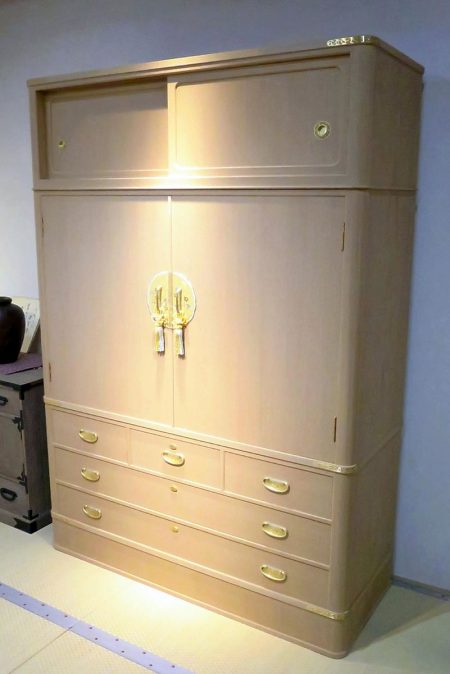
A Kishu chest of drawers featuring beautiful wood grain
16:20 JST, January 18, 2026
KINOKAWA, Wakayama — Kishu tansu chests of drawers, a traditional craft from Wakayama Prefecture, are made from paulownia wood, and have both decorative appeal and durability. Their ability to maintain ideal moisture inside and strong insect-repellent properties makes them ideal for storing clothing.
Present day Wakayama Prefecture used to be part of the former Kishu province. According to a local industry association of the paulownia chest manufacturers, “Nanki Tokugawa Shi,” a historical record of the Kishu Tokugawa family that ruled the province during the Edo period (1603-1867), states that after Wakayama Castle was struck by lightning and burned down in 1846, nagamochi wooden storage trunks, among other items, were remade.
The account indicates that furniture manufacturing techniques had been established in the castle town by the late Edo period. Wood cut from the local mountains was floated down the Kinokawa river, and skilled craftsmen gathered around the river mouth in Wakayama City.
Chests made with white solid paulownia were especially valued as part of a bridal trousseau. Since the Meiji era (1868-1912), sales expanded mainly in the Kansai region due to the development of transportation networks. In the 1980s, about 100 companies were involved in producing Kishu chests of drawers.
With the collapse of the bubble economy in the early 1990s, the culture of made-to-order wedding furnishings faded. Today, only three companies remain as members of the industry association.
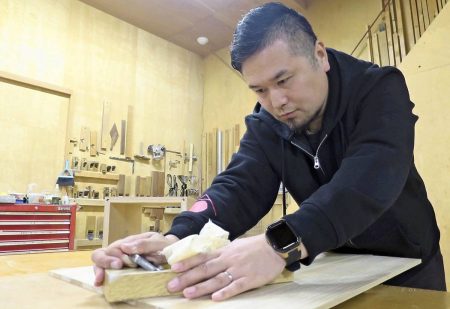
Fukutaro Azuma planes paulownia lumber at his company’s workshop in Kinokawa, Wakayama Prefecture.
In November, I visited Kagu no Azuma, a company in Kinokawa. The company’s workshop echoed with the rhythmic sounds of paulownia being planed, and the gentle scent of the wood wafted through the space.
“Paulownia wood has many cavities, so it protects clothes from impact and fire,” said Fukutaro Azuma, 44, the fifth-generation owner of the company and a Kishu chest artisan, holding a plane. “It feels like a mother’s kindness.”
The company, founded in 1891, shifted its business from lumbering to furniture manufacturing under the fourth-generation owner. In elementary school, Azuma declared he would “become the world’s best paulownia chest craftsman.” After graduating university, Azuma studied Kyo sashimono wood joinery in Kyoto. He honed his skills under Kunio Naito, right-hand man of living national treasure Tatsuaki Kuroda, before returning to his hometown in 2006 to take over his family business.
The production of Kishu chests involves four stages: lumber preparation of selecting and drying wood; sizing for cutting lumber into boards of the required sizes; assembling with wooden nails to join boards vertically by interlocking notches made in their edges; and finishing by planing the surface, coating to highlight grain and attaching metal fittings.
The planing step in the finishing stage requires precision measured in one-hundredths or one-thousandths of a millimeter. The finished products have an elegant, pale color. Their drawers slide astonishingly easily and smoothly.
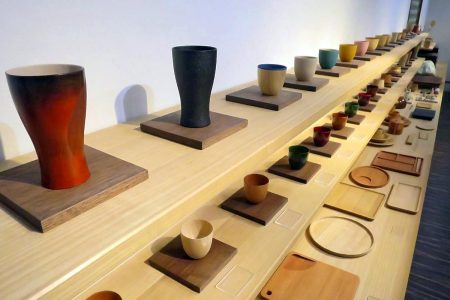
The Me Mamoru brand includes tableware such as cups and bowls
To support the company’s main business of making chests, Azuma launched the Me Mamoru brand in 2016. The brand offers items like paulownia cutting boards and drinking cups. The company has expanded its sales into Europe, in addition to domestic sales.
“Without the brand, we might have gone out of business,” Azuma said. “Some overseas customers who learned about our company through the Me Mamoru brand now come directly to us to buy Kishu chests.”
In 2022, Azuma’s wife, Chiaki, 43, became the first woman certified as a traditional Kishu tansu artisan in the coating division. Two young employees are also seeking certification as traditional craft artisans.
“If we compete in the high-end market, we can make it in the world,” Azuma said.
“To pass on tradition and techniques, we want to nurture talent without turning anyone away.”


Related Tags



Most Read
Popular articles in the past 24 hours
-

Milano Cortina 2026: Figure Skaters Riku Miura, Ryuichi Kihara Pa...
-

Japan’s Updated ‘Free and Open Indo-Pacific’ Initiative to Streng...
-
Record 700 Startups to Gather at SusHi Tech Tokyo in April; Event...
-

Man Infected with Measles Reportedly Dined at Restaurant in Tokyo...
-
Takaichi Chats with Tunku Tunku, Interactive Mascot for Internati...
-
“The Tale of Genji” Back-Translation Project Led to Touching Enco...
-

Myaku-Myaku Fan Event Held in Osaka; ‘Its Butt is so Cute!’ Says ...
-

Taisei Unveils ‘Zero-Carbon Building’ in Japan's Saitama Prefectu...
Popular articles in the past week
-

Videos Plagiarized, Reposted with False Subtitles Claiming ‘Ryuky...
-

Woman with No Overseas Travel History Infected with Measles in Na...
-

Milano Cortina 2026: Kokomo Murase Comes Out on Top After Overcom...
-

Tokyo’s New Record-Breaking Fountain Named ‘Tokyo Aqua Symphony’
-
CRA Leadership Election Will Center on Party Rebuilding; Lower Ho...
-
Milano Cortina 2026: Figure Skaters Riku Miura, Ryuichi Kihara Pa...
-

Crime in Japan Ticks Up for 4th Straight Year
-

Japanese Constitutional Revision Debate Expected to be Revived Af...
Popular articles in the past month
-

Japan Institute to Use Domestic Commercial Optical Lattice Clock ...
-

Israeli Ambassador to Japan Speaks about Japan’s Role in the Reco...
-

Man Infected with Measles May Have Come in Contact with Many Peop...
-

China Eyes Rare Earth Foothold in Malaysia to Maintain Dominance,...
-

Prudential Life Insurance Plans to Fully Compensate for Damages C...
-

Woman with Measles Visited Hospital in Tokyo Multiple Times Befor...
-
Australian Woman Dies After Mishap on Ski Lift in Nagano Prefectu...
-
Foreign Snowboarder in Serious Condition After Hanging in Midair ...
Top Articles in Society
-
Man Infected with Measles May Have Come in Contact with Many People in Tokyo, Went to Store, Restaurant Around When Symptoms Emerged
-
Woman with Measles Visited Hospital in Tokyo Multiple Times Before Being Diagnosed with Disease
-
Australian Woman Dies After Mishap on Ski Lift in Nagano Prefecture
-
Foreign Snowboarder in Serious Condition After Hanging in Midair from Chairlift in Nagano Prefecture
-
Record-Breaking Snow Cripples Public Transport in Hokkaido; 7,000 People Stay Overnight at New Chitose Airport
JN ACCESS RANKING
-
Japan Institute to Use Domestic Commercial Optical Lattice Clock to Set Japan Standard Time
-
Israeli Ambassador to Japan Speaks about Japan’s Role in the Reconstruction of Gaza
-
Man Infected with Measles May Have Come in Contact with Many People in Tokyo, Went to Store, Restaurant Around When Symptoms Emerged
-
Prudential Life Insurance Plans to Fully Compensate for Damages Caused by Fraudulent Actions Without Waiting for Third-Party Committee Review
-
Woman with Measles Visited Hospital in Tokyo Multiple Times Before Being Diagnosed with Disease