
Nagasaki Photo Exhibition Compares Images of Ukraine from 2012, 2025 to Show Devastation of War
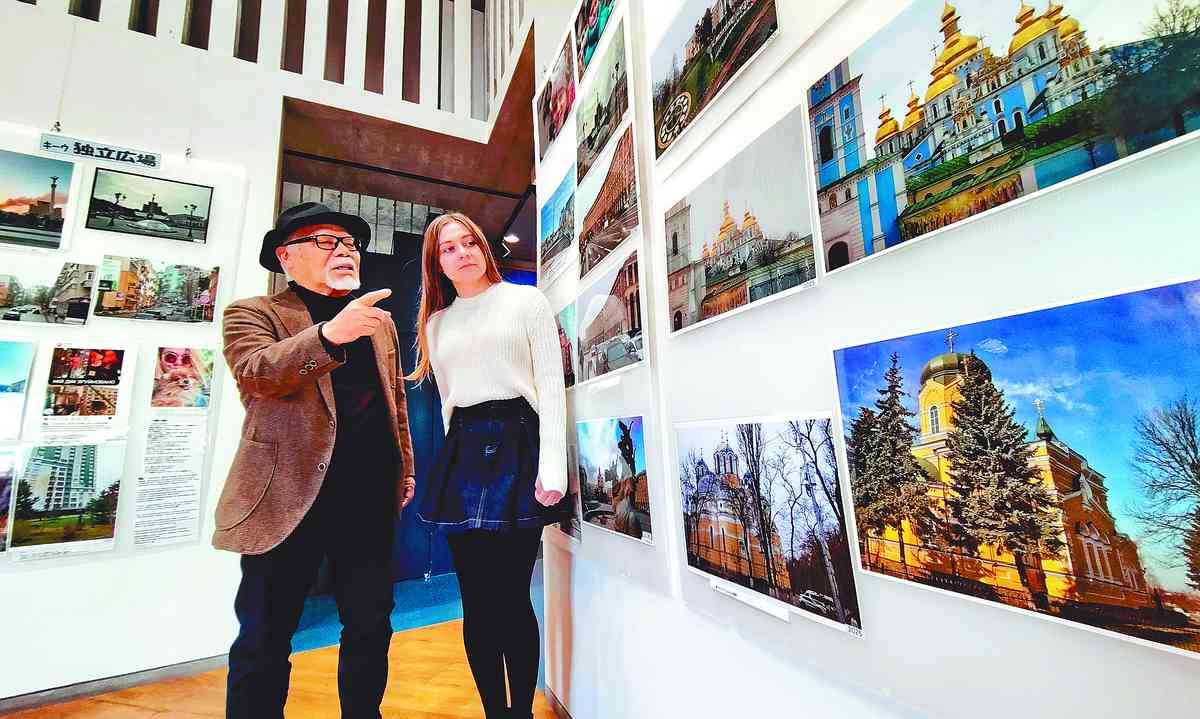
Tadayoshi Ogawa, left, and Anastasia Strashko look at their photos displayed at the Ukraine Record of Time Photo Exhibition in Nagasaki City on Jan. 7.
7:00 JST, January 14, 2026
NAGASAKI — An exhibition featuring photos taken in Ukraine 14 years ago and again recently from the same angles is being held in Nagasaki City through Jan. 25.
The Ukraine Record of Time Photo Exhibition compares scenes of the war-ravaged country.
The photos from 14 years ago were taken by Tadayoshi Ogawa, a hibakusha atomic bomb survivor who lived through the bombing of Nagasaki in 1945. The more recent ones were taken by Anastasia Strashko, a Ukrainian woman who visited her home country last year. Strashko was forced to flee to Japan due to the war.
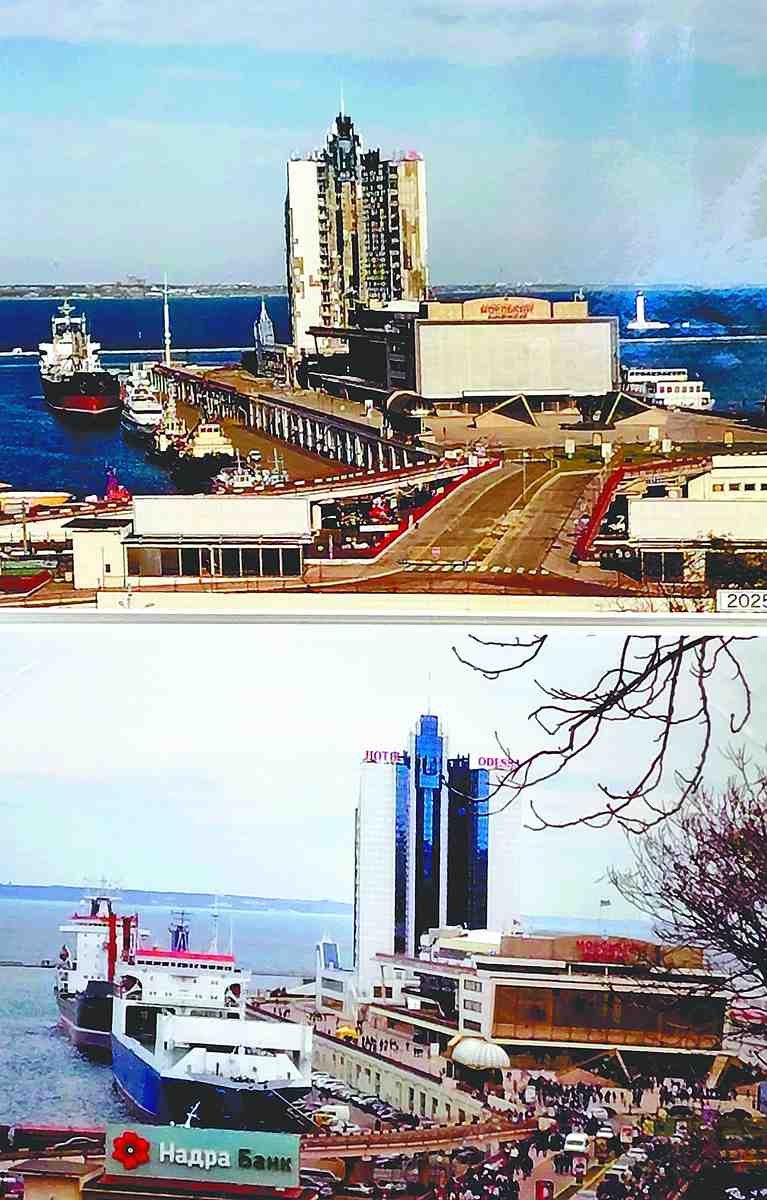
A photo taken by Tadayoshi Ogawa of Odesa Port in 2012, below, and a photo taken recently by Anastasia Strashko of the same building from the same angle.
After nearly four years since Russia began its aggression against Ukraine, the photographers said they want people to see the reality that the country’s beautiful scenery is being destroyed.
In a pair of photos, a modern high-rise hotel with glass panels on its exterior is seen in one photo, while the other shows the same building taken from the same angle with the glass destroyed and the walls broken.
Among the photos displayed at the Nagasaki Peace Museum, the venue of the exhibition, are 12 pairs of photos, comparing scenes from before and after Russia’s aggression.
Strashko studied about Japan when she was a student at the National University of Kyiv.
In February 2022, when Russia began its aggression against Ukraine, she and her family fled to Georgia. With the attack on her home country, she felt as if her life was over.
At the time, she was aware that many Japanese universities have systems to assist students from abroad. Strashko came to Japan partly because she wanted to study in Nagasaki and learn about peace, so she arrived in September 2022 and enrolled in Nagasaki University. In September 2025, she graduated from the university’s graduate program.
She currently works for a company in Kobe that imports and sells Ukrainian traditional crafts to help craftsmen in her home country.
Ogawa, who lives in Nagasaki, took part in a project in 2012 to travel around the world by ship to urge for the abolition of nuclear weapons. During the project, he visited Ukraine.
Ogawa spoke to people in Odesa, a port city in southern Ukraine facing the Black Sea, and in Kyiv while taking photos of people and the scenery.
Every year, Ogawa asks people worldwide to take a photo at 11:02 a.m. on Aug. 9, the time and date of when the atomic bomb was dropped on Nagasaki.
Last year, Strashko asked her family and friends to send photos of Ukraine on Aug. 9 to take part in Ogawa’s project. Strashko has lost two relatives in the war who became soldiers.
She said the reason she did so was because she could not help but feel emotional about Nagasaki, as she is a citizen of a country that is being threatened by nuclear weapons.
Ogawa was moved by her sentiment and thought that hibakusha in Nagasaki cannot ignore the plight of Ukrainians.
Before Strashko left to visit her home country in late September last year, Ogawa asked her to photograph the same sites in Ukraine that he photographed 14 years ago, from the same angles, to compare.
Their actions led to this photo exhibition.
Strashko visited the places where Ogawa took the photos in Dnipro, eastern Ukraine, where she is from.
Odesa has been frequently hit by drones and missiles, and a building at the port has been damaged. People are not allowed to enter the area around the building.
In addition, almost no one is seen on the Potemkin Stairs, which was a tourist spot that appeared in a movie, as places where people gather are targeted.
In a large plaza in Kyiv, many small flags to mourn the victims of the war were fluttering in the wind.
It took six hours by train to reach Odesa and another nine to reach Kyiv via a night train. Everywhere she stayed, she was worried about Russian drone attacks. Whenever she held her camera on the streets, passersby seemed worried that she might be a Russian spy, causing some to cover their faces.
At the Nagasaki Peace Museum, in addition to the comparison photos, about 60 other photos are on display. The other photos include scenes of Ukraine taken on Aug. 9, such as a photo of a street in Dnipro where evacuation shelters were set up.
“Compared to the photos taken 14 years ago, the recent photos of the cities do not show young people or children smiling,” Ogawa said.
Strashko also organizes events in Japan to introduce Ukrainian culture.
Strashko said she really wants to show the younger generations the devastation of war and how it impacts people and the damage it causes.
The exhibition is free and will run through Jan. 25.


Related Tags
Most Read
Popular articles in the past 24 hours
-
Kesennuma, Miyagi Pref., Locals Raise Carp Streamers as Symbol of...
-

Iran Situation: Significance of Rule of Law Must Be Conveyed
-

Toyota Advancing Plant-Based Biofuel Development in Fukushima Tow...
-

Trump Says Iran Had a New Site for Developing Nuclear Weapons
-
2 People Reportedly Found on Mt. Fuji; Hiking Trail Currently Clo...
-

CARTOON OF THE DAY (March 10)
-
Rapeseed Flowers Reach Peak Viewing Period at Tokyo's Showa Kinen...
-

Japan's TEPCO to Raise Electricity Rates for Corporations in Apri...
Popular articles in the past week
-

Ibaraki Pref.'s 1st Foreign Bus Driver Hired in Tsukuba
-

Amid Strait of Hormuz Blockade, Shipping Companies Scramble to Ge...
-
Govt to Utilize ODA for Ensuring Economic Security; Securing Ener...
-
Japan Govt Survey Finds Just 10% of Workers Want Working Hours to...
-

Japan's 2nd Round of U.S. Investments May Be Worth Over $100 Bill...
-

Imperial Family Watches World Baseball Classic Game Against Austr...
-

Nippon Life Insurance's U.S. Arm Sues OpenAI Over Legal Assistanc...
-
Donald Keene’s Drinking Buddy and Translator Yukio Kakuchi Pays T...
Popular articles in the past month
-

Producer Behind Pop Group XG Arrested for Cocaine Possession
-

Japan PM Takaichi’s Cabinet Resigns en Masse
-

Man Infected with Measles Reportedly Dined at Restaurant in Tokyo...
-

Videos Plagiarized, Reposted with False Subtitles Claiming ‘Ryuky...
-

iPS Treatments Pass Key Milestone, but Broader Applications Far f...
-

Sanae Takaichi Elected Prime Minister of Japan; Keeps All Cabinet...
-

Nepal Bus Crash Kills 19 People, Injures 25 Including One Japanes...
-
South Korea Tightens Rules on Foreigners Buying Homes in Seoul Me...
Top Articles in Society
-
Producer Behind Pop Group XG Arrested for Cocaine Possession
-
Man Infected with Measles Reportedly Dined at Restaurant in Tokyo Station
-
Bus Carrying 40 Passengers Catches Fire on Chuo Expressway; All Evacuate Safely
-
Tokyo Skytree’s Elevator Stops, Trapping 20 People; All Rescued (Update 1)
-
Ibaraki Pref.’s 1st Foreign Bus Driver Hired in Tsukuba
JN ACCESS RANKING
-
Producer Behind Pop Group XG Arrested for Cocaine Possession
-
Japan PM Takaichi’s Cabinet Resigns en Masse
-
Man Infected with Measles Reportedly Dined at Restaurant in Tokyo Station
-
Videos Plagiarized, Reposted with False Subtitles Claiming ‘Ryukyu Belongs to China’; Anti-China False Information Also Posted in Japan
-
iPS Treatments Pass Key Milestone, but Broader Applications Far from Guaranteed