
Self-Driving Vehicles to Get Their Own Expressway Lanes from FY2033; Will Link Japan’s Tohoku and Kyushu Regions
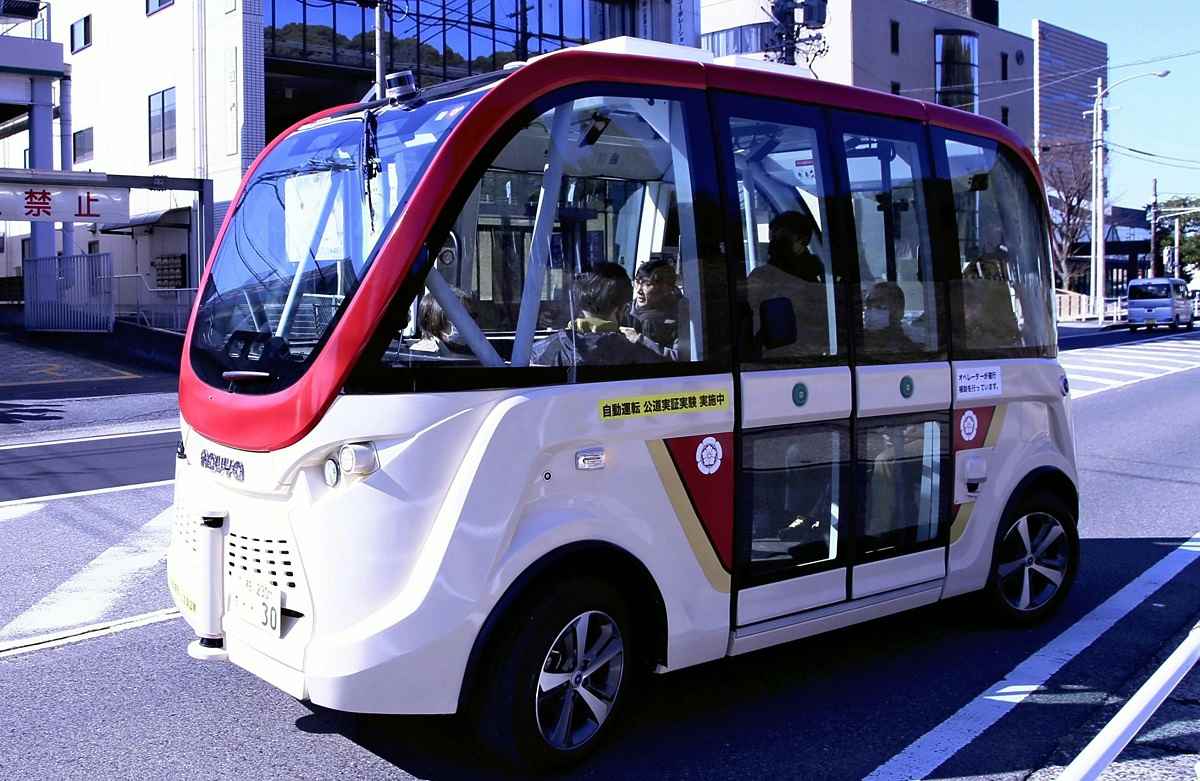
An autonomous bus makes a test run on a public road in Komaki, Aichi Prefecture, in February.
6:00 JST, March 29, 2024
The government, looking to promote the use of self-driving vehicles, plans to provide them with exclusive lanes on expressways all the way from the Tohoku region in the north to Kyushu in the south by fiscal 2033.
The project will be included in a general plan to be compiled soon to develop digital lifelines for the digitization of infrastructure. The plan is part of Prime Minister Fumio Kishida’s “Vision for a Digital Garden City Nation” that aims to achieve rural-urban digital integration and transformation.
The Economy, Trade and Industry Ministry was to approve the self-driving lanes at a meeting of experts on Thursday.
The infrastructure digitization plan also calls for establishing drone flight routes and creating three-dimensional data on underground infrastructure such as water pipes. The ministry forecasts that the projects will generate at least \2 trillion in economic activity over the next 10 years.
Self-driving lanes were already planned for fiscal 2024 on the 100-kilometer stretch on the Shin-Tomei Expressway between Surugawan Numazu and Hamamatsu. The new plan will extend the lanes on the Tohoku and other expressways by fiscal 2026, and complete the connection to Kyushu by fiscal 2033.
The plan assumes use of the lanes by autonomous cars ranging from “Level 2” vehicles with advanced driving assistance to “Level 4” driverless ones.
The drone flight routes will be set up by fiscal 2033 in air space over the nation’s first-class rivers, covering a total length of 10,000 kilometers, and the nation’s power grid, a total of 40,000 kilometers.
The aim is to utilize drones to deliver supplies, inspect electric power infrastructure and other tasks.
The creation of 3D data of underground infrastructure such as water and gas pipes is planned to begin in Saitama and Hachioji in Metropolitan Tokyo, and will be expanded to 10 cities nationwide by fiscal 2026 and to 50 by fiscal 2033.
It is expected to help make it easier to find damaged spots and speed up recovery from disasters.


Most Read
Popular articles in the past 24 hours
-
Kesennuma, Miyagi Pref., Locals Raise Carp Streamers as Symbol of...
-

Iran Situation: Significance of Rule of Law Must Be Conveyed
-
Toyota Advancing Plant-Based Biofuel Development in Fukushima Tow...
-

Trump Says Iran Had a New Site for Developing Nuclear Weapons
-
2 People Reportedly Found on Mt. Fuji; Hiking Trail Currently Clo...
-

CARTOON OF THE DAY (March 10)
-
Rapeseed Flowers Reach Peak Viewing Period at Tokyo's Showa Kinen...
-
Japan's TEPCO to Raise Electricity Rates for Corporations in Apri...
Popular articles in the past week
-

Ibaraki Pref.'s 1st Foreign Bus Driver Hired in Tsukuba
-
Amid Strait of Hormuz Blockade, Shipping Companies Scramble to Ge...
-
Govt to Utilize ODA for Ensuring Economic Security; Securing Ener...
-
Japan Govt Survey Finds Just 10% of Workers Want Working Hours to...
-
Japan's 2nd Round of U.S. Investments May Be Worth Over $100 Bill...
-

Imperial Family Watches World Baseball Classic Game Against Austr...
-

Nippon Life Insurance's U.S. Arm Sues OpenAI Over Legal Assistanc...
-

Donald Keene’s Drinking Buddy and Translator Yukio Kakuchi Pays T...
Popular articles in the past month
-

Producer Behind Pop Group XG Arrested for Cocaine Possession
-

Japan PM Takaichi’s Cabinet Resigns en Masse
-

Man Infected with Measles Reportedly Dined at Restaurant in Tokyo...
-

Videos Plagiarized, Reposted with False Subtitles Claiming ‘Ryuky...
-

iPS Treatments Pass Key Milestone, but Broader Applications Far f...
-

Sanae Takaichi Elected Prime Minister of Japan; Keeps All Cabinet...
-

Nepal Bus Crash Kills 19 People, Injures 25 Including One Japanes...
-
South Korea Tightens Rules on Foreigners Buying Homes in Seoul Me...
Top Articles in Society
-
Producer Behind Pop Group XG Arrested for Cocaine Possession
-
Man Infected with Measles Reportedly Dined at Restaurant in Tokyo Station
-

Bus Carrying 40 Passengers Catches Fire on Chuo Expressway; All Evacuate Safely
-
Tokyo Skytree’s Elevator Stops, Trapping 20 People; All Rescued (Update 1)
-
Ibaraki Pref.’s 1st Foreign Bus Driver Hired in Tsukuba
JN ACCESS RANKING
-
Producer Behind Pop Group XG Arrested for Cocaine Possession
-
Japan PM Takaichi’s Cabinet Resigns en Masse
-
Man Infected with Measles Reportedly Dined at Restaurant in Tokyo Station
-
Videos Plagiarized, Reposted with False Subtitles Claiming ‘Ryukyu Belongs to China’; Anti-China False Information Also Posted in Japan
-
iPS Treatments Pass Key Milestone, but Broader Applications Far from Guaranteed