
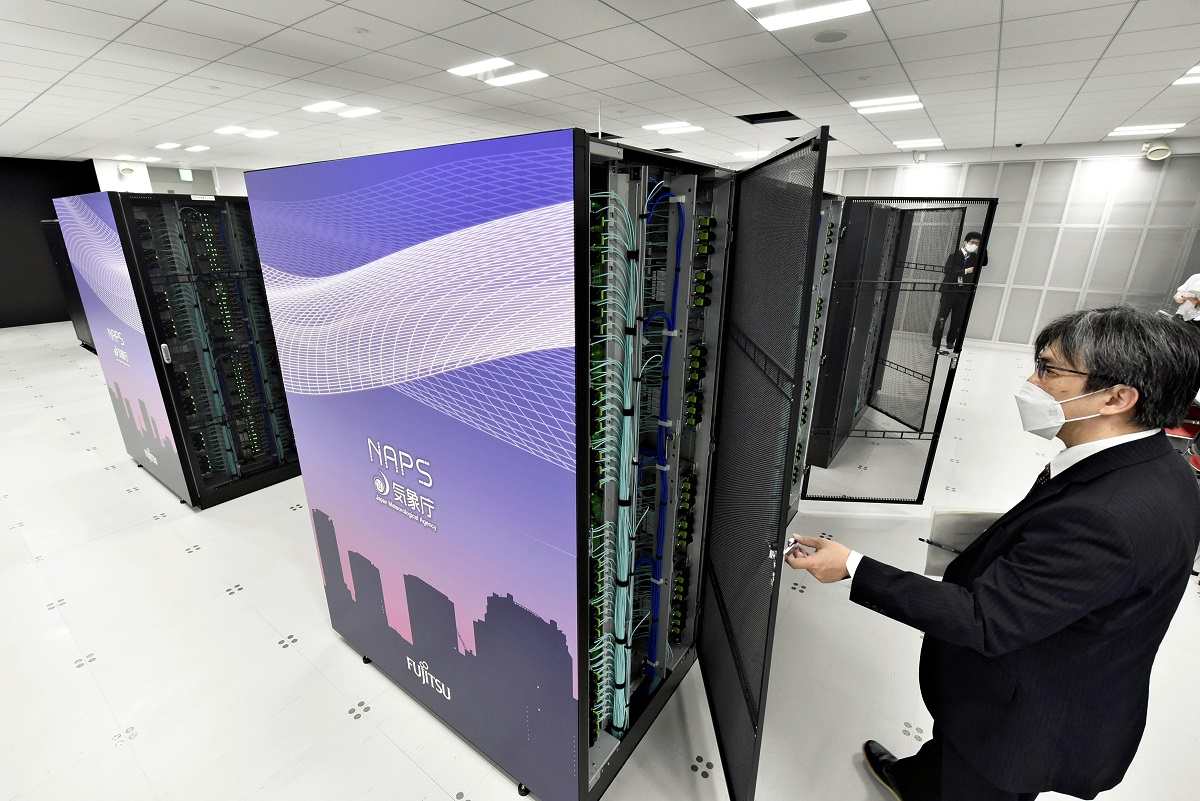
The new supercomputer recently introduced by the Japan Meteorological Agency is seen in Tatebayashi, Gunma Prefecture, on Thursday.
7:00 JST, March 27, 2023
The Japan Meteorological Agency held a press viewing of a new supercomputer for predicting the occurrence of linear precipitation bands that bring intense downpours.
The agency aims to improve the accuracy of forecasts with the latest supercomputer, which has about twice the calculation power of the current model.
The agency currently predicts the amount of rainfall for each five kilometers square of the Japanese archipelago to issue forecasts for the occurrence of linear precipitation bands in such wide-area units as the Tokai and Kinki regions.
With the introduction of the new supercomputer, the agency can narrow the range of rainfall forecasts to every two kilometers square. It plans to start making forecasts for each prefecture in fiscal 2024.
Only three out of 13 forecasts issued by the agency last year for linear precipitation bands were accurate, and the low accuracy rate is a problem.
The new supercomputer, manufactured by Fujitsu Ltd., has been in operation since March 1 in a company facility in Tatebayashi, Gunma Prefecture.






Most Read
Popular articles in the past 24 hours
-

Party Representatives’ Questions in Diet: Takaichi Says Consumpti...
-

Milano Cortina 2026: News in Pictures / Feats of Japanese Athlete...
-

Pokémon Celebrates 30 Years with Japanese Pro Baseball Collab
-

Microsoft Japan Raided by Antitrust Watchdog for Allegedly Blocki...
-
Japan Eyes Introducing Prescreening System for Foreign Travelers,...
-

Bernini, Barberini Celebrated as Vatican Marks 400 Years of St. P...
-

CARTOON OF THE DAY (February 26)
-

Nikkei Tops 59,000 for First Time
Popular articles in the past week
-

Producer Behind Pop Group XG Arrested for Cocaine Possession
-

iPS Treatments Pass Key Milestone, but Broader Applications Far f...
-

Tokyo Skytree's Elevator Stops, Trapping 20 People; All Rescued (...
-

Milano Cortina 2026: Japanese Gold Medalist Figure Skater Miura S...
-

Nepal Bus Crash Kills 19 People, Injures 25 Including One Japanes...
-

Japan’s Major Real Estate Firms Expanding Overseas Businesses to ...
-

Baby Monkey Punch Captures Hearts at Chiba Pref. Zoo, on Social M...
-

Milano Cortina 2026: Japanese Figure Skater Kaori Sakamoto’...
Popular articles in the past month
-
Producer Behind Pop Group XG Arrested for Cocaine Possession
-

Japan PM Takaichi’s Cabinet Resigns en Masse
-

Japan Institute to Use Domestic Commercial Optical Lattice Clock ...
-

Man Infected with Measles Reportedly Dined at Restaurant in Tokyo...
-

Israeli Ambassador to Japan Speaks about Japan’s Role in the Reco...
-

Videos Plagiarized, Reposted with False Subtitles Claiming ‘Ryuky...
-

Man Infected with Measles May Have Come in Contact with Many Peop...
-

Prudential Life Insurance Plans to Fully Compensate for Damages C...
Top Articles in Society
-
Producer Behind Pop Group XG Arrested for Cocaine Possession
-
Man Infected with Measles Reportedly Dined at Restaurant in Tokyo Station
-
Man Infected with Measles May Have Come in Contact with Many People in Tokyo, Went to Store, Restaurant Around When Symptoms Emerged
-

Woman with Measles Visited Hospital in Tokyo Multiple Times Before Being Diagnosed with Disease
-
Australian Woman Dies After Mishap on Ski Lift in Nagano Prefecture
JN ACCESS RANKING
-
Producer Behind Pop Group XG Arrested for Cocaine Possession
-
Japan PM Takaichi’s Cabinet Resigns en Masse
-
Man Infected with Measles Reportedly Dined at Restaurant in Tokyo Station
-
Israeli Ambassador to Japan Speaks about Japan’s Role in the Reconstruction of Gaza
-
Videos Plagiarized, Reposted with False Subtitles Claiming ‘Ryukyu Belongs to China’; Anti-China False Information Also Posted in Japan