
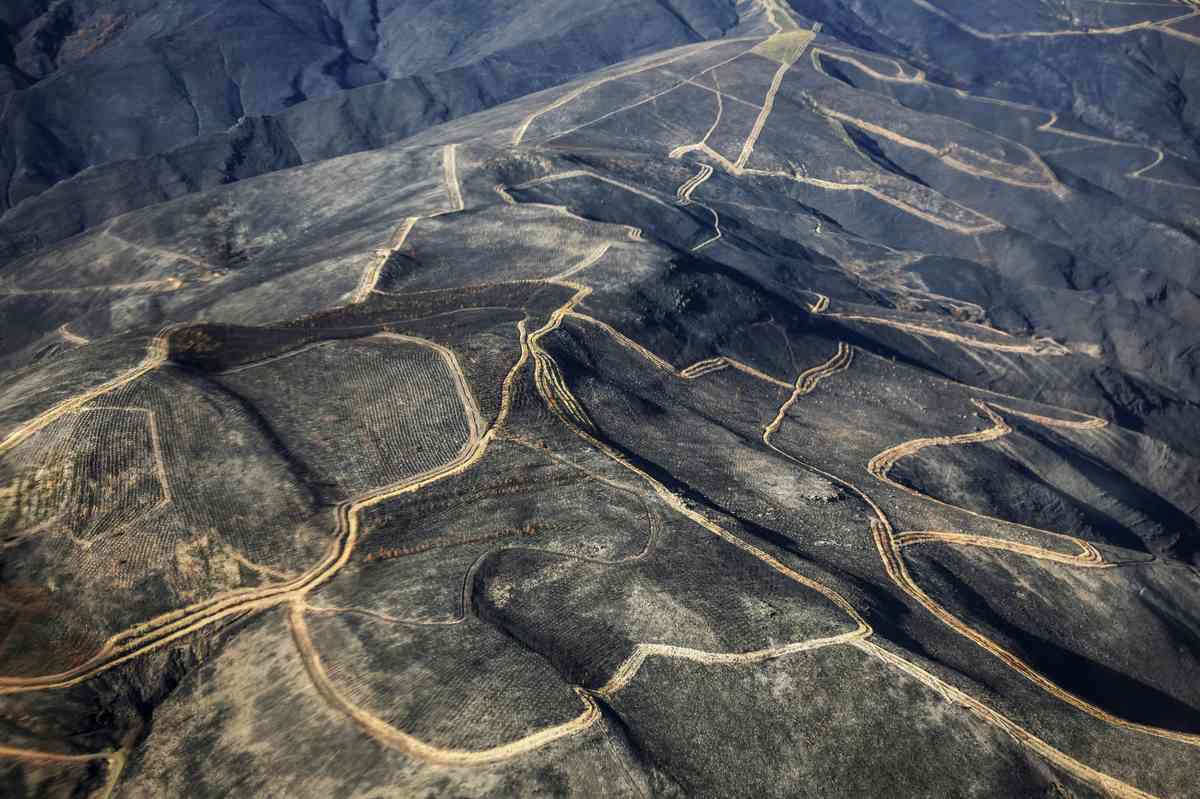
Thousands of charred hectares are seen in the mountains of Galicia, Spain, on Sept. 16.
16:06 JST, December 10, 2025
GALICIA, Spain (Reuters) — “The fire started on my birthday,” says taxi driver Simon Rodriguez, hauling jugs of water out of the back of a car four months later. “And here we are, fighting it!”
Although the record-breaking wildfires that ripped across Spain and Portugal in August have subsided, residents in rural communities in Spain’s northwestern Galicia region are still battling the aftermath.
Now it is water contamination as autumn rains wash ash and sediment down denuded hillsides, clogging waterways and making drinking water unsafe.
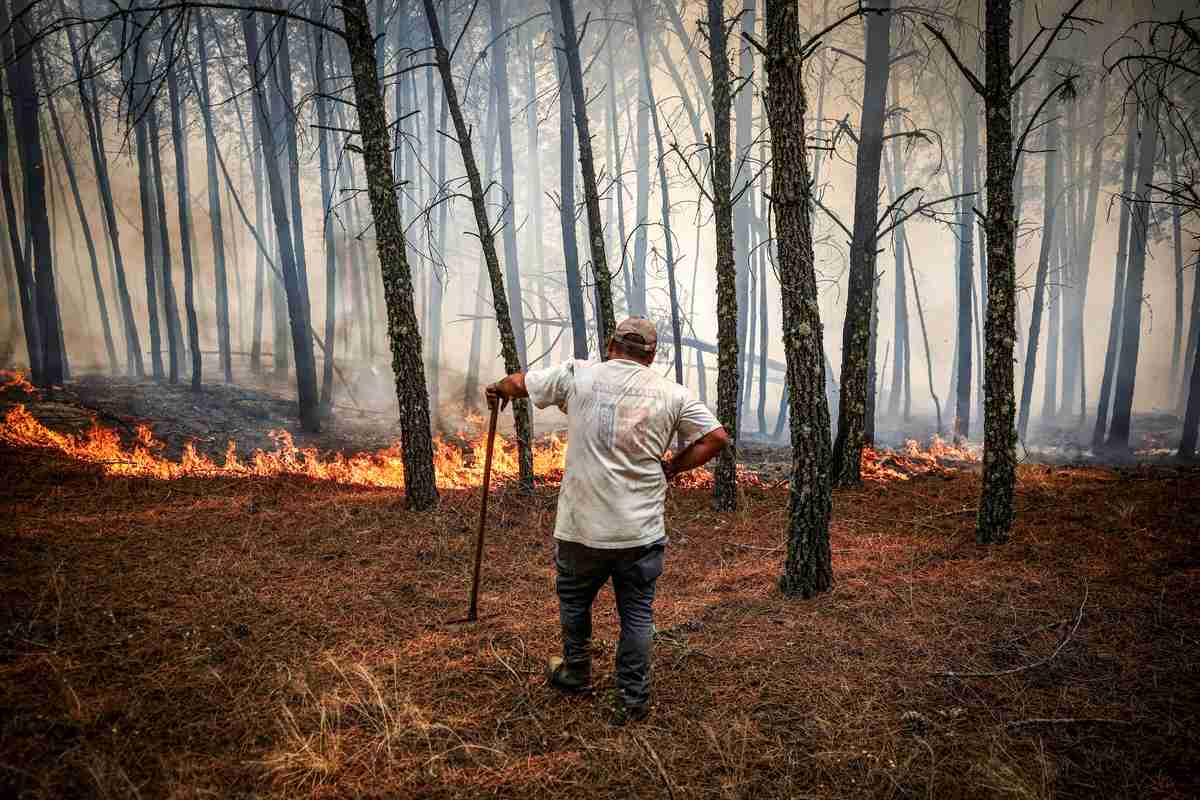
A man rests with his agricultural tool in an area where a wildfire was brought under control in Trancoso, Portugal, on Aug. 13.
“We can’t shower because the water is completely black. I haven’t showered in two days. We have to wait for the rain to stop before we can shower,” Rodriguez says while delivering drinking water to residents in the municipality of Villamartin de Valdeorras, who have been advised since late October to avoid using water for cooking or drinking.
As governments and business leaders met for the annual U.N. climate negotiations in Brazil last month, communities globally are reeling from the worsening impacts of rising global emissions on their homes and livelihoods, calling on governments to spend and do more to repair the damage.
Ash clogs natural water filters
In Galicia, as the seasonal October rains picked up, the entire vegetative layer which had turned to ash began to clog the sandtraps — known locally as areneros — that decant rainwater to prevent debris from reaching the water line, feeding the reservoir.
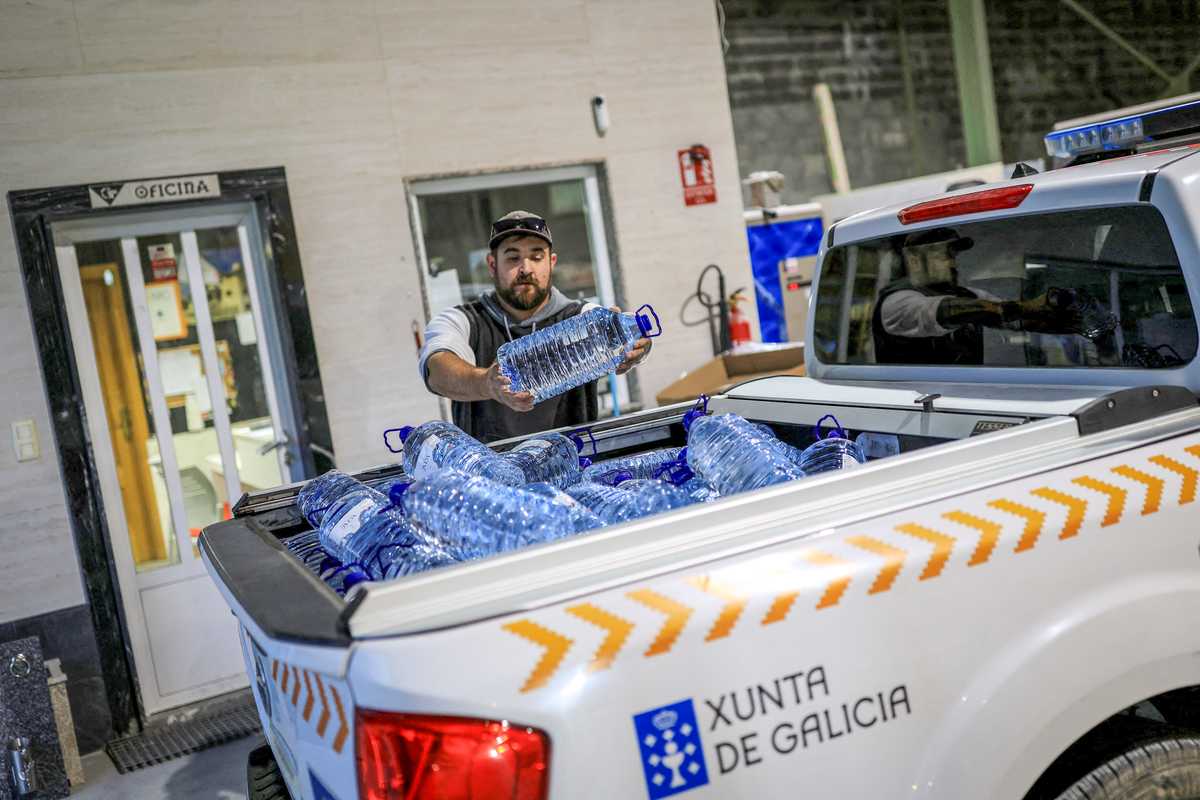
Simon Rodriguez throws five-liter jugs of bottled water in the trunk of a car for local residents, after seasonal rains washed down ash and sediment from a wildfire in August, making the water unsafe for cooking and drinking, in Galicia, Spain, on Nov. 7.
Local crews hike in three times daily to scoop out heavy sediment, but it has become practically impossible to deliver water in an acceptable condition to residents, Villamartin de Valdeorras Council Mayor Enrique Alvarez Barreiro said.
“We have been here for almost a month, working to remove the ash mixed with mud,” said Raul Lopez, a worker for the municipality.
“We have never seen a disaster like this before in our lives … Neither my grandfather nor my father, nor anyone else, can remember a disaster like this.”
Summer wildfires are common in Spain and neighboring Portugal and are essential to the local ecosystem, helping to regenerate the land.
But climate change made the hot, dry and windy weather that fueled the deadly wildfires in Spain and Portugal 40 times more likely, according to scientists with World Weather Attribution. “What happened here is crazy,” said Cristina Santin, a biologist from northwestern Spain who studies fire impacts. “Suddenly you get up one day and your home region is burning on a scale that is completely unprecedented.”
Homes reduced to rubble
The fires forced more than 42,000 people across Spain to evacuate, according to the Ministry of Interior, with some returning to find their homes had been reduced to ashes.
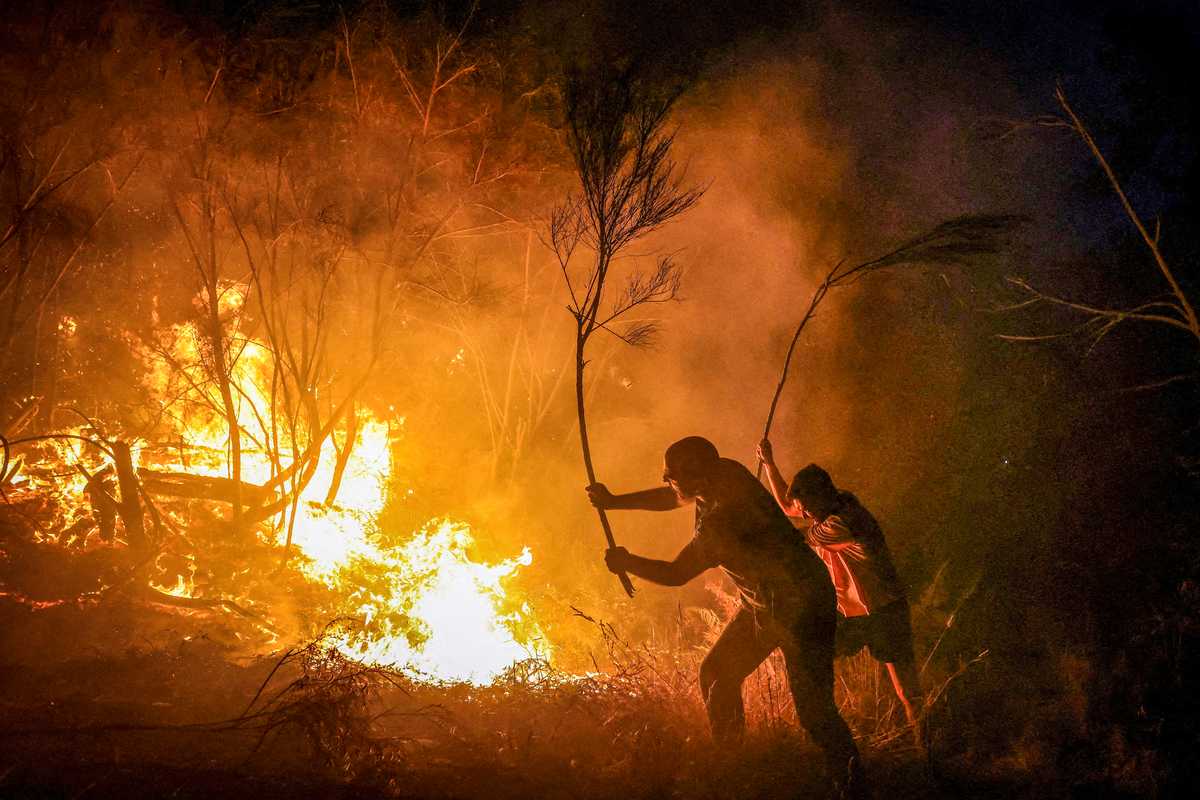
Residents use tree branches as they try to extinguish flames from a wildfire in Galicia, Spain, on Aug. 15.
When Susana Fernandez Gonzalez came back to her family home in San Pedro de Cansoles, in Castilla y Leon, she described it “as if a bomb was dropped [on the village].” The civil guard and psychologists had escorted them back in, she said. “Everything was shattered.”
The smoke plume from the Iberian fires severely degraded local air quality with the impact felt across parts of France, the U.K. and Ireland, according to Mark Parrington, a senior scientist with Copernicus Atmosphere Monitoring Service.
Emissions at record levels
As a result of the fires in Spain and Portugal, total estimated emissions across Europe and the U.K. were the highest on record in the Copernicus Atmosphere Monitoring Service’s dataset, which has monitored global emissions of wildfires since 2003.
Spain is grappling with how to improve forest management across areas where the local population has shrunk and the countryside has rewilded with limited controls.
Spanish Prime Minister Pedro Sanchez has acknowledged that more efforts were needed to prevent wildfires and pledged to do whatever it takes to ensure fires on such a scale never happened again.
With the natural vegetative sponge layer of Galicia’s hillsides reduced to ash, locals are concerned about water shortages in years ahead, as the rainfall is carried into streams and rivers, instead of percolating into the local aquifer.
That ash also makes its way to the sea.
“Everyone knows that ash is a problem for shellfish along all the coasts. So the problem doesn’t end for us,” said Alvarez Barreiro.
In the near term, the hillsides are unfit for livestock to graze.
Alvarez Barreiro’s municipality is planning to take protective measures by using drones to plant seeds to protect the areneros. It will cost about €12,000 ($14,000) for an area of approximately 40 hectares.
“I think we’re very far from addressing the vastness of the problem,” he said.






Most Read
Popular articles in the past 24 hours
-

Japan Govt to Tighten Requirements to Receive Permanent Residency...
-

Tail of ANA Plane Struck Runway During Landing in Houston; No Inj...
-

Medical Care at Home and Disasters: Ensure Systems to Provide Con...
-

Samurai Japan Holds First Practice in Miami; Team Will Play again...
-

White House Takes First Step toward Permanent Fix for Illegal Tar...
-

CARTOON OF THE DAY (March 12)
-

The Japan News / Weekly Edition (3/13-3/19)
-

Iran Targets Busiest International Airport as Top UN Body Demands...
Popular articles in the past week
-

Japan Figure Skating Legend Yuzuru Hanyu Is Proud Disaster Surviv...
-

Nippon Life Insurance's U.S. Arm Sues OpenAI Over Legal Assistanc...
-

Govt to Utilize ODA for Ensuring Economic Security; Securing Ener...
-

Massive Sewer Pipe Found Jutting Out of Highway in Osaka
-

Beckoning Cats Get Makeover to Fit Modern Lifestyles with Sleek D...
-
Japan Govt Survey Finds Just 10% of Workers Want Working Hours to...
-

Japan's 2nd Round of U.S. Investments May Be Worth Over $100 Bill...
-

Imperial Family Watches World Baseball Classic Game Against Austr...
Popular articles in the past month
-

Producer Behind Pop Group XG Arrested for Cocaine Possession
-

Japan PM Takaichi’s Cabinet Resigns en Masse
-

Man Infected with Measles Reportedly Dined at Restaurant in Tokyo...
-

Videos Plagiarized, Reposted with False Subtitles Claiming ‘Ryuky...
-
Japan Figure Skating Legend Yuzuru Hanyu Is Proud Disaster Surviv...
-

iPS Treatments Pass Key Milestone, but Broader Applications Far f...
-

Sanae Takaichi Elected Prime Minister of Japan; Keeps All Cabinet...
-

Nepal Bus Crash Kills 19 People, Injures 25 Including One Japanes...
Top Articles in Science & Nature
-
iPS Treatments Pass Key Milestone, but Broader Applications Far from Guaranteed
-

Record 700 Startups to Gather at SusHi Tech Tokyo in April; Event Will Center on Themes Like Artificial Intelligence and Robotics
-
iPS Cell Products for Parkinson’s, Heart Disease OK’d for Commercialization by Japan Health Ministry Panel
-

Japan to Ban Use of Power Banks on Airplanes
-

Japan Govt Aims for 10-Fold Increase in Computing Power of Supercomputers for AI Use at Universities, Research Institutions
JN ACCESS RANKING
-
Producer Behind Pop Group XG Arrested for Cocaine Possession
-
Japan PM Takaichi’s Cabinet Resigns en Masse
-
Man Infected with Measles Reportedly Dined at Restaurant in Tokyo Station
-
Videos Plagiarized, Reposted with False Subtitles Claiming ‘Ryukyu Belongs to China’; Anti-China False Information Also Posted in Japan
-
Japan Figure Skating Legend Yuzuru Hanyu Is Proud Disaster Survivor and Gold Medalist, Vows to Continue Support Efforts