
Minority Ruling Parties Face Tough Going as Extraordinary Diet Session Begins; Opposition Parties Face Unity Issue
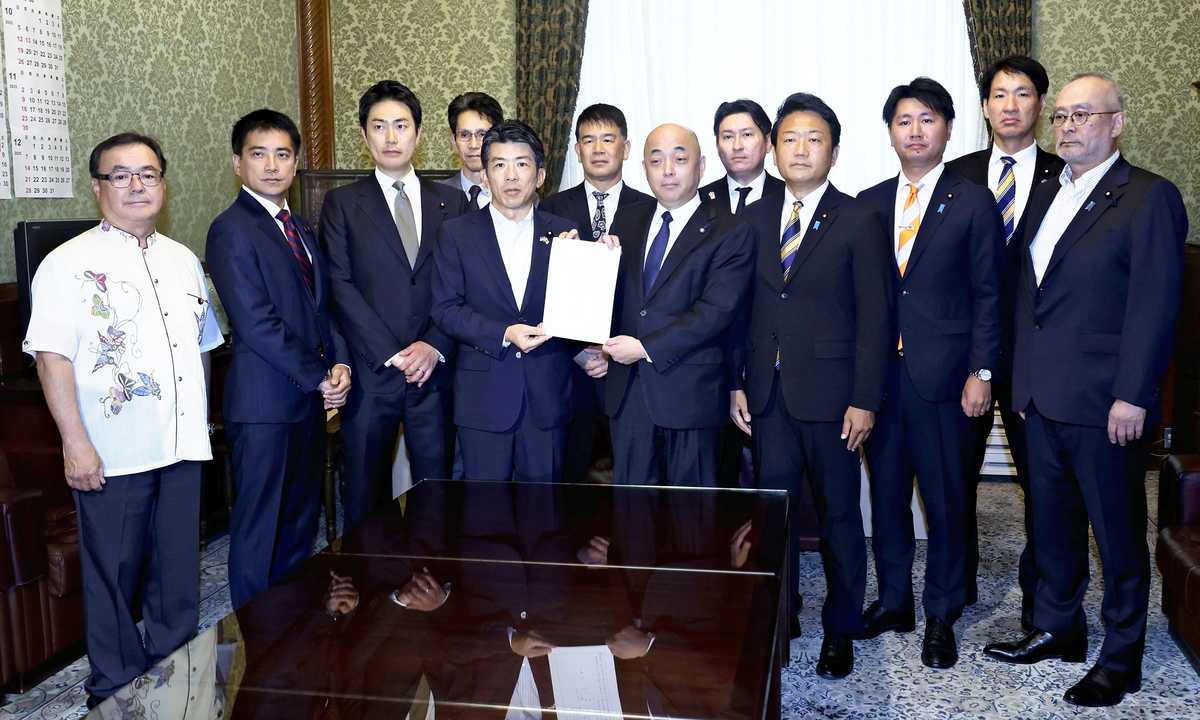
Lawmakers of opposition parties that jointly submitted a bill to abolish the provisional gasoline tax rate to the House of Representatives at the Diet building are seen on Friday.
1:00 JST, August 3, 2025
The Liberal Democratic Party and its coalition partner Komeito, which now comprise a minority in both houses of the Diet, face a tough road ahead in the extraordinary Diet session that began Friday.
The situation has worsened for the ruling parties since the previous ordinary Diet session, when they held a minority only in the House of Representatives. The coalition now also has the difficult task of securing opposition support in the House of Councillors, which decides the fate of bills and budget proposals.
The opposition parties, however, lack unity, with newly risen parties charting their own courses. The legislature, with a closely matched balance of power between the ruling and opposition forces, likely faces an uncertain future.
“I want us to be united and work together for Japan and the world,” Prime Minister Shigeru Ishiba, who is also LDP president, said in front of LDP lawmakers gathered on Friday at the Diet Building.
This is the first time since the LDP’s founding in 1955 that it is running the government as a minority ruling party in both houses of the Diet. The LDP and Komeito suffered major defeats in last year’s lower house election and last month’s upper house race.
Now, when a vote is held, the ruling parties will fall 13 seats short of a majority in the lower house and three seats short in the upper house.
As a result, opposition parties are expected to gain control in steering Diet proceedings, leaving the government and ruling parties in a passive position.
Although no bills will be deliberated in the current Diet session, some of the standing committee chair posts previously held by LDP members have been turned over to opposition party members.
Now that the ruling parties cannot pass bills or budget proposals alone, they will need to coordinate with opposition parties.
There have been calls within the LDP to approach individual lawmakers who do not belong to parliamentary groups of either the ruling or opposition parties to secure their votes, but whether this will work is unclear.
On Friday, seven opposition parties jointly submitted a bill to abolish the provisional gasoline tax rate. The ruling parties had been cautious about abolishing the tax rate at an early date but eventually agreed to do so within the year, leading to the start of working-level talks among six parties, including ruling and opposition parties, on the same day.
“From now on, we will have no choice but to make compromises with opposition parties on all issues,” said a mid-ranking LDP member.
Constitutional Democratic Party of Japan President Yoshihiko Noda, at a press conference Friday, said, “We want to make sure we leave a clear mark [on Diet proceedings].”
So many opposition parties
However, it is also true that the opposition parties lack momentum, because there are so many of them. In the same way as the ruling parties, the opposition parties will need to draw in lawmakers who are not affiliated with any party to secure a majority.
“It looks like it will be very difficult to manage Diet affairs,” said Hirofumi Ryu, chairperson of the CDPJ’s Diet Affairs Committee.
The lack of unity among the opposition parties is further complicating an already uncertain situation.
Reiwa Shinsengumi, for instance, did not take part in the joint submission of the bill to abolish the provisional gasoline tax rate.
While Sanseito joined the submission, its leader, Sohei Kamiya, said at a press conference Friday, “The opposition parties are not yet in a place to take unified action.” He added that he would decide whether to cooperate with other parties on a policy-by-policy basis.
Takahiro Anno, the leader of Team Mirai, who won the party’s first seat in the upper house election, also told reporters, “I will cooperate [with other parties] on a policy-by-policy basis, taking a fair and unbiased stance.”
In uniting the opposition parties, the leadership of the CDPJ will likely be tested as the main opposition party.




Popular Articles
Popular articles in the past 24 hours
-

Nikkei Stock Average Exceeds 54,000 for 1st Time
-

Japan, Qatar Ministers Agree on Need for Stable Energy Supplies; ...
-

Milano Cortina 2026: Japanese Bobsleigh Athletes Lose Chance to C...
-
Poems on Brightness Recited at Imperial New Year's Reading; Princ...
-

Japanese PM Takaichi, South Korean President Lee Play Drums in Na...
-

Japan-South Korea Summit: Build up Cooperation through Frequent R...
-

Construction Crane Falls onto a Moving Train in Thailand, Killing...
-

Houses at UNESCO World Heritage Site Shirakawa-go Illuminated for...
Popular articles in the past week
-

JAL, ANA Cancel Flights During 3-day Holiday Weekend due to Blizz...
-
China Confirmed to Be Operating Drilling Vessel Near Japan-China ...
-

Univ. in Japan, Tokyo-Based Startup to Develop Satellite for Disa...
-

Honda to Launch New Electric Motorbike in Vietnam
-

Japan's ANA to Introduce Nationwide Logistics Service Using Drone...
-

10 Universities in Japan, South Korea, Mongolia to Establish Acad...
-

Inclusive Society / Japan's Remote Tourist Areas See Deluge of Fo...
-

At 58, the World's Oldest Professional Soccer Player Says He Is O...
Popular articles in the past month
-
As Chinese Tourists Shun Japan, Hotels and Stores Suffer
-
BOJ Gov. Ueda: Highly Likely Mechanism for Rising Wages, Prices W...
-

Core Inflation in Tokyo Slows in December but Stays above BOJ Tar...
-

Osaka-Kansai Expo's Economic Impact Estimated at ¥3.6 Trillion, T...
-

Japan Govt Adopts Measures to Curb Mega Solar Power Plant Project...
-

Economic Security Panels Debate Supply Chains, Rare Earths; Parti...
-

Japan, U.S. Start Talks on Tokyo's $550 Bil. Investment in U.S.; ...
-

Tokyo Ranks 2nd in Global Power City Index, Highest-Ever Position...
"Politics" POPULAR ARTICLE
-

Japanese Language Requirement Eyed for Permanent Residency Status; LDP Plans Revisions of Laws on Foreigners
-
-250x167.jpg)
Japan Eyes Plan to Accept Up To 1.23 Mil. Foreign Workers by End of Fiscal 2028
-

AI-Driven ‘Zero Clicks’ Phenomenon Threatens Democracy; News Outlets Must Be Able to Recover Costs, Stay Independent
-
Japanese Public, Private Sectors to Partner on ¥3 Tril. Project to Develop Domestic AI, SoftBank to Be Key Firm Involved
-
Japan’s Defense Ministry to Extend Reemployment Support for SDF Personnel to Age 65; Move Comes Amid Ongoing Labor Shortage
JN ACCESS RANKING
-
As Chinese Tourists Shun Japan, Hotels and Stores Suffer
-
BOJ Gov. Ueda: Highly Likely Mechanism for Rising Wages, Prices Will Be Maintained
-
Core Inflation in Tokyo Slows in December but Stays above BOJ Target
-
Osaka-Kansai Expo’s Economic Impact Estimated at ¥3.6 Trillion, Takes Actual Visitor Numbers into Account
-
Japan Govt Adopts Measures to Curb Mega Solar Power Plant Projects Amid Environmental Concerns