
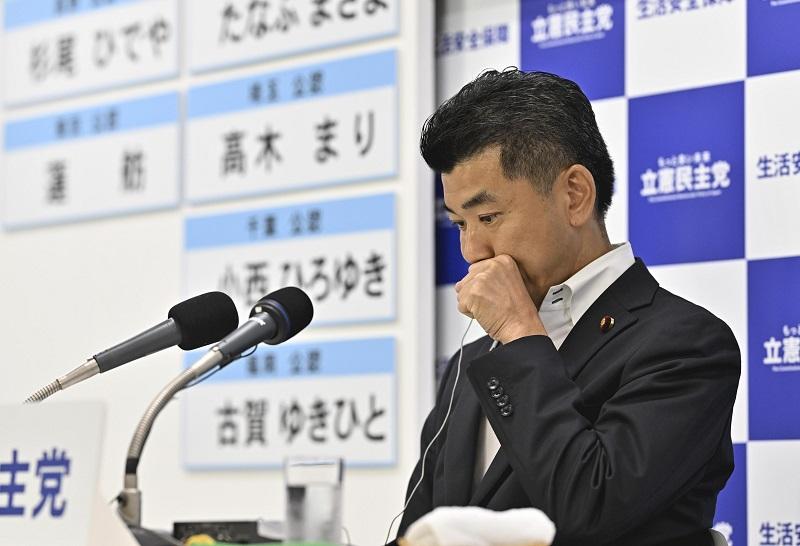
Kenta Izumi, leader of the Constitutional Democratic Party of Japan, is seen at party headquarters on Sunday night.
17:25 JST, July 11, 2022
The main opposition Constitutional Democratic Party of Japan did not fare well in Sunday’s election, falling short of the 23 seats the party was defending in the House of Councillors election.
The CDPJ’s campaign blamed the administration of Prime Minister Fumio Kishida for the rise in prices, decrying “Kishida inflation” allegedly caused by its missteps, but the party’s bid to garner votes critical of the government did not garner wide support.
“With the approval rating [for our party] still low, we must put the highest priority on restoring and reinforcing our strength as we move forward,” CDPJ leader Kenta Izumi said Sunday night on an NHK program.
Izumi positioned Sunday’s election as a springboard for his party to once again be able to vie for control of the government, only to see a tough road ahead to recover its strength first.
Yuko Mori, the party’s upper house secretary general, lost her bid for a fourth term in the Niigata Constituency after a head-to-head battle against a Liberal Democratic Party rookie.
In the Kanagawa Constituency, where a total of five seats — four contested and one to fill a vacancy — were up for grabs, the CDPJ fielded two candidates, Yusuke Terasaki and Motoko Mizuno. However, midway through the campaign, the party took the unusual step of concentrating its support on Mizuno, to prevent both candidates from going down in defeat.
As a result, Mizuno managed to be the fifth winner, with a three-year term instead of six, as she will fill the vacant place and her term will therefore be the same as that of an uncontested seat.
The CDPJ did poorly in the House of Representatives election last October. Then leader Yukio Edano resigned to take responsibility, despite having led the party since the CDPJ’s founding in 2017.
Shifting from Edano’s policy to cooperate with the Japanese Communist Party, Izumi sought to win over conservative voters in addition to CDPJ’s original support base of liberal voters. He emphasized realizing policies from the perspective of consumers, dubbed “livelihood security.”
Viewing price increases as a key issue, Izumi called for lowering the consumption tax for a limited period of time, providing more in the way of pensions, and reviewing a joint statement advocated by the government and the Bank of Japan to realize a 2% inflation target.
At a press conference Sunday night, Izumi rejected the idea of his resigning from the party leadership. “I’ll work to expand our party’s influence in the next election,” Izumi said. However, some CDPJ members may demand that Secretary General Chinami Nishimura and other executives be held accountable for the defeat.





Most Read
Popular articles in the past 24 hours
-

Japan Figure Skating Legend Yuzuru Hanyu Is Proud Disaster Surviv...
-
Massive Sewer Pipe Found Jutting Out of Highway in Osaka
-

Japan-U.S. Summit Likely to Focus on Middle East; Takaichi to Fac...
-

Hawaii Museum on Tsunami Including Japan's 2011 Disaster at Risk ...
-

15 Years since Great East Japan Earthquake: How Can Affected Area...
-

Japan Holds Memorial Events to Mark 15th Anniversary of 2011 Eart...
-

Japan’s Nikkei Stock Average Rise Lifted by AI Stocks, Easing Con...
-

Parents in Japan to Get Instagram Notifications When Teens Repeat...
Popular articles in the past week
-

Ibaraki Pref.'s 1st Foreign Bus Driver Hired in Tsukuba
-

Nippon Life Insurance's U.S. Arm Sues OpenAI Over Legal Assistanc...
-
Japan Figure Skating Legend Yuzuru Hanyu Is Proud Disaster Surviv...
-
Govt to Utilize ODA for Ensuring Economic Security; Securing Ener...
-

Amid Strait of Hormuz Blockade, Shipping Companies Scramble to Ge...
-
Massive Sewer Pipe Found Jutting Out of Highway in Osaka
-
Japan Govt Survey Finds Just 10% of Workers Want Working Hours to...
-

Beckoning Cats Get Makeover to Fit Modern Lifestyles with Sleek D...
Popular articles in the past month
-

Producer Behind Pop Group XG Arrested for Cocaine Possession
-

Japan PM Takaichi’s Cabinet Resigns en Masse
-

Man Infected with Measles Reportedly Dined at Restaurant in Tokyo...
-

Videos Plagiarized, Reposted with False Subtitles Claiming ‘Ryuky...
-

iPS Treatments Pass Key Milestone, but Broader Applications Far f...
-

Sanae Takaichi Elected Prime Minister of Japan; Keeps All Cabinet...
-

Nepal Bus Crash Kills 19 People, Injures 25 Including One Japanes...
-

South Korea Tightens Rules on Foreigners Buying Homes in Seoul Me...
Top Articles in Politics
-
Japan PM Takaichi’s Cabinet Resigns en Masse
-
Sanae Takaichi Elected Prime Minister of Japan; Keeps All Cabinet Appointees from Previous Term
-

Japan’s Govt to Submit Road Map for Growth Strategy in March, PM Takaichi to Announce in Upcoming Policy Speech
-
CRA Leadership Election Will Center on Party Rebuilding; Lower House Defeat Leaves Divisions among Former CDPJ, Komeito Members
-
LDP Begins Training New Lawmakers to Avoid Scandal, Gaffes; Historic Victory in Latest Election Heightens Focus on Party
JN ACCESS RANKING
-
Producer Behind Pop Group XG Arrested for Cocaine Possession
-
Japan PM Takaichi’s Cabinet Resigns en Masse
-
Man Infected with Measles Reportedly Dined at Restaurant in Tokyo Station
-
Videos Plagiarized, Reposted with False Subtitles Claiming ‘Ryukyu Belongs to China’; Anti-China False Information Also Posted in Japan
-
iPS Treatments Pass Key Milestone, but Broader Applications Far from Guaranteed